Who will blink first in Atlantic City budget crisis?
With Atlantic City on the edge of fiscal disaster, the Democrats are feuding with one another, the Republican governor is saying "my way or the bankruptcy way," and the Republican mayor is calling out almost everyone.
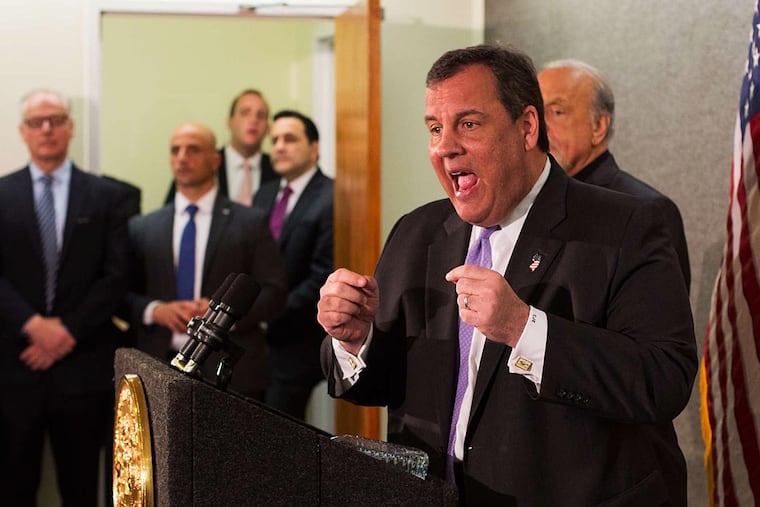
With Atlantic City on the edge of fiscal disaster, the Democrats are feuding with one another, the Republican governor is saying "my way or the bankruptcy way," and the Republican mayor is calling out almost everyone.
Meanwhile, nothing is getting done to ease the city's financial crisis. Ultimately, a decision will be made and it could have a profound impact on New Jersey bond ratings as well as the sanctity of public-sector contracts.
Forty years ago, New Jersey moved to save a dying resort by legalizing gaming. Atlantic City's casinos grew to where they employed more than 45,000 workers. The industry generated huge revenue for the state and the city.
But the way Atlantic City expanded ensured its demise. The industry, looking to maximize revenue, walled off the casinos from the rest of the resort, including the Boardwalk and the beach. The development was a mile long and a block deep.
The state grabbed most of the revenue generated by the industry. Though the Casino Redevelopment Authority invested in economic development, little development occurred.
The city government assumed that its regional monopoly on gaming would last forever, and with property values skyrocketing, ramped up spending.
When Pennsylvania and other neighboring states legalized gaming, it was all over. Atlantic City was a zombie and didn't even know it.
The Great Recession finished the job. Casinos closed, employment fell by more than half, and property values declined from more than $20 billion in 2010 to about $7 billion now. Meanwhile, government spending rose.
Rising expenses and falling revenue are never a good combination. Atlantic City is about $500 million in debt, has a $100 million hole in its $262 million budget, and is cash poor.
So, what do you do? The options are limited and require sacrifices, some significant. New Jersey's politicians cobbled together a plan that included casino payments in lieu of taxes (PILOT), which provide a fixed but secure flow of tax revenue while limiting property-tax appeals. That is not a major sticking point.
What is holding up the agreement is more fundamental: the timing of the takeover and the state's powers.
Some members of the Legislature - in particular, Democratic Senate President Stephen Sweeney and Democratic Assembly Majority Leader Lou Greenwald - and Gov. Christie want an all-powerful, immediate takeover. Democratic Assembly Speaker Vincent Prieto and Republican Mayor Don Guardian want a two-year plan that limits state powers.
The key sticking point is the ability to abrogate union contracts. The governor has made that a line in the sand. The "do it now" side in the Legislature has acquiesced. Prieto's "takeover later" group is against it. I suspect that he recognizes it sets a precedent that could be applied to other public-sector contractual agreements.
Whether the state should have the power to unilaterally terminate the labor contracts is a matter of perception. Are public workers' contracts less sacrosanct than private-sector workers' contracts?
It is interesting that the union contracts are not the only promissory notes at risk here. Bankruptcy would destroy what is left of the value of the city's bonds.
Those bonds are rated as junk and only speculators are buying them. But they are promises to pay, not unlike government workers' contracts. When the government signs a union contract, it is assumed it will use its full faith and credit to pay the workers what was negotiated. When the government sells a bond, it agrees to use its full faith and credit to pay the interest and principal on the borrowed funds.
So, the real question is: Who should get hurt more by the state takeover of Atlantic City, the workers or the bondholders?
The state's politicians know that bankruptcy is not an option. It would harm the bond ratings for all municipalities and the state. Thus, they really cannot push the city into bankruptcy, or they would have already. That is Speaker Prieto's only leverage.
No matter which course is taken, New Jersey taxpayers will foot part of the bill as the state will pump money into Atlantic City. It will then either immediately take it over with full contract powers, or impose strict financial requirements without unlimited powers, and possibly do it later. But someone has to blink first.