'Sideways' still, a house now touches the outdoors and suits the family within
In 2007, Mark Alter and Margi Shah, who had been living in Brooklyn, began looking for a larger home in suburban Philadelphia, near her family.
In 2007, Mark Alter and Margi Shah, who had been living in Brooklyn, began looking for a larger home in suburban Philadelphia, near her family.
Margi had two stipulations: "I didn't want a sideways house or a house without a mudroom."
Side entrances, common in area homes, seemed awkward to Margi, who grew up in Newtown Square. She favored a front door facing the street. And a mudroom was essential because she and Mark have two young daughters.
The couple, both psychiatrists, house-hunted for a year. They narrowed their search to Lower Merion with its good school system but, Margi recalls, "We couldn't find anything we liked or didn't need a lot of work." Frustrated, she sent Mark to meet with a Realtor one weekend while she stayed in Brooklyn with the children.
To her dismay, Mark put an offer on a sideways house with no mudroom.
The spacious three-story Dutch Colonial was otherwise ideal, she conceded. It was in a leafy Ardmore neighborhood, near the train station and Suburban Square, and featured a new kitchen, wainscoting, oak flooring, and fireplaces in the living and dining rooms.
Margi and Mark bought that house. And though she couldn't swivel it, she would get her mudroom, and much more.
The couple hired Ben Nicholson, of J.B. Nicholson Architecture in Philadelphia, to design an addition. It included a mudroom with a soapstone sink, a wet bar with custom cabinets and soapstone counters, and a dramatic covered porch with a fireplace, a ceiling fan and a flat-screen TV.
The original porch had been enclosed years before.
"Everyone on the street socializes on their porches," says Margi. "We missed having the outdoor space."
The couple replaced cedar siding with beige Hardiplank, a fiber-cement product. "No more carpenter ants," Margi says.
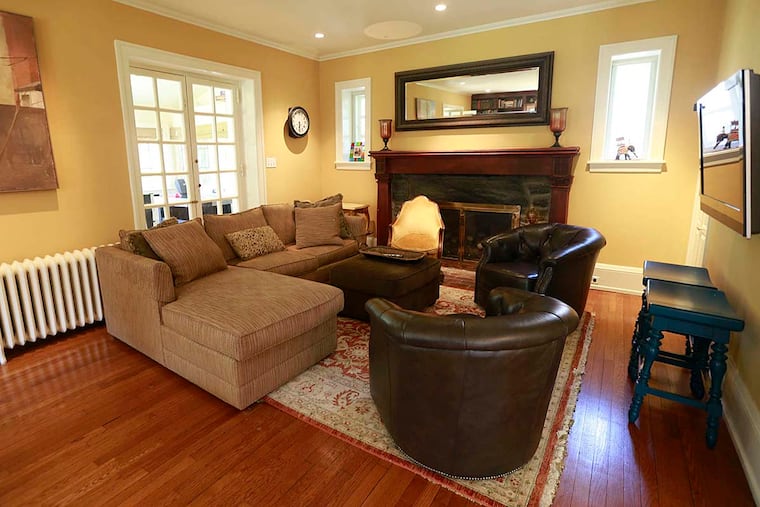
Inside, the living room, with its walnut fireplace mantel and walnut bookshelves, was painted gold. The dining room and kitchen were painted in shades of pale green. An elaborate brass wall clock once owned by Mark's aunt now adorns the gray foyer.
The foyer's Persian rug and a multicolored Indonesian panel in the staircase landing were purchased from ABC Carpet and Home in New York, as was a painted cabinet in the dining room and a long narrow table that seats 12.
Two crystal chandeliers purchased in a shop in Italy once hung in a Rome hotel. Silver candlesticks on the dining room mantel belonged to Mark's family. Rattan furniture with sage cushions and a zinc table and chairs in the covered porch came from Restoration Hardware.
"We like the antique look combined with the new," Margi says of the home's decor.
Apparent throughout the house are the activities of daughters Marisa, 14, and Marin, 10 - from the displays of sports medals in their lavender bedrooms on the second floor, to the wall of painted canvases in the basement playroom. Both girls take art lessons. Marisa plays the piano in the enclosed porch, and the girls play their violas there.
Black-and-white photos of Marisa and Marin are arranged on the wall in the living room. Photos on the staircase represent older generations: Margi's Indian and Mark's Jewish parents, grandparents, and great-grandparents.
Framed hand-painted tiles from India decorate a wall in the kitchen. A statue of the Indian god Krishna poses on a red table in the foyer.
To create a master suite on the second floor, two bedrooms were combined. The third floor has an office and two guest bedrooms for visiting relatives.
Mark and Margi landscaped the home with a sweeping front lawn and hydrangea and rose bushes. The flat lawn behind the covered porch is perfect to set up tables for large-scale entertaining, Margi says. Guests often bypass the side entrance and head for the porch and wet bar.
She has reconciled herself to owning a "sideways" house, especially one with a sweet story.
It turns out her home and the house next door face each other because they were built in 1903 by Ed W. Munderson for his two daughters.
Margi can appreciate such family ties. She is close to her own sister, who lives nearby in Berwyn.