As economy improves, workers (finally) feel hopeful, Rutgers study says
For months, the news about job growth has been good, at least nationally. But, until recently, it seemed as though the American people hadn't yet received the memo.
For months, the news about job growth has been good, at least nationally. But, until recently, it seemed as though the American people hadn't yet received the memo.
Now, finally, there's a shift, with optimism on the rise, a Rutgers University study shows.
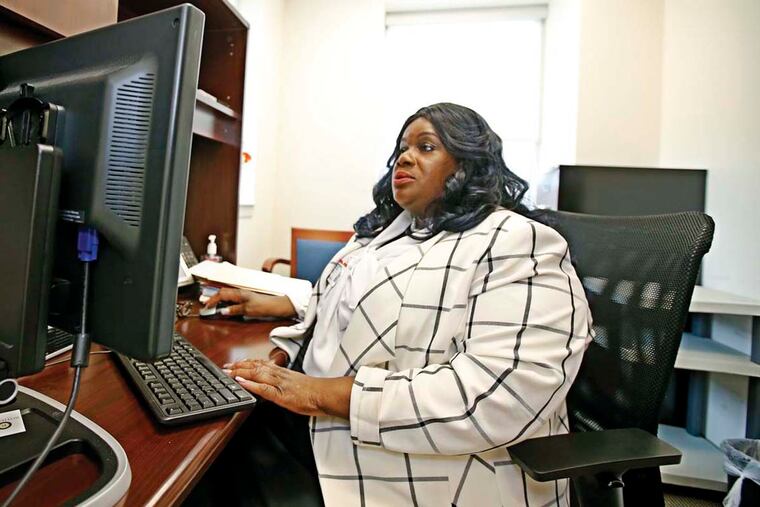
Annette Reeves, 58, is feeling the mood. After many years of unemployment or underemployment, she started a full-time job in July.
"I feel extremely confident," Reeves said.
Like others caught in the recession, Reeves had lost her job, her house, and - almost - her spirit, a common effect of joblessness.
These days, two of the three are back - the job and the spirit, although the house she owned in Elkins Park now belongs to someone else, the result of foreclosure.
"What's going on is that public attitudes are much more upbeat than they were two years ago," said Carl Van Horn, a Rutgers University professor and coauthor of a study released for Labor Day by the school's John J. Heldrich Center for Workforce Development.
Regularly over the last eight years, the center, which Van Horn directs, has taken the pulse of worker attitudes about jobs and the economy.
What has mystified researchers is that while the economic news has generally been positive, worker attitudes remained mired in the negative.
"It has taken so long for people to change attitudes, because they were so scarred by the recession," Van Horn said.
Like Reeves, people are now more upbeat about their finances and the economy, although worry persists about prospects for the next generation.
"First of all, millions more people are working," Van Horn said. "Incomes have [only] gone up slightly, but there has been some wage recovery. There is less fear.
"This has been a very long recovery, very steady, long and slow," he said. "But it has been steady."
The nation's payrolls expanded by 151,000 jobs in August, part of 15.1 million private-sector jobs added since February 2010.
When Reeves lost her job in November 2009, unemployment was double its current rate of 4.9 percent. Reeves joined 15.2 million people without work. For eight months, that number topped 15 million.
No wonder that, in 2010, 78 percent of those Rutgers surveyed said it was a bad year to find a good job. Half said they weren't very confident or confident at all that they'd be able to find work.
By August 2014, despite months of positive job growth, perceptions had not changed, with 48 percent still not confident about finding a good job.
By last month, when the most recent survey was taken, the tide had turned.
Nearly one in three thought they could get a good job, while the number who weren't confident had fallen to 31 percent. The most pessimistic group fell by half.
Surveyors interviewed 822 people in a sample weighted for age, gender, education, and race.
"The average person losing a job today can get another job," Van Horn said.
He pointed to Labor Department statistics showing that people are more willing to quit their jobs, a move that was too risky in the recession.
But the problem of long-term unemployment persists. In August, two million people of the 7.85 million, or 26.1 percent, who lost their jobs still aren't working six months later.
And other measures, such as the number of people working part time because they can't get full-time jobs, still show weakness in the labor market.
When Reeves lost her job in November 2009, the unemployment rate that included all those kinds of discouraged workers had reached 17.1 percent.
It is now 9.7 percent.
This year, CareerLink brought in a program for the long-term unemployed that was successful in Connecticut. Reeves was accepted into the first class in Germantown.
The program, Platform to Employment, put participants through a five-week course that taught them up-to-date job-search techniques, had them review the latest technologies, and helped them with lingering fiscal and emotional issues from unemployment.
"It gets your confidence back up," she said.
Reeves, who lost a long-term job as an administrative assistant in a hospital in 2009, was out of work until December 2011, when she landed part-time work for a tax preparer.
Reeves couldn't find a good full-time job with benefits. "Everywhere I went, they told me I was overqualified."
Eventually, she lost her house and now lives in an apartment in Northeast Philadelphia. "I had to start from scratch," she said. "I had no choice."
The program helped her expand her job search using LinkedIn and other social media and quickly snagged her current post as an administrative assistant at the Rothman Institute's Bryn Mawr facility.
"There are jobs out there," she said. "You have to be in it to win it."
215-854-2769 @JaneVonBergen