Blue notes as Cunningham Piano showroom quits Germantown Avenue
After 60 years at the same spot on Germantown Avenue - a giant stone-and-mortar castle that once was a Masonic lodge - the showroom of the Cunningham Piano Co. is leaving, headed to new quarters beside the King of Prussia Mall.
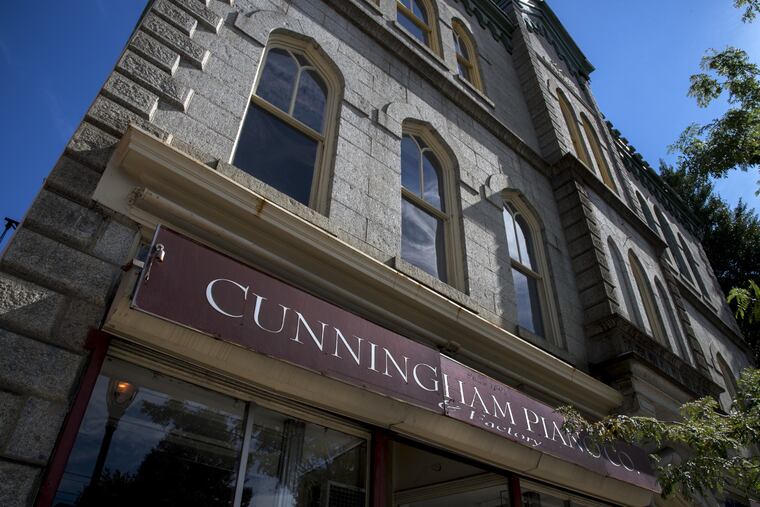
After 60 years at the same spot on Germantown Avenue - a giant stone-and-mortar castle that once was a Masonic lodge - the showroom of the Cunningham Piano Co. is leaving, headed to new quarters beside the King of Prussia Mall.
Why? Changes. In markets, in buying habits, in the neighborhood.
The firm serves an East Coast clientele - and wants to grow local mom-and-pop sales, to more easily connect to suburban families looking to purchase a quality piano. And, its owners said, it needs to escape the perception of some metro-area customers that a visit to East Germantown is risky, a view encouraged by comings and goings at the methadone clinic next door.
"We need to be somewhere the local folks feel more comfortable," said co-owner Rich Galassini.
A factory and smaller showroom will stay, set in a nearby building on Coulter Street. The main showroom, which features top-of-the-line, quarter-million-dollar instruments, now is crowded with shipping crates as the firm slashes prices to move stock.
The departure of a business from city to suburb - where space, land, and customers beckon - is hardly new. But every situation is different, none more than Cunningham Piano. In its 125th year, the company confronts a market far removed from the era when every family wanted a piano in the living room - and needed those instruments tuned and serviced.
The move represents a big change for a firm founded in Philadelphia in 1891, that today sells, restores, and repairs pianos from the finest makers, including Bösendorfer, Steinway, Baldwin, and Yamaha. At the moment about a hundred pianos are being worked on in the shop.
"We're trying to do the level-one, top quality," craftsman Jason Andino said last week as he built a soundboard.
When the pope led Mass on the Ben Franklin Parkway last year, Cunningham Piano provided the organ.
Its classic, glass-walled showroom stands in a neighborhood that teems with history - and troubles.
Novelist Louisa May Alcott, who wrote the eternally popular Little Women, was born on the site of what is now the piano firm.
Next door stands St. Luke's Episcopal Church, founded in 1811, and across the street is the Friends Free Library. Just up the avenue is the Deshler-Morris House, the "Germantown White House," where President Washington lived during parts of 1793 and 1794.
Today the neighborhood celebrates investments in housing and strides in tourism but battles persistent crime and indigence. Fine shops that once lined this section of Germantown Avenue have been replaced by dollar stores and empty storefronts.
The East Germantown poverty rate is 31 percent, unemployment nearly 16 percent.
Cunningham co-owner Tim Oliver said customers have driven up to the curb outside, noticed addicts hanging outside the clinic - and then pulled away.
In June, four people were hit by gunfire in a 20-minute span - provoking the kind of news coverage that no neighborhood wants.
East Germantown ranks 12th out of 55 city neighborhoods in violent crime, statistics show. In the last month there were two rapes and 30 robberies or assaults, along with 79 property crimes.
"I'm not going to say that Germantown and the problems of Germantown don't affect businesses here," said Emaleigh Doley, commercial corridor manager for Germantown United Community Development Corp. "But they're a niche business, not really in the same boat as a mom-and-pop restaurant, or a sneaker store, or any of the other businesses that keep a neighborhood commercial corridor thriving."
Overall, she sees Germantown headed up, attracting young people full of energy and creativity, and gaining investment from government and private developers. Vernon Park, the Wayne Junction train station, and Maplewood Mall are being renovated or reimagined.
Still, the showroom will be missed.
"That's sad for the neighborhood," said Kate Gaffney, the second-generation operator of nearby Gaffney Fabrics. "But I understand, absolutely."
The fabric store stays because it's a destination, offering an infinite array of choices to a dedicated base of shoppers, everyone from students to strippers, Mennonites to Muslims. Why change what's working?
At the same time, people have suggested the store brighten its entrance by getting rid of its steel security gates, and, "We're not prepared to do that."
Developer Ken Weinstein is buying the showroom building, with settlement set for late October, both parties said.
The head of Philly Office Retail plans to invest $2 million, placing 14 apartments on the upper floors and turning the street-level showroom into commercial space, possibly as a coffee shop and restaurant. The exterior will remain intact.
"Sure, Germantown has its urban ills," Weinstein said, "but we do see neighbors pulling together and trying to make it better."
Back in 1891, as the new Wrigley Co. was starting to sell gum in Chicago, and former Gov. Leland Stanford opened a university in California, an Irish immigrant named Patrick J. Cunningham founded a piano-maker here.
He faced competition from a dozen manufacturers in the city and several hundred nationwide - yet did very well. In its first decades the firm moved among Center City locations, including, in 1924, to a custom-built, 15-story structure on Chestnut Street that cost $2 million - the equivalent of $28 million today.
Cunningham later sold the business to Louis Cohen, who in the 1950s moved it to 5427 Germantown Ave. He shifted the company focus from making and selling its own models to the restoration and repair of other brands.
Cohen's daughters led the firm after his death, and co-owners Galassini and Oliver took over in 2008.
They face a challenging market.
Last year, sales of grand and vertical pianos in the United States were down 9 percent, and the dollar value of home-piano sales was flat at about $535 million, according to the Music Trades, which tracks industry sales.
Cunningham wants to sell half its 200 pianos in order to better fit into a new showroom on Allendale Road, across the street from the King of Prussia Mall.
On Germantown Avenue, it could seem as if people from Boston and New York were more willing to visit than people from the suburbs.
"Coming into Philadelphia is not always a positive experience," Galassini said. "It can be a stressful experience. . . . We need to be in a place where more people are happy to visit us."
215-854-4906@JeffGammage