Twenty years in pain for Iroko's Osagie Imasogie
Osagie Imasogie, 55, has spent the last 20 years in pain. Nothing hurts, including the bottom line, but as chairman of Iroko Pharmaceuticals, a company that makes and markets non-opioid pain medicine, Imasogie spends a lot of time understanding the science and economics of pain.
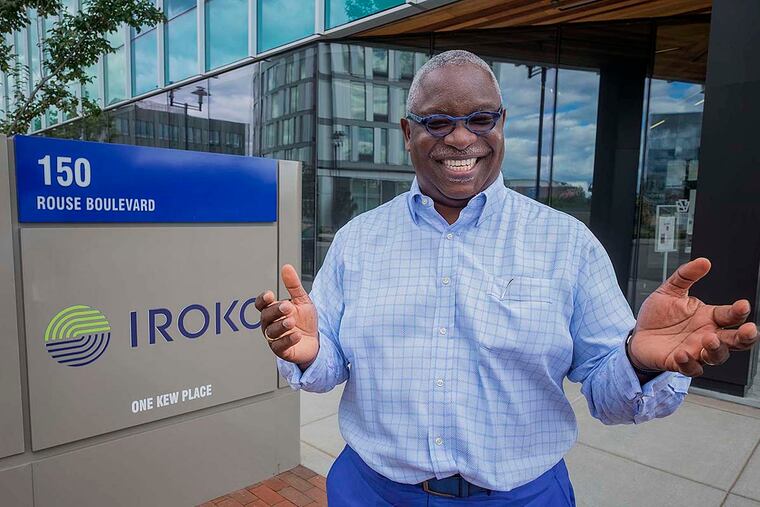
Osagie Imasogie, 55, has spent the last 20 years in pain.
Nothing hurts, including the bottom line, but as chairman of Iroko Pharmaceuticals, a company that makes and markets non-opioid pain medicine, Imasogie spends a lot of time understanding the science and economics of pain.
Also, through his venture capital firm, Phoenix IP Ventures, he has led investors into the pain business, including iCeutica Inc., a company that he also chairs. That company developed a method of delivering medicine so lower doses can be used.
"When a child is born, in the old days, the mother wanted the doctor to whack his little posterior, so that she could hear the child cry, which would tell her that the child was not stillborn," he said, waxing philosophical. "So at the very beginning of life there's a little bit of pain.
"Most of us, at the end of life what we're managing is the pain," he said. "So from the beginning of life until the end of life, and everywhere in between pain defines life."
Imasogie said he has not experienced much serious pain, although his mother suffered from chronic arthritic pain. "When people are in severe pain, chronic pain, it's a horrible thing," he said.
What are the economics of the pain business?
The demographics are fantastic. People are living longer. That means what? They have more incidents, more chances of experiencing pain. It's a growth industry. I love it.
Even so, you've had layoffs, letting go about a quarter of your headquarters staff.
We let go just over 30. Every company within life sciences, particularly pharmaceuticals, is confronted with significant price pressures. Everyone is pushing generics. On the flip side, we are hiring another 90 people to add to the sales force. There are some cards - and it's very painful - that we had to drop in order to pick up some would be more aligned with our more immediate revenue drivers.
Does it bother you to make money on people suffering?
I feel extraordinarily pleased in helping people manage their pain. It consumes their existence. To be able to create products so that they can have the rest of their life, that gives me goose bumps.
As a venture capitalist, you interview chief executives. How do you judge them?
If you have the traditional job interview questions, everyone is prepped for that. What I like to do is to ask people, 'Do you like Star Trek or Star Wars?' If they happen to like Star Trek, that tells me a lot about the way they think.
How so?
People who like Star Trek have a huge imagination because you have to imagine everything, which means they are creative minds. Check. That's what I'm looking for.
It also means they're comfortable with differences.
Your regular Star Trek [cast], the first African American woman, who was an officer, a Russian on the bridge at the height of the Cold War, a Vulcan with the pointed ears.
So, these are people who are comfortable with a wide range of differences. Check. That's what I'm looking for.
What else?
There have been five Star Trek captains. If I ask them which captains they like and why, that tells me the kind of leadership style they're most comfortable with. I tend to do interviews finding analogs that allow me to peek behind the curtain, and get a sense of what the person is. If it's not Star Wars, if it's not Star Trek, we'll find something else.
Which "Star Trek" captain most resembles you?
Jean-Luc Picard. Introspective. French. Plays the flute. Bald. I think he's the smartest, the most thoughtful. He's one that infused the best team spirit within his ship.
You've invested in a lot of winners. When you lost money, what went wrong?
I bet on technology, not in a person and I've lost money picking the wrong person.
If people are really, really bright I love it. That's a big turn on for me. Sometimes you get really bright people who are just crooks. Where I messed up was betting on a really bright person who didn't have as much integrity as I thought. I sensed it early on, but the brilliance was so thrilling that I still went ahead with the deal. But you learn.
Interview questions and answers have been edited for space.
215-854-2769@JaneVonBergen