Commerce head exits an empire of his own making
Bank's founder emphasized customer service - and caught regulators' eye.
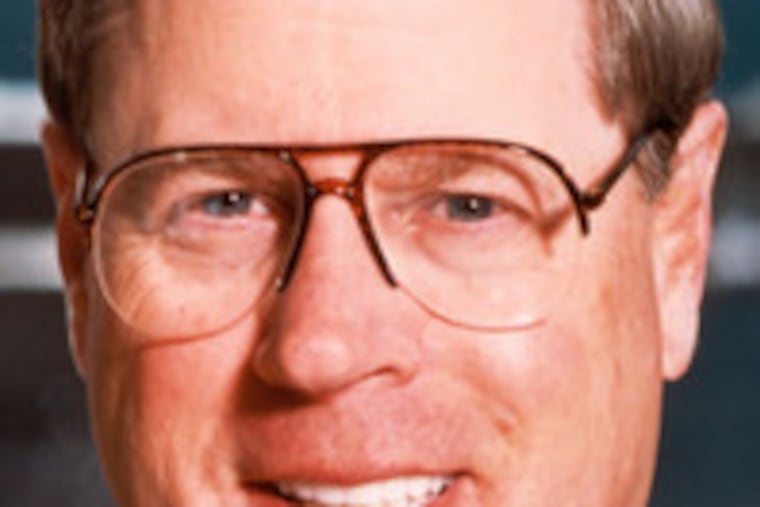
Vernon W. Hill II, a Wharton grad with a stutter and entrepreneurial ambitions, launched Commerce Bank in 1973 with a single branch in Marlton. He was 27.
His drive and daring made Commerce, now with 437 branches and $47 billion in assets, the biggest home-grown bank in the Philadelphia region.
But some of his daring, including sending almost $60 million in bank business to his wife's decorating company, ran afoul of federal regulators, who looked unfavorably on the insider dealing.
To settle a dispute with banking regulators, who haven't approved a new Commerce Bank branch this year, Hill was ousted Friday from the top positions at the bank he founded. Commerce officials say they hope Hill's departure will shore up the regulators' confidence.
"As a businessman, he deserves an A," said Milton Leontiades, former dean of the business school at Rutgers University in Camden. "Just as a customer, if you drive around, his bank branches always seem to be crowded with cars."
Still, Leontiades said, "as a personality, he made a lot of enemies and rubbed people the wrong way. I would guess a lot of people are secretly clapping." He added that Hill "has had a tendency to walk to the legal edge."
In an interview Friday, Hill, 61, acknowledged he has critics but declared: "I am who I am, and I am an entrepreneur at heart. ... Every dollar we took, we took from the competition."
With Hill at the helm, Commerce Bank courted depositors with zeal - and free checking, no-fee Visa cards, free coin counting, convenient branch hours, and other customer-service amenities.
"Vernon did a great job of building a new business model in a very lethargic business," said W. Kirk Wycoff, a Philadelphia banking veteran who starts tomorrow as managing partner at Patriot Capital Partners, which will invest in start-up banks.
"My personal view is he was very good for banking because he was so good to his customers," said Gary B. Townsend, a banking analyst at Friedman, Billings, Ramsey & Co. Inc. "I would daresay that many banks ... learned a great deal about how to do banking at his knee. He had a lot to teach."
In its announcement on Friday of Hill's departure from various posts, Commerce said it had signed a consent order and a memorandum of understanding with federal banking regulators saying it would improve governance at the company.
Regulators had focused not only on the bank business that went to Hill's wife, Shirley, but also on relationships with other Hill family businesses. He operates a real estate firm that scouted sites for new branches. According to corporate regulatory filings, Commerce Bank paid Hill family businesses $72 million, which includes the money to his wife's firm, between 1996 and 2006.
In its statement, Commerce it would review its real estate and vendor relationships. "Today marks the beginning of a new era with governance at the company," Douglas Pauls, chief financial officer, said in a Friday-morning conference call with analysts.
Banking executive Dennis DiFlorio will become chairman of Commerce Bank, and Robert Falese will take the titles of president and chief executive officer.
"This is not a company that has run out of gas," DiFlorio said Friday to analysts. "This is not a situation of a desperate company. What we are interested in is moving this company forward."
Hill said he was disappointed at what happened but remained proud of Commerce Bank and wanted the company to stay independent and based in South Jersey. It shouldn't be sold, he said.
"We created a world-class organization headquartered in Cherry Hill," he said. "I don't think there is any reason why the team can't keep the model or the business together."
Hill would not comment on the details of what happened with his departure. He said he expected to move on to a new business challenge. One of his first projects: He'll publish a book in the fall on the Commerce Bank story with the title Fans, Not Customers.
Hill made headlines when he donated $10 million to the University of Pennsylvania's School of Veterinary Medicine in 2005. He also made headlines when he built a 46,000-square-foot manse in Moorestown - reportedly bigger than Bill Gates' home.
The banking executive made sure Commerce was politically connected. George E. Norcross 3d, a South Jersey political boss, runs the bank's insurance unit and sits on the board of directors.
In 2005, two Commerce executives were indicted in a Philadelphia corruption investigation. They were convicted a year later, and the case is under appeal. Some people viewed the executives' behavior as reflecting an overly aggressive corporate culture.
Hill, the son of a Virginia real estate developer, started his banking career at First People's Bank in Somerdale in the 1960s. People's was run by William A. Rohrer, a car dealer and South Jersey Republican power broker. Rohrer would mentor Hill, teaching him that a banker should focus on selling products, according to a 2002 Inquirer profile of Hill.
Within a year of its 1973 launch on Route 70 in Marlton, Commerce Bank had $8 million in assets.
Coincidentally, Friday was the branch's 34th anniversary. Balloons and birthday cake-shaped hats festooned the walls and heads of employees. Some wore red and blue paint on their faces. One entered the bank in a clownlike red suit.
The first customer at the drive-through received $234, said Carl Williams, 31, an assistant manager who has worked at the bank for five years.
Bank employees weren't talking about Hill's departure. A news release, handed out to a reporter, was the only acknowledgment.
One customer, Maureen Caton, 27, whose husband did business with Hill, described him as "a very stand-up guy."
Even in the early days, customer service was the focus of Commerce Bank. In 1982, Commerce Bank's shareholders reported talks about the bank's commitment to free checking.
Hill eventually focused on longer hours for his branches, free coin counting, attractive branch locations, and other customer-service amenities. A bank, he thought, had to offer more than higher-rate money markets. Some would dub Hill's approach the Burger King strategy, referring to the fast-food chain's "Have it your way" ad campaign.
"I'm not happy about it," Hill said of his losing his positions at the bank. "But it does not affect the power of the brand or what this company can do or will do."