To compete, malls get more than a face-lift
Cherry Hill, Plymouth Meeting and Voorhees share a risky plan for new life.
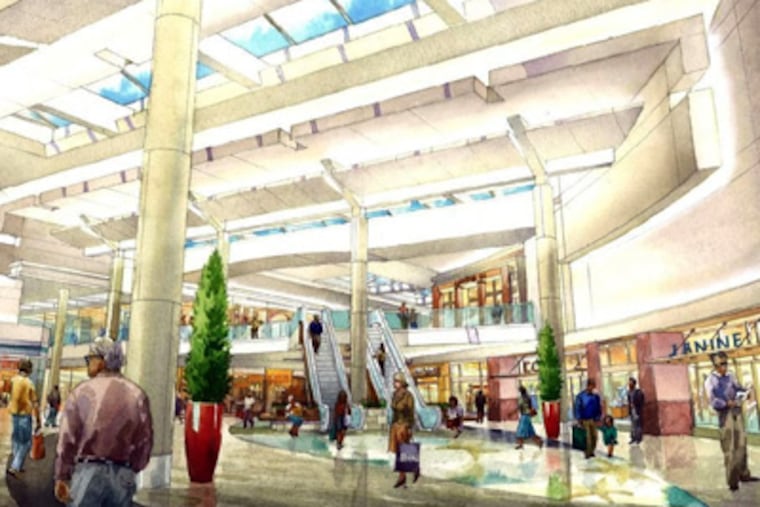
It was all about the Jersey plates. Too many of them, too often, filling up parking spots at the King of Prussia mall. All those Jersey shoppers, with all that Jersey cash, ditching their local malls and defecting to the Main Line / Montgomery County mecca of upscale shopping.
The frustration was enough to fuel a counterattack from an underdog that decided the time had come: Fight back. Reclaim what should be yours. And while you're at it, stick it to the rest of the competition, too - those big-box shopping centers that have stolen suburbanites from under the once-supreme shopping mall.
Hoping to win back the sex appeal, the Cherry Hill, Plymouth Meeting and former Echelon Malls are undergoing a real estate version of plastic and bariatric surgery.
The bill: $365 million - most of it borrowed cash at a time when borrowed cash is scarce and retailers are hurting.
The goal: that by 2009 all three bear little resemblance to your mother's mall - or the mall of your own perhaps ill-spent, hair-sprayed youth.
For months, bulldozers have lopped off dead anchor stores and sliced and diced concrete like Legos on a kindergarten floor.
The jewel, and most expensive makeover, is Cherry Hill. That 47-year-old mall is going upscale by adding a Nordstrom department store, the region's second; adding high-end catches such as Apple, BCBG and Armani Exchange; building new restaurants; and replacing its food court with ritzier tenants.
The Echelon Mall has been chopped down and renamed Voorhees Town Center. New homes are planned where half the mall once stood.
Plymouth Meeting is becoming a recreation-and-errands hub in the inescapable shadow of King of Prussia. A knot of mall stores is now a two-story Dave & Buster's arcade, freestanding restaurants including P.F. Chang and Redstone have opened to long lines of workers from nearby offices, and a Whole Foods market attached to a strip of pricey new shops is going up where an Ikea once beckoned.
Though the $165 million being spent between Voorhees and Plymouth Meeting is huge, the $200 million Cherry Hill project is the glitziest and potentially most threatening to the competition.
"This mall is - without a Nordstrom - a powerhouse," said Joseph F. Coradino, who helped hatch the overhaul. "With a Nordstrom, it turns from a powerhouse into a trophy."
"You're taking a very good mall," real estate analyst Nathan Isbee of Stifel, Nicolaus & Co. said, "and you're making it into a great mall."
The two other malls, meanwhile, are getting a chance at new life.
"The Plymouth Meeting and Voorhees malls were probably going to go dark, or would undergo a significant decline without the work they're doing there," said Isbee, whose firm has done banking work for the mall owner.
The three malls are being redeveloped by the Philadelphia outfit that bought them from the Rouse Co. in 2003: the Pennsylvania Real Estate Investment Trust, or PREIT.
PREIT bought the malls only after concluding that they could be more profitable with substantial makeovers, said Coradino, president of PREIT Services L.L.C. and PREIT-Rubin Inc.
Analysts say the renovations are a good idea, if risky in size for a company stretched thin by debt and by a shaky retail economy that is forcing some tenants to shut down.
"They have a big pipeline of redevelopments that are opening in the next year or so, at a time when retailer appetite for opening new space is pretty low," Isbee said.
PREIT believed it had little choice. Regional malls have lost their hegemony to the massive shopping centers that have cropped up in the last 20 years.
"It was a pretty solid bet that if you built the mall - you got two department stores to decide to go into a piece of property, and you put a bunch of stores in between them, you enclosed them in air-conditioning - that, you know, you'd just sit back and clip coupons. Right? Not a bad deal," Coradino said.
"Unfortunately," he said, "times have changed."
Malls have had to reinvent themselves to stay vibrant and avoid being "scraped" - an industry term for demolished.
The King of Prussia mall, owned by Kravco Simon Co., has shown the way, said analyst Ben Yang, who follows PREIT and other publicly traded mall developers for Green Street Advisors Inc.
"When I grew up, it was just the Plaza," said Yang, a Villanova native. "They built the Court adjacent to that property. I think that's a good example of a mall owner that has grown with the times. Now, it's just a juggernaut that's very difficult to compete against."
Two of the three malls are being transformed into hybrids of an enclosed mall with the wildly popular style of newer strip centers.
Before embarking on the plan, PREIT decided it was critical that Nordstrom be receptive to opening at Cherry Hill, its linchpin.
"What's the first thing that King of Prussia got to sort of kick it off?" Coradino asked. "Nordstrom, right?"
Retail broker Brandon Famous, who books tenants for shopping centers, said high-gloss retailers wanted to be near a Nordstrom shopper. They will clamor for mall space at Cherry Hill. Shoppers will follow.
Restaurants do something similar. Shoppers who dine at "first-class" mall restaurants are more likely to buy something in the mall than those who don't stop to eat, Coradino said.
PREIT had been wooing Nordstrom since the late 1990s to develop a store in Center City.
"Courtship with Nordstrom was not a one-night stand," Coradino said. "They were very diligent about their approach to the market."
Talks become more intense when department-store consolidations left the Cherry Hill Strawbridge's anchor vacant and PREIT poised to capitalize. The Nordstrom deal for Cherry Hill was locked by late 2004, Coradino said.
The PREIT team then executed its attack plan.
Victory No. 1: Crate & Barrel. At the time, the hip furniture retailer was close to signing a deal at a new shopping center at the former Garden State Racetrack, down the road from the Cherry Hill Mall.
"We sent a truck to Crate & Barrel in King of Prussia, and we bought a table, chairs, silverware, dishes, place mats, lamps, occasional chairs," Coradino said. "Loaded it into the truck, drove it to Cherry Hill."
When Crate & Barrel executives walked into the furnished management office at Cherry Hill, the message was clear.
"This is where you need to be," Coradino recalled. "Again, the magic word: Nordstrom. We were able to steal the deal away from the racetrack site."
The $10,000 furniture tab?
"Best money we ever spent," he said with a devilish smile.
Restaurants and recreation, rather than traditional retail, are the impetus behind the Plymouth Meeting project.
The plan, it seems, is working. Shoppers who had sworn it off as a "dead" mall - including Fran Fioravanti of Eagleville and her sister Lisa Rossi of Limerick - have made repeat visits since restaurants and the Dave & Buster's opened.
"I'm going to go to Macy's after this," Fioravanti said during a visit, referring to one of the anchors.
Fioravanti took her 11-year-old grandson, Nico, to Dave & Buster's for his birthday. She had dined at P.F. Chang a few times earlier. She hadn't been to Plymouth Meeting for nine months before that.
"I said to my sister this is going to be ideal in the dead of winter when you don't have anything to do - when the kids are off from school," said Rossi, who took her own two children to the birthday festivities.
PREIT launched its renovation in 2005, when the economy was healthier and debt financing easier to secure. By the end of 2009, the company will have spent $650 million to redevelop these three sites and others in its collection of 52 malls and shopping centers across the Mid-Atlantic.
Some analysts say that is too much. They fear PREIT may have trouble obtaining the remaining loans it needs to finish the work. They also worry that enough retailers - whose sales have been battered by the economic downturn - may not be interested in signing leases at the reconstituted malls.
Malls make their money from rent. And with the rise of retail bankruptcies this year, investors have watched PREIT's stock lose more than half its value.
Isbee said PREIT was carrying a lot of debt - including $400 million from its acquisition of a number of other malls a few years back. This will make additional loans harder to get.
Still, Coradino said results so far were promising.
"We think it's working," he said, then added with a dash of self-deprecation: "If it doesn't, they'll fire me, and the next guy can figure something else out."
Contact staff writer Maria Panaritis at 215-854-2431 or
» READ MORE: mpanaritis@phillynews.com
.
Inquirer staff writer Dan Lieberman contributed to this article.