Talking Small Biz: Got an electric car? No wires in this start-up
ANDREW DAGA, 55, of Malvern, is the principal founder and CEO of Momentum Dynamics, which is developing a wireless recharging system and other technologies for electric vehicles. Last month, the 10-employee start-up, which began in 2009, announced it had wirelessly charged a Chevy Volt. Momentum's wireless charger delivers more than 20,000 watts, far more than plug-in chargers supply.
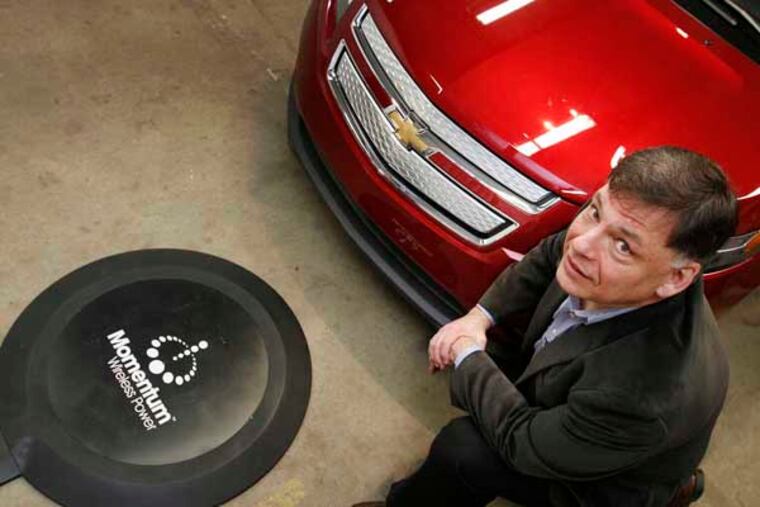
ANDREW DAGA, 55, of Malvern, is the principal founder and CEO of Momentum Dynamics, which is developing a wireless recharging system and other technologies for electric vehicles. Last month, the 10-employee start-up, which began in 2009, announced it had wirelessly charged a Chevy Volt. Momentum's wireless charger delivers more than 20,000 watts, far more than plug-in chargers supply.
Q: How did you come up with the idea for wireless charging?
A: I was working on a project to deliver solar power to troops during the Iraq war, which led me to a safe, short-distance method of transmitting power wirelessly. The clear application was electric vehicles. The challenge was not the vehicle or battery but the charging connection to the grid.
Q: How does the technology work?
A: The vehicle sits over a charging pad that recognizes your vehicle and then charges your account like E-ZPass does.
Q: Is the public ready for this?
A: The adoption rate of electric cars is likely to be slow, but the economic case for commercial fleets is strong. We have pursued that market faster than our competitors. As a startup, we won't get investors to invest if they must wait eight years for a payoff.
Q: Why do you think your business model is better?
A: Eight companies in the world are working on this, names like Siemens and Nissan. But they're not as agile, take fewer risks and are slowed by internal inertia, and the smaller firms are focused on passenger cars.
Q: What's next on the horizon?
A: Wireless charging is the future, and plug-in will be obsolete. We have more demand than we can deal with. We don't have production capability. We're transitioning and need to supply public-transit agencies, university transit systems, all who want to reduce fuel and maintenance costs.
Q: Why not license the technology and sub out manufacturing?
A: That's probably part of what we'll be doing. This is a multisegment play - electric cars, buses, delivery vehicles, utility carts. We will be equipping a Federal Express truck for a pilot.
Q: How much cash have you raised and who are the investors?
A: About $3.5 million, and the investors are all high-net-worth individuals, friends, family, many in the Washington, D.C., area.
Q: You have revenues yet?
A: We expect our first revenues this year.
Q: Any customers lined up?
A: We have two customers ready to take purchase orders. We're working with Berks Area Regional Transportation Authority to convert two paratransit vehicles.
Q: What does the product cost?
A: For a public, high-powered charging location, such as in front of a mall or office building, the charging pad costs $6,500. The receiver, mounted to the underside of a vehicle, costs $300. A less-expensive version of the pad for residential application is projected to cost near $2,500.
Phone: 215-854-2656
