Lenders to service members to refund $6.5M
Complaints about the financing program came from people like the father of a 21-year-old infantryman about to ship overseas. He said his son was paying more than $500 a month - more than half his take-home pay - toward a loan on a $20,000 used Dodge Ram, partly because of costly add-ons and an 18 percent interest rate.
Complaints about the financing program came from people like the father of a 21-year-old infantryman about to ship overseas. He said his son was paying more than $500 a month - more than half his take-home pay - toward a loan on a $20,000 used Dodge Ram, partly because of costly add-ons and an 18 percent interest rate.
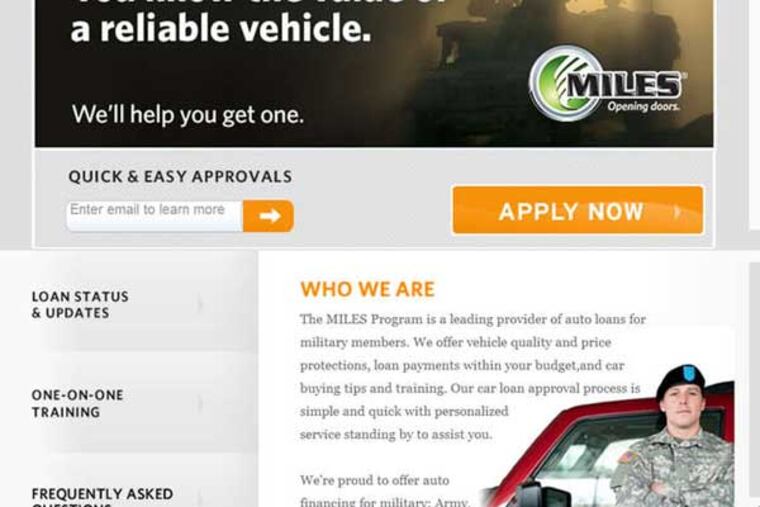
The money paid to the Military Installment Loans and Educational Services (MILES) auto-loans program came directly from the Defense Department. It was sent via the military allotments system, designed decades ago to help service members protect their families and credit while they were busy protecting the country.
The father said the MILES program and allotment system were instead harming his son, according to Richard Cordray, director of the Consumer Financial Protection Bureau. Cordray recounted the complaint Thursday at a news conference called to announce that U.S. Bank and Berwyn-based DFC Global Corp. had agreed to refund about $6.5 million to more than 50,000 service members hurt by the MILES program since 2010.
The CFPB said the bank and a DFC Global subsidiary, Dealers' Financial Services L.L.C. of Lexington, Ky., violated the Truth in Lending Act and other laws against deceptive marketing and lending practices.
Cordray said the Massachusetts man "wanted to know how a program claiming to educate its customers - the word educational is in its title - could saddle such a loan on a young soldier on his way to Iraq."
Cordray said his and similar complaints prompted a yearlong investigation of the MILES program, which the CFPB said used a network of more than 700 dealers to deceptively market costly subprime loans and add-ons to those in the military - particularly service contracts that added an average of $2,600 to a loan but that sometimes failed to cover expected repairs.
The agency also faulted the MILES program for requiring borrowers to repay via the allotment system without disclosing how that made payments more costly than alternatives now routinely available, such as preauthorizing a checking-account debit.
CFPB officials said the case had prompted a broader examination of military allotments. Defense Secretary Chuck Hagel announced Thursday that he had ordered an interagency review "to ensure our discretionary allotment system no longer creates an opportunity for unscrupulous businesses and lenders to take advantage of those who serve in the armed forces."
DFC Global describes its primary market as "unbanked and under-banked consumers." It reported more than $1 billion in revenue last year from a business that includes Internet lending and about 1,400 pawn shops, loan stores, check-cashing outlets, and similar businesses in nine countries.
DFC said it had agreed to pay $3.3 million in restitution and to alter its practices "without admitting or denying any of the facts or conclusions of the review."
U.S. Bank, based in Minneapolis and identified by the CFPB as "the primary lender for the MILES program," agreed to pay $3.2 million in restitution. A spokesman told Bloomberg News that "we apologize for any confusion this program may have caused our customers."