Travel company strikes back at its Internet critics
Sundance Vacations had a problem. Unhappy customers weren't just complaining to consumer agencies or regulators, where it was used to quietly settling or pushing back. Instead, many were connecting on Facebook - finding a "Boycott Sundance Vacations" page whose 2,200 thumbs-ups might as well be thumbs-downs.
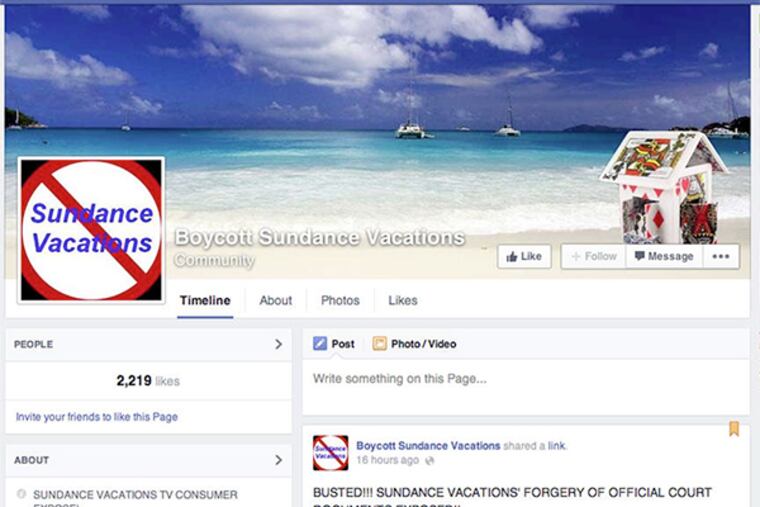
Sundance Vacations had a problem. Unhappy customers weren't just complaining to consumer agencies or regulators, where the Wilkes-Barre, Pa., company was used to quietly settling or pushing back. Instead, many were connecting on Facebook - finding a "Boycott Sundance Vacations" page whose 2,200 thumbs-ups might as well be thumbs-downs.
Today, a prospective customer who types "Sundance Vacations" into a search engine such as Google is likely to find the boycott page, managed by a group of activist critics, near the top of the results. Those who click through encounter a brand of self-help consumer protection - including advice on how to try to cancel Sundance's uncancellable plans - that has plainly proved a nightmare for the lodging marketer.
In the Internet era, businesses are increasingly obsessed with how they look online. Some spend heavily on staff or consultants to put their best faces forward. A few have gotten more aggressive. KlearGear.com, an Internet retailer based in Michigan, stirred a furor in 2012 by billing a disgruntled customer $3,500 for refusing to delete a complaint on RipoffReport.com, citing a "nondisparagement clause" in its terms of service.
That case led to a lawsuit by Public Citizen and, last month, to a new California law barring such contract clauses. Even Congress may weigh in - a proposal introduced last month would protect consumers from attempts to bar critical online comments.
Since the Boycott Sundance Vacations page appeared in November 2010, Sundance has been stymied in its own efforts to fight back - even after suing Facebook in Luzerne County Court last year seeking to shut the page down.
That case grew out of Sundance's long dispute with Albert Whitehead, a Philadelphia man whom Sundance has accused of being behind both the boycott page and "nearly all" consumer complaints against the company.
Suing Facebook
When a Luzerne County judge ordered Whitehead to remove the page last year, Whitehead insisted he could not. He was backed by a witness - Sean Oakley, a former manager at Sundance's partner, Travel Advantage Network - who identified himself as one of the page's half-dozen administrators and said Whitehead never had the power to kill it, even when also serving in such a role for about six months in 2011 and 2012.
Sundance responded by suing Facebook, too, a move that drew a rebuke from the social-media company on behalf of its members. "Sundance has turned its claim against Whitehead into a vehicle for silencing legitimate online criticism by others," Facebook said, arguing for the suit's dismissal before Sundance dropped it. Facebook lawyers called the case a "thinly disguised attempt to stifle lawful speech."
How badly has the page hurt the 23-year-old Sundance?
"It's the single worse thing that's happened to our business since we started it," Sundance owner and president John Dowd testified last year, according to a transcript. "It's cost us millions of dollars over the past few years. We laid off over a hundred people as a result of problems caused by this page. People believe what they see on the Internet. They think that stuff is credible."
Sundance declined to answer questions about the Facebook dispute or other aspects of its business. Outside legal experts say posts on the page occasionally overstate consumers' rights - for instance, by suggesting customers everywhere have a clear right everywhere to cancel Sundance contracts within their initial days. Even so, some praise the site for helping customers cope.
"It has sparked a real interest among people who don't know each other and have no ax to grind, other than their shared interest in what Sundance has done to them," said Wisconsin lawyer DeVonna Joy, who has helped some customers cancel their deals with Sundance. "It also helps them learn their rights."
Facebook and Whitehead have not been Sundance's only targets. In a 2012 letter, Dowd accused Joy of violating Wisconsin ethics rules governing lawyers' advertising by posting on the page - an accusation Joy rejects and said Sundance never pursued.
An odd turn
Sundance has also taken aim at criticism on other websites, a story that recently took a strange twist.
In June 2013, Sundance vice president Candy Bednar sent an e-mail to Matthew Haughey of Portland, Ore., owner of Metafilter.com, one of several other sites, such as RipoffReport.com, where consumers have posted Sundance warnings or complaints. Bednar provided documents from the Whitehead case, and asked Haughey to remove a 2010 post titled "Am I about to get screwed by Sundance Vacations?" Haughey said he found no evidence linking the post to Whitehead, and declined to remove it.
Last month, Haughey received another e-mail demanding he delete the same post, this time from a "Brian Smith" at Sundance and including a court document from Mississippi purportedly identifying the link as defamatory - a document that Haughey, with help from a Mississippi court clerk, identified as a forgery.
In an e-mail to Haughey, Sundance's Dowd said the company was uninvolved and "as concerned as you are regarding this matter and are working feverishly to determine the source of the forged documents." Brier said the company had asked for a criminal investigation.
Oakley, the ex-TAN manager, said Sundance's battle against critics was misdirected and a sign of underlying problems. "If they were really in the right, they would be focusing more of their energy on making clients happy and not on getting them to shut up," he said.
A company such as Reputation.com can help a business address some kinds of problems. But spokeswoman Leslie Hobbs said patterns should raise flags. "When you get consistent complaints that are thematic in nature, then you should take it seriously," she said. "It's a signpost that there are things customers don't like."
Public Citizen's Scott Michelman, who won the KlearGear case, said trying to just silence critics can backfire because of bad publicity. "A lot of companies that try to prevent or take down online criticism end up doing themselves more harm than good," he said.
215-854-2776 @jeffgelles