Newtown-built satellite crashes after launch
A Russian rocket carrying a Lockheed Martin satellite built in Newtown veered off course and crashed soon after a predawn launch today from the Baikonur Cosmodrome in Kazakhstan.
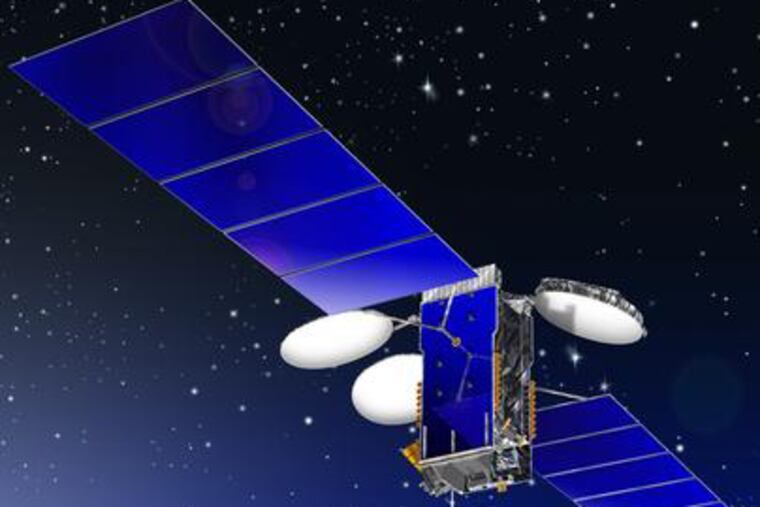
A Russian rocket carrying a Lockheed Martin satellite built in Newtown veered off course and crashed soon after a predawn launch today from the Baikonur Cosmodrome in Kazakhstan.
International Launch Services, of McLean, Va., the firm hired by Japan's JSAT Corp. to put the satellite in orbit, said the second stage of the Proton M/Breeze M launch vehicle "failed to inject JCSAT-11 into orbit."
The Associated Press, quoting Alexander Vorobyov, a spokesman for the Russian space agency Roskosmos, said the problem developed two minutes and 19 seconds after liftoff at an altitude of 46 miles. Parts of the 1.5-million-pound rocket fell into an uninhabited area 30 miles southwest of the central Kazakh town of Zhezkazgan, Vorobyov said.
The heavy-lift rocket's fuel included highly toxic heptyl, causing worries of environmental contamination, Kazakhstan's Kazinform news agency reported, quoting Kazakh space agency chief Talgat Musabayev.
The JCSAT-11 satellite was designed and built by Lockheed Martin Corp.'s Commercial Space Systems unit in Newtown. It was to provide backup broadcast and communications services for JSAT and its customers, for at least 15 years, over a wide Asia-Pacific area that includes Hawaii and Japan.
JSAT awarded the satellite contract to Lockheed's Newtown unit in October 2005. Neither company would disclose financial terms.
"We are participating with JSAT and ILS to obtain an understanding of root cause [of today's failure], and we will be supporting JSAT during this time as they plan their next steps," said Dee Valleras, spokeswoman for the Newtown unit.
ILS, the launching service, was formed in 1996, with Lockheed Martin as a partner. The company sold its stake in September 2006 to Space Transport Inc., of the British Virgin Islands. It is now a joint venture of Space Transport, Khrunichev State Research and Production Space Center, and RSC Energia of Moscow.
ILS said additional details would be released after reports from Khrunichev, which built the Proton, were translated into English.
Khrunichev released a statement expressing its regret to JSAT and others involved in the mission.
The failure came less than a month before the 50th anniversary of the cosmodrome's Oct. 4, 1957, launch of Sputnik I, the world's first man-made satellite, an event that launched the race to land a man on the moon, which the United States won in 1969.
The launch was the third this year under auspices of ILS, and it was the 42d since the company was formed. All but four have been successful, ILS said.
ILS and Khrunichev pledged aggressive efforts to identify and correct the problems to avoid an extensive delay in future launches. ILS has 21 Proton missions planned between now and 2013.