SugarHouse called a gaming hall done well
At the seventh annual Pennsylvania Gaming Congress, the executive director for the City Planning Commission praised how smoothly things have gone with the city's only casino to date, SugarHouse, on the Penn's Landing waterfront, and he steered clear of any discussion of Foxwoods' revoked license to build a second gambling hall here.
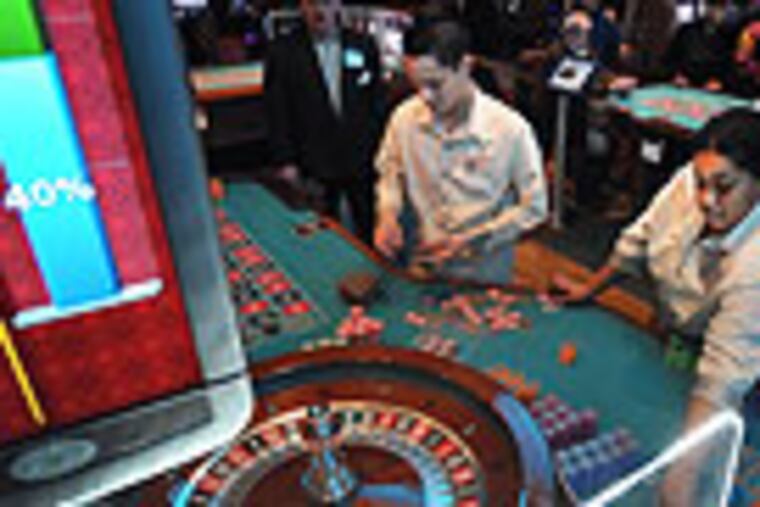
At the seventh annual Pennsylvania Gaming Congress, the executive director for the City Planning Commission praised how smoothly things have gone with the city's only casino to date, SugarHouse, on the Penn's Landing waterfront, and he steered clear of any discussion of Foxwoods' revoked license to build a second gambling hall here.
Alan Greenberger said SugarHouse followed the steps to creating a successful casino in an urban environment. He said the casino's management had created relationships with the local neighborhood groups, brought on top consultants to mitigate issues, such as traffic, hired a vast majority of its workforce from the nearby area, and invested in the community.
"Our experience with SugarHouse has been terrific," he said. "Issues are worked out in a professional manner."
Greenberger made the remarks as the opening keynote speaker Tuesday for the second and final day of the Gaming Congress at the Loews Hotel at 1200 Market St. The event is a series of panels looking at issues impacting the state's burgeoning gambling industry. It is being held in Philadelphia for the first time.
Southeastern Pennsylvania is home to three of the state's 10 gambling halls. It has market-leading Parx in Bensalem, Harrah's Chester Casino & Racetrack in Delaware County, and SugarHouse.
General managers for Harrah's Chester and SugarHouse will headline a panel later today called "The Beast in the East," which highlights the region's gaming importance.
The Philadelphia market will soon host a fourth venue, with the decision earlier this month by the State Supreme Court to allow a local investor group led by real estate titan Ira Lubert to develop a casino at the Valley Forge Convention Center in King of Prussia.
The fate of Philadelphia's second gaming license remains unresolved. In January, the Foxwoods group behind the development of a casino planned for South Philadelphia appealed a decision by the Pennsylvania Gaming Control Board to revoke its license after repeated delays and difficulty in obtaining financing to build the gambling hall.
The Foxwoods legal case is likely to be tied up in the courts for many months, if not years - something that Greenberger touched on.
"There are a whole set of other issues with Foxwoods," he said Tuesday, before focusing his speech on SugarHouse's impact after it opened Sept. 23.
It took the state courts nearly two years to decide on the Valley Forge casino resort license.
Another issue hanging in the balance - and one that will be discussed this afternoon - is the awarding of the second casino resort license. Four groups with projects proposed for Gettysburg, Mechanicsburg, the Poconos and southwestern Pennsylvania are in contention. The state gaming board said it plans to make a decision by the end of next month.
The competition for the final license is fierce. Last year, Pennsylvania's 10 casinos grossed nearly $2.5 billion in revenue from slot machines and table games. The state has a 55 percent tax rate on gross gambling revenue, meaning that the state received about $1.3 billion in taxes last year from gaming.
There are about 26,700 slot machines distributed among the state's 10 casinos and 842 table games, including poker and blackjack.
Greenberger said he believed that "inevitably, every state will have some form of gambling."
"None can tolerate the thought of having residents cross their borders to gamble elsewhere," he said. "Gambling is going to be localized and more regionally dependent. We're not creating new Las Vegases and Atlantic Citys."
Analysts from Wall Street took the stage this morning and offered opinions on the state's potential, as far as revenue projections, growth expectations and saturation issues in the Philadelphia/Greater Atlantic City market.
Andrew Zarnett of Deutsche Bank said that sometime next year, Pennsylvania's gaming revenues would most likely be bigger than Atlantic City's.
Concurred Adam Steinberg, an independent gaming analyst: "It has the potential to be one of the largest gaming markets in the United States."
All four analysts at the session said they thought there should be a moratorium on casino licenses in the Philadelphia region until the existing casinos in the state had a chance to develop.