Bucks clinic serves uninsured workers
March was a weird month for Mae O'Brien to begin her new job as executive director of HealthLink Medical Center, a free clinic serving the working uninsured in Bucks and Montgomery Counties.
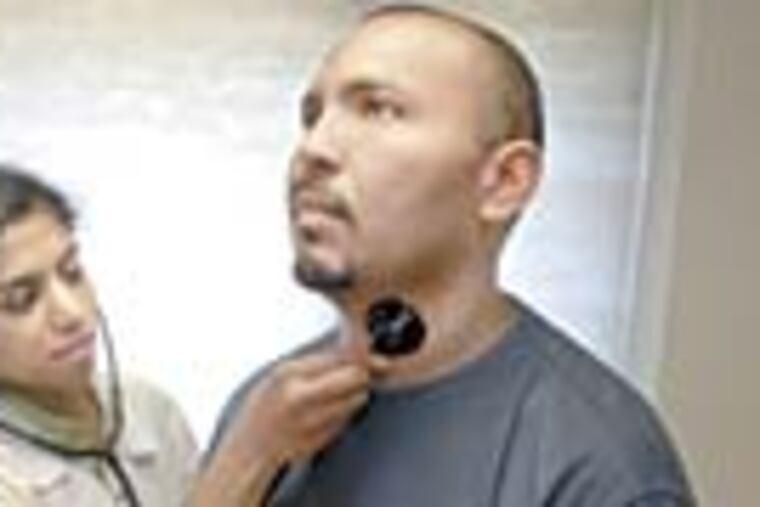
March was a weird month for Mae O'Brien to begin her new job as executive director of HealthLink Medical Center, a free clinic serving the working uninsured in Bucks and Montgomery Counties.
That's because March was the same month that President Obama signed the federal Affordable Care Act, with its promise of increased access for all.
Would a free medical clinic still be relevant?
"The more I read about it," O'Brien said, "the more I think there are still going to be people who fall through the cracks."
Most of the main provisions in the law will not take effect until 2014. Meanwhile, there's a reason that Rene Rodriguez, a groom at PhiladelphiaPark racetrack, and his wife are patients at the clinic housed in a renovated rancher on Street Road in Southampton.
Rodriguez earns $450 a week, barely enough to pay rent in Bensalem and buy food for his wife and two children. The children are covered by a government-funded health-insurance plan.
"They make sure everything is OK," said Rodriguez, 32, who visited the clinic Monday for a checkup.
The clinic differs from most others by requiring that patients be working to qualify for care.
That's because the clinic's initial benefactor, Eugene Jackson, cofounder of the medical publishing company Springhouse Corp., wanted to help working people who could not afford insurance. He thought that there were government programs for the very poor through Medicaid, for the elderly through Medicare, and for children through the CHIP program, which covers Rodriguez's son and daughter.
"We have waitresses, landscapers, people working at places like Wal-Mart and McDonalds," said Linda Veloso, operations manager at the clinic. For care, they must earn less than $44,100 a year for a family of four. Rodriguez's annual salary is $23,400.
Under the health-care act passed in March, everyone must have insurance, either through an employer or by buying it through an exchange.
The cost will be a factor.
Even a modest monthly premium of $80, Veloso said, would be beyond reach for many of the clinic's 1,325 patients.
"These people are making $8.50 an hour," she said. "They can't afford their rent."
As the recession worsened, O'Brien said, patients who lost their jobs were afraid to inform clinic staff for fear of losing coverage. "But we don't drop someone because of that," she said.
They have noticed more people losing full-time jobs with insurance and winding up with part-time jobs that do not provide coverage.
"A lot of people are working 10 hours here, 20 hours there, just trying to get in the hours," Veloso said.
The clinic is part of a national network of volunteer clinics, Volunteers in Medicine. Its headquarters are in Burlington, Vt., and there are local clinics in West Chester and in Cape May Court House.
O'Brien's main job is to raise the $1 million that HealthLink needs to operate. It employs 12 people. Many others, including active and retired physicians and dentists, volunteer. The clinic offers medical, dental, and vision care and can help with some prescriptions. Area hospitals take turns underwriting laboratory tests.
Internist Jennifer Black, of Jenkintown, volunteers as the clinic's chief medical officer, a post that lets her spend time with her young children while still seeing patients.
"I really missed patient care," she said.
HealthLink has a striking resemblance to a normal suburban physician's office. Nothing is rundown. Waiting is minimal. The examination and waiting rooms are clean.
"People have enough stress being poor," nurse-practitioner Becky Godfrey said. "We try to make this an environment where they are treated like everyone else, not like a bunch of cattle. We try to make it as pleasant as possible."
Godfrey, who is the highest-ranking paid medical person on staff, said that the clinic's patients have the typical problems of the poor: asthma, diabetes, and hypertension.
"It's hard for them to control their diet," she said. "If you had to live on minimum wage, you'd be eating mac-and-cheese and hotdogs because you could afford it and it fills you up. But it's the worst possible thing for your health."
Fazlul Islam, 49, of Lansdale, stopped in on Monday morning for a blood test to monitor his diabetes. He lost his temporary mail-room job eight months ago. His family of four is relying on his wife's income as a production worker.
"This is Mom," he said, praising the care he and his wife receive at the clinic. "That's what I call it, Mom. In the whole world, where is the best place? It's Mom's place. I'm happy they take care of me."