Report: wide variance in Medicaid use of costly hepatitis C drug
A groundbreaking - but very expensive - new drug that cures many people with hepatitis C caused rapid and widespread increases in Medicaid spending in 2014, but with substantial variation across states, two doctors reported in a recent article in the New England Journal of Medicine.
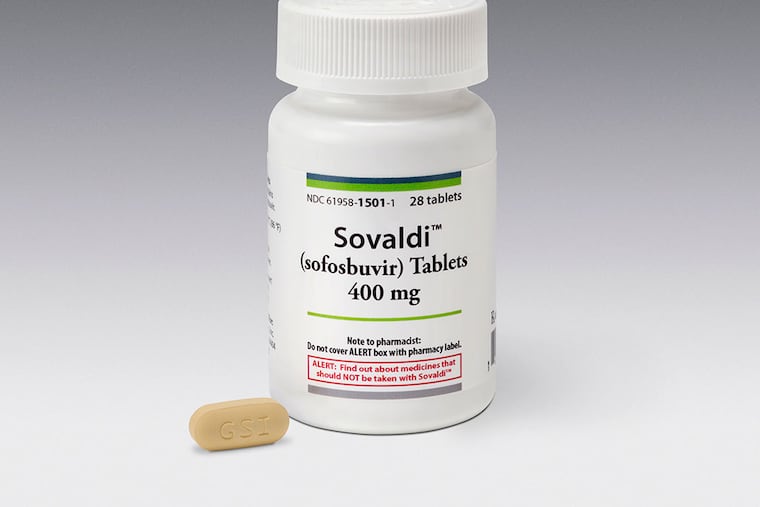
A groundbreaking - but very expensive - new drug that cures many people with hepatitis C caused rapid and widespread increases in Medicaid spending in 2014, but with substantial variation across states, two doctors reported in a recent article in the New England Journal of Medicine.
Sofosbuvir, which has the brand-name Sovaldi and is made by Gilead Sciences, changed the standard of care for hepatitis C, which can destroy the liver and cause death if not properly treated. The 12-week course of treatment had a list price of $84,000. Gilead and corporate competitors have since released similar medications, but none is cheap.
Pennsylvania's entire Medicaid prescription drug bill was $2.16 billion in 2014, with 3.67 percent, or $79.3 million, going just for Sovaldi, according to the report, based on data from the Centers for Medicare and Medicaid Services.
In New Jersey, 4.85 percent, or $49.6 million, of the $1.02 billion total went toward Sovaldi. In Delaware, 0.62 percent of total spending of $235.99 million was for Sovaldi.
"There is a lot of detail around the variation in state programs," Penn Medicine doctor Joshua M. Liao, one of the authors, said in an interview. "While there is a big number on the total spending on sofosbuvir - $1.3 billion - we are just getting at the tip of the iceberg in hepatitis C incidence."
About 2.7 million people are thought to be infected.
The journal report adds to the growing public debate about the price of drugs and other care, with government budgets stretched and individuals having to pay more for medicine and services, covered by insurance or not.
Further outrage came earlier in September when a hedge fund manager, shortly after buying Turing Pharmaceuticals, jacked up the price of a 62-year-old medicine, Daraprim, with few competitors. That prompted a drug price control proposal from Democratic presidential candidate Hillary Rodham Clinton.
Presidential candidate and U.S. Sen. Bernie Sanders (D., Vt.) has introduced a bill that would enable consumers to import cheaper drugs from Canada and require companies to submit annual reports on how they price drugs. Medicaid is the federal government's health insurance program for low-income people but the program is administered by states, which set their own rules for covering drugs.
Unlike Medicare, Medicaid officials can negotiate for lower prices and drug companies must give so-called rebates on prices for drugs distributed through Medicaid, but those negotiated prices are not publicly disclosed.
Michael A. Fischer, of Brigham and Women's Hospital in Boston, and Liao wrote that the cure rates with Sovaldi have been "remarkable."
But their analysis of Medicaid spending showed great disparity in usage that did not correlate to the incidence of patients with hepatitis C. There was also no clear correlation between use of the drug and a governor's decision to expand Medicaid.
"The high cost of the drug has raised concerns" that poor patients won't be able to get the medicines, Fischer and Liao wrote.
Sovaldi was approved by the U.S. Food and Drug Administration late in 2013, so 2014 was the first full year the drug was available. For that year, Sovaldi accounted for anywhere from 2 percent (Texas) to 44 percent (Hawaii) of all prescriptions written for hepatitis C infections covered by Medicaid.
Pennsylvania was at nearly 35 percent while New Jersey was at just over 38 percent. Delaware was closer to Texas, with just 16.1 percent of hepatitis C prescriptions being written for Sovaldi.
Fischer, who is a primary-care physician, said that "ideally," a good new drug would be available to all who need it. He said Sovaldi was the most clear and dramatic example of a common problem that states are "grappling with" as they use "triage" on their Medicaid budgets.
"This drug works really well where others were pretty crummy," Fischer said. "But it is extremely expensive, and the same thing [lack of access] occurs with some other drugs where people can't afford them."
215-854-4506@phillypharma