Sisters worked to integrate W. Mount Airy
When twin sisters Doris Polsky and Shirley Melvin launched a real estate company in 1965, they had a vision for West Mount Airy, the Northwest Philadelphia community where they lived. They envisioned a neighborhood where whites and blacks, gays and straights, could live in harmony.
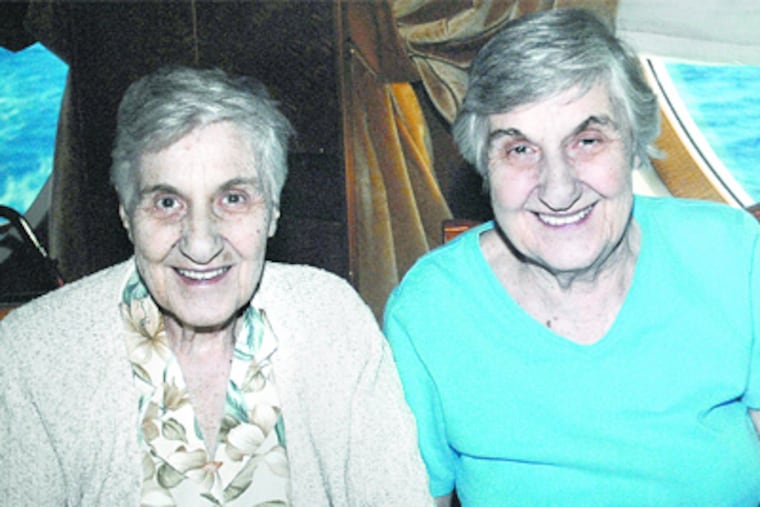
When twin sisters Doris Polsky and Shirley Melvin launched a real estate company in 1965, they had a vision for West Mount Airy, the Northwest Philadelphia community where they lived.
They envisioned a neighborhood where whites and blacks, gays and straights, could live in harmony.
"What we wanted was an integrated community," Polsky said. "We had wonderful neighbors who were right with us."
Their dream has blossomed into a national model.
Despite many obstacles, Polsky, now 84, and Melvin, who died July 21 of heart failure, were largely successful in helping to build West Mount Airy into what the U.S. Department of Housing and Urban Development and others have hailed as one of the best-integrated communities in the country.
A neighborhood of mostly large single-family and twin homes, West Mount Airy is bounded by Germantown Avenue to the east, the Wissahickon Creek to the west, Cresheim Valley Road to the north, and Johnson Street to the south.
The area is diverse: 49 percent black, 44 percent white, and 3 percent multiracial, according to the 2000 census. In 1960, it was 81 percent white and 19 percent black; by 1980, it was 52 percent white and 46 percent black.
Polsky and Melvin were raised to help others and advocate social justice.
As a teenager, Melvin was mentored by Gertrude Dubinsky, a social worker who placed refugee children in foster homes during World War II. Dubinsky taught Melvin the importance of activism, said her daughter Anita.
After marrying and having children - three daughters for Melvin, three daughters and two sons for Polsky - the twins wanted to go into business, and decided on real estate so they could help integrate their neighborhood.
Polsky and Melvin, who both had homes in the 600 block of Upsal Street, opened Twin Realty in 1965 at 33 Maplewood Mall in Germantown. The sisters learned a lot about real estate from their father, Jack Blumberg, a South Philadelphia real estate broker.
Polsky said her husband, Samuel Polsky, a professor of law and medicine at Temple University who died in 1975, encouraged her to become a real estate broker and her sister to become a sales agent.
Aware of sexism, the twins decided to hire only women. "It was kind of unique, because it was an all-women firm," said Polsky, who uses a walker but whose memory is sharp and whose voice is full and rich. "It was a lot of fun."
But the sisters were troubled to learn that banks were redlining in West Mount Airy - withholding loans often on the basis of race or gender. And real estate brokers were engaging in blockbusting, encouraging owners to hastily sell their homes, particularly when blacks moved nearby, Polsky said.
"The rest of the real estate brokers around here really didn't care. They weren't even aware, until we started digging into the rules and regulations, that redlining was taking place," Polsky said.
Their own response was to press the banks and mortgage companies to provide loans to blacks and women, Polsky said.
"We had a lot of diverse clients, and we were in and out of the banks and mortgage companies a lot," she said. "We became aware very quickly that mortgage financing was very unfair."
Just as insidious was blockbusting by real estate companies, Polsky said.
"If a black family bought a house in Mount Airy - West Mount Airy included - for-sale signs would go up in front of all the houses on the block," Polsky said.
She said real estate agents would send letters and fliers to homes, advising residents that blacks were moving in and to call their agents if they wanted to sell their homes.
To counter these efforts and prevent panic selling, Polsky said, she and Melvin would find someone on a block "who had the same feelings about integration as we did" and get them to host a welcoming party for the new black neighbors.
Polsky said, "We found a woman on Westview Street and we said, 'We have to have a welcoming party for a new neighbor. Can we have it at your house?'
"So we had a very lovely party at her house and invited all the neighbors, all the ones who had for-sale signs up. They got to meet the new neighbors," Polsky said. "And all of the for-sale signs started coming down."
She and Melvin repeated those parties wherever for-sale signs went up, Polsky said.
In one instance in the early 1970s, Polsky recalled, a black clergyman wanted to sell.
Every home on his block had been purchased by blacks, Polsky said. She and Melvin asked him to let them hold the house for a white buyer.
"He got annoyed and said, 'You're asking me to discriminate against my own people.' I said, 'What we don't want is separation. We're asking you to help integrate the community,' " Polsky said.
He agreed. "And so we broke that trend, and then black people came and white people came. Then it became an integrated block. That was our purpose, to integrate every block," Polsky said.
Anne Ewing, emeritus member of East Mount Airy Neighbors, the residents' organization for the neighboring community, said the work of Melvin and Polsky was critical to building a diverse area.
"They were selling one house at a time and dealing individually in changing hearts and minds, one house at a time," Ewing said.
Their work won notice.
In 2004, the Philadelphia Commission on Human Relations, which enforces civil-rights laws, gave Melvin and Polsky its Human Rights Award for Community Service for their efforts.
Polsky and Melvin also are among about 10 women featured in a 2005 documentary film titled Neighbor Ladies. The documentary by local filmmaker LeAnn Erickson examines integration in Mount Airy.
In 1991, Polsky retired and Twin Realty merged with Wissahickon Realty. Melvin continued to work there until 2008, retiring at age 83.
The sisters touched their community and the country in other ways.
Just after graduating from Girls High School in 1942, the sisters, who were standout students in mathematics, did secret work for the Department of Defense during World War II.
While studying at the University of Pennsylvania, the twins were among 100 women recruited to make mathematics tables for precision aerial bombings and long-distance ballistics. The women worked in round-the-clock shifts on thousands of calculations.
Erickson is also producing a one-hour documentary on the project, featuring Polsky and Melvin, called Top Secret Rosies.
In a trailer for the film, Melvin said the sisters were eager to help the war effort.
"We were sending our troops over there to risk their lives," Melvin said. "We certainly had to help out on this end in whatever capacity we had skills in."
Before starting in real estate, the sisters in 1959 were founding members of West Mount Airy Neighbors, a 600-member organization marking its 50th year of "preserving and enhancing the quality of life in its richly diverse urban neighborhood."
In 1953, the twins, as young mothers, wanted a place for children and adults to study the arts. They were involved in founding the Allens Lane Arts Center at 601 W. Allens Lane in a building owned by the Fairmount Park Commission. Melvin was the center's first president.
"The Allens Lane Arts Center was the first integrated and multireligious preschool program in the city of Philadelphia," Polsky said. "We were very successful there. We had really diverse families involved with us, and we got a lot of neighbors to come aboard."
The center continues to offer a wide variety of programs in creative and performing arts.
The sisters had their share of critics, some of whom challenged them by asking what they would do if one of their children married a black person. Polsky's answer: That's happened.
One of Polsky's sons is married to an African American, and she has grandchildren whose parents are Latino and Asian. "We're an integrated family," she said.
When the twins both lived on Upsal Street, their children often had friends of all races in their homes.
Lynne Southerland, a producer of animated feature films in Los Angeles and lifelong friend of Melvin's daughters', recalls visiting often. "So many people considered Shirley like a second mom or grandmother," she said. "I know I felt like she was a second mom to me."
Relaxing in a chair in her dining room, Polsky said she was pleased with her and Melvin's achievements.
"It's been, for Shirley and me, a very wonderful life. We had fantastic lives. We accomplished what we wanted to accomplish, and we had the children we wanted."
A tribute to Shirley Melvin will be held at 3 p.m. Saturday at the Allens Lane Arts Center.