Lift for an old carriage house
An architect father and his photographer son, both needing new space, now share the building.
The year was 2007, and Daniel Traub was thinking of coming home.
A photojournalist and fine-arts photographer, Traub, 37, had been away a long time, living in Beijing, Shanghai, and New York, but he thought it was time to return to his native Philadelphia. He hadn't seen much of his parents, architect David S. Traub and artist Lily Yeh, during his years away, and time, as we all know, waits for no one.
But where to live?
About the same time, his father was looking to move, too - out of his pricey office space in Center City. One day, a friend told the senior Traub about an available space in the city's Francisville neighborhood.
David Traub, a modern architect with a weak spot for preservation, went to look at the property near Girard Avenue. "It bought me," he said of the carriage house of legendary local brewer Christian Schmidt.
And so was born a relatively unusual partnership: Son owns property; dad rents office space from son.
"We had talked about doing an investment together," said the younger Traub. "He found the place, I own it, he helped me figure out what place to buy."
David Traub, 67, one of a dying breed of professionals who wear seersucker suits in July, has a son who trusts deeply in his father's talents. With little input from Daniel Traub, he gutted the carriage house, redesigning it as he saw fit.
At the bottom, where the carriages once were housed, is David Traub's office. On the upper level, where hay was stored as well as unused carriages, is Daniel Traub's 1,000-square-foot home.
The upstairs living space is a singular mix of old and new, dark and light, Asian and American. The original round windows remain where they were installed in 1894, as do the skylights. David Traub moved a wall to maximize the light from one of them.
And he saved the big pulley mechanism once used to haul the carriages up. Daniel Traub's home is primarily one large room, and David Traub used the wheel to separate the bedroom from the main living area.
"I was going to glass this in," the architect said, clearly delighted that he thought better of the idea.
A passerby might not suspect that the building houses both a dwelling and an office. David Traub did not change the facade of the carriage house: The large doors are still there, but unused; a smaller door is used for access.
"The outside was in good condition," David Traub said. "The inside was in shambles."
No more. His office, which is nearly all white, is an expansive room of modern design, with little decoration. The conference room, its walls lined with books, once housed horses. He kept the original windows, which still have chains on the sashes.
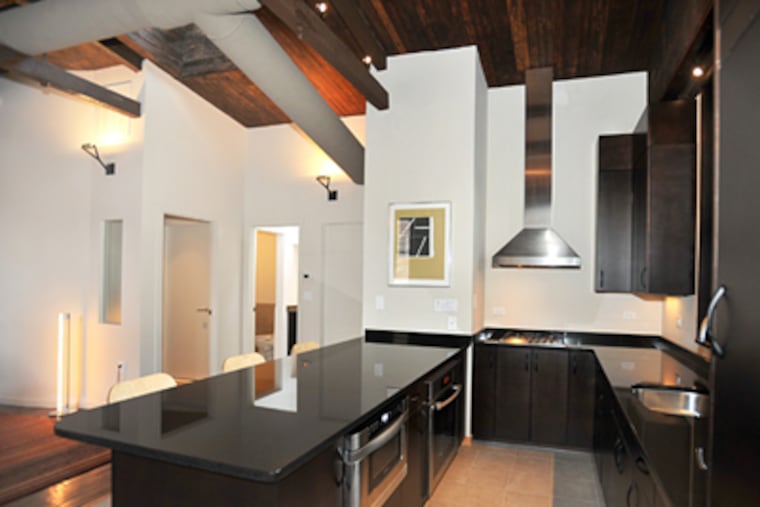
Up a white stairwell leading from a separate door is Daniel Traub's home. A visitor is first greeted by those round windows and then, at the top of the stairwell and to the left, a small galley kitchen.
From the black granite countertop, one sees a large room, but it is easy to recognize distinct spaces. White tile covers the floor in the kitchen area, but in the dining area there is wood. A sofa is the line of demarcation for the living room.
In front of the sofa is a solid-wood coffee table of Chinese manufacture. And underneath a window - also original - is Daniel Traub's great-grandmother's rosewood table and two chairs. A tower leads to a skylight 20 feet up that bathes the area in light.
The bathroom - light porcelain tile, with pale green glass tile in the shower - has two doors. One leads from the dining area, so it can be a powder room for visitors. The other door leads into the bedroom, located behind a curved wall that is next to the elevator wheel, which is nearly five feet in diameter. The wall is curved, David Traub said, so the light "falls gently around" the bedroom area.
On the other side of the dining area, along the wall, is Daniel Traub's work space.
Overall, it is a masculine space - no curtains, no bedspreads. What is dark - the windows, the original trusses, the pitched roof, the pulley wheel - are original to the building. What is white and light is David Traub's handiwork.
"It was a challenge, having one space and creating differentiated" areas, David Traub said.
His son placed his trust well.
"I love the flywheel elevator, that it's still intact there, it's a vestige of the past," Daniel Traub said. "And the open space, the vaulted ceiling, the tower, leaves a sense of history of the place."
His father "meshed the most beautiful part of the carriage house" into a modern place that is livable and comfortable.
Philadelphia is quickly becoming home to him again, Daniel Traub said. The neighborhood is quiet and close to some of the city's most well-loved spaces.
Another good thing: being near his parents.
"It's been nice to get to know them again, and to see Dad every day . . . and to see the kind of work he's doing."