Glouco houses rehabbed, just in time for new port
The house at 107 W. Adams St. in Paulsboro sat empty for eight months. By the time workers got to it, mold was growing in the bathroom and kitchen of the foreclosed property. The roof of a detached garage was falling in. Rodents in the attic were chewing through electrical wiring.
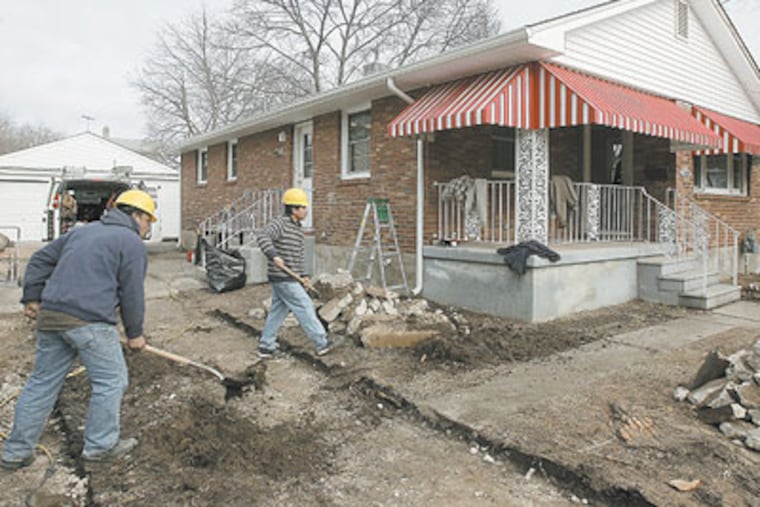
The house at 107 W. Adams St. in Paulsboro sat empty for eight months. By the time workers got to it, mold was growing in the bathroom and kitchen of the foreclosed property. The roof of a detached garage was falling in. Rodents in the attic were chewing through electrical wiring.
"There were dead squirrels in the closet," said Jerry Velazquez, president of the community development group Triad Associates of Vineland, N.J. "The rugs were horrendous."
The house is one of 20 in Paulsboro and Woodbury that Velazquez's organization, with help from Gloucester County and a $2.5 million federal grant, will renovate and try to sell at affordable prices before year's end. Triad will use a separate $1.6 million federal grant to overhaul 14 homes in Burlington City.
The 1,300-square-foot brick Paulsboro house now has new wood floors, a fresh coat of honey-color interior paint, Energy Star windows, and granite kitchen counters. With three bedrooms and a small yard, it's ready for a family.
The grant from the U.S. Department of Housing and Urban Development's two-year-old Neighborhood Stabilization Program aims to help neighborhoods hard-hit by the recent rise in foreclosures and create jobs for local contractors.
The Paulsboro neighborhood, just north of central Broad Street, was about 20 percent vacant when the county applied for the grant last year.
Abandoned property becomes "like a cancer," Gloucester County Freeholder Joe A. Brigandi Jr. said. "It brings down the property values of the whole neighborhood. It makes people scared to go live there."
A small yellow house a few blocks away at 205 W. Washington St., where Triad has installed a more-efficient heating system and cleaned up the yard, has been a big headache for next-door neighbor William Burl since it became vacant nearly three years ago.
Unruly bushes crept over the top of a fence between the properties and toppled boards. Burl, 41, a heavy equipment operator, tacked felt across the bottom of the fence to keep mice and snakes from going underneath. He worried about how the property would affect the value of his home.
"We were all concerned," he said, referring to the three homeowners on a block of mostly rental units.
Situated between two refineries - Valero and NuStar - Paulsboro has "always been a place of working-class people and workforce housing," said Mayor John Burzichelli, who is also a state assemblyman.
Improving the housing stock is particularly important before the scheduled opening of a $250 million port in 2012, he said. The port is expected to bring 2,500 jobs to the area.
Paulsboro has just 2,000 dwellings - including rentals and owner-occupied homes - that house a population of about 6,100, Burzichelli said. "You do [renovations on] a handful of properties, and you've got an immediate impact," he said.
Throughout the state, $49.5 million in Neighborhood Stabilization money was distributed last year. The region will see millions more for similar renovations through a second round of grants announced last week.
Camden will receive about $26 million to renovate and demolish hundreds of foreclosed or abandoned houses over three years. Philadelphia will receive $44 million.
Between the Gloucester County and Burlington City grants, Triad received 465 applications for a chance to purchase one of the 34 homes.
Applicants, who were ranked using a lottery system, had to have a household income of no more than 120 percent of the median area income, which is $77,800. The sale price will be based on what they can afford.
Buyers must qualify for a private mortgage. That's proved difficult for many on the list, and Triad this week reopened the application process.
The Adams Street home could go for between $85,000 and $115,000, Velazquez said. The deed will prohibit renting and set strict rules to prevent quick resale.
No families have been matched with homes yet. That's the next step for Faye Brown of Blackwood, who is second on the list and has been approved for a mortgage.
Brown, 56 and a caseworker for the Division of Youth and Family Services, where she makes about $48,000, was not sure how she would buy another home after she lost one in Philadelphia's Mount Airy neighborhood to foreclosure in 2003.
The home was shoddily constructed, she said, with no insulation. When Brown could not afford her heat bills and the mortgage, the bank took the property, and she filed for bankruptcy.
"I was one of those people who got hoodwinked," she said.
Brown has been building her credit and searching for a house she could afford. A county official connected her with the grant program.
With help from the program's required consumer education class, she is learning to budget, she said.
She now pays $1,025 per month for a two-bedroom apartment that she shares with her daughter and two teenage grandchildren. She's looking forward to having more space and a small yard, along with stability.
"I prayed a lot for something to come along," she said.