Buying a crime scene
Notorious murders took place on the premises, but the current owners of these homes say that gave them no qualms.
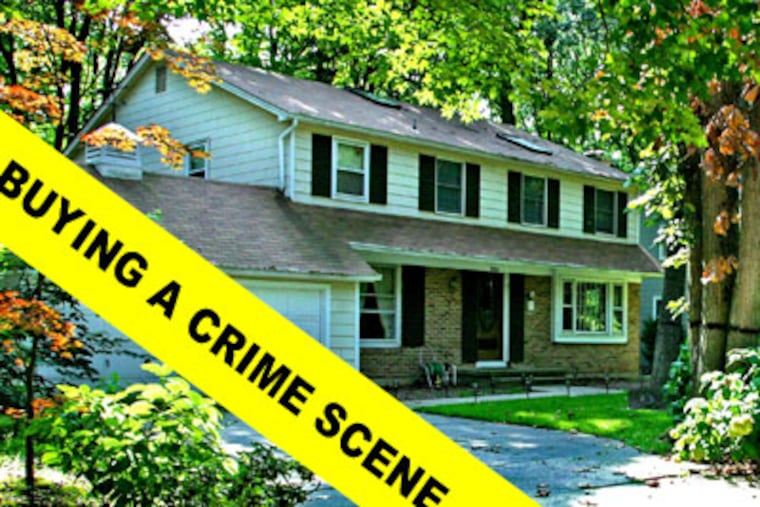
More than 30 house hunters toured Rabbi Fred Neulander's Cherry Hill Colonial when it went up for sale in 2004. About half of them already knew, when they stepped over its threshold, that Carol Neulander was murdered in its 19-by-13-foot living room.
Listing agent Bob Harvey told the prospective buyers about the house's lethal history, but he wasn't really required to do so.
Laws in New Jersey and Pennsylvania allow sellers to keep mum about what real estate professionals dub "scarecrow houses" - unless a buyer specifically asks.
Sellers must disclose a quirky attic fan or a leaky water heater, but not a shooting in the sunroom.
The Neulanders' well-maintained four-bedroom house on a leafy lot quickly sold for $270,100 - more than the $264,900 asking price - although three agents who showed it say it needed some updating.
"We had multiple bids on it, which surprised me because I thought what happened would drive the price down," says Martin Hill, who runs the Century 21 Alliance office that got the listing. "I thought we'd have to go $20,000 under market."
Hill and other agents say that, while disclosure is ultimately up to the seller, they strongly advise it's best to be up front with potential buyers to avoid problems down the road.
"The neighbors always rat the house out anyway," says ReMax Tri-County agent Maxine Brimmer.
Even when buyers do know, an eyebrow-raising past doesn't necessarily affect a home's desirability. A 2001 survey by Wright State University professor James E. Larsen showed 67 percent of stigmatized properties sustain no negative effect on their sales prices.
Barbara Jo Connors, a Prudential Fox & Roach agent who showed the Neulander house twice, says buyers told her it wasn't for them, but they didn't seem to be ruffled by what went on there. "It was just that when they saw what they were getting for the price range, they wanted something newer," Connors says.
Police were still at work there when a single professional man bought the handsome Lower Merion home where latex salesman Craig Rabinowitz strangled his lawyer-wife, says Linda Z, the Re/Max Executive Realty agent who sold the house in just four weeks.
Z, who legally shortened a much longer surname, says the news photographers who camped out on the lawn actually helped market the two-story brick charmer. The Colonial's curb appeal was obvious as it flashed on television screens and landed on front pages after the 1997 slaying. It quickly sold for $225,000, just $5,000 less than the Rabinowitzes paid for it two years earlier.
"They did a bit of updating and it was a great family neighborhood," Z says. "I know some people said, 'Oh, a murder house. I don't want to buy a murder house.' The fact that the fellow did that dirty deed in the house, yes, it's tragic, but the house had nothing to do with it."
Robin and Neal Pomerantz were the next owners. They bought the house for $310,000 in the robust market of 2003, after weighing the house's tainted history. They knew Rabinowitz had strangled his wife and staged her "accidental" drowning in one of the home's 2½ baths so he could use the insurance money to pursue a Delilah's Den dancer billed as Summer.
"We looked at another house in the neighborhood, but I kept saying I really love that one. I really like the backyard. I like everything about it," Robin Pomerantz says. "We lowballed him a little bit. He didn't accept our original offer, but he came back to us months later and said, 'OK, I'll accept.' I thought it was meant to be."
Within the first week after they moved in, a next-door neighbor mentioned the murder. Then, a team of movers delivering a new refrigerator asked to see the bathtub.
When the couple decided to buy a life insurance policy for Neal Pomerantz, the insurance agent who came to the house mentioned that she'd been there before. "She said, 'I'm the one who sold the $1 million policy to them [the Rabinowitzes],' " Robin Pomerantz says. "I looked at my husband, and I said, 'I promise I'm not going to kill you.' "
The couple had the bathtub resurfaced, but Pomerantz says it was because it was worn, not because of the slaying.
"We would think about it a lot," Pomerantz says. "I didn't think it was haunted or anything. I wasn't scared. I would just think about it, and I would get very sad. I had a young daughter, and I just couldn't imagine how anybody would do that to her."
The couple's kindergarten-age daughter never learned about the tragedy while she lived at the home. "I made sure my daughter never knew for the three years we lived there," Pomerantz says. "The neighbors were kind enough not to say anything to a little kid."
Pomerantz felt sad when she dug out Stefanie Rabinowitz's garden to plant grass: "I knew that she really loved it there, and I wanted to leave something of her. I kept her ceramic address sign."
In 2004, she sold the house in three weeks for $525,000, without a real estate agent. "By the time I sold it, the stigma was gone," she says.
Would she buy another scarecrow house?
"I would - in a heartbeat," Pomerantz says.
A couple who unwittingly purchased the site of the most notorious homicide in Levittown history, the Mary Mamon murder, got no heads-up that they were buying a stigmatized property when they house-hunted in the fall of 2001.
The homeowner, who asked that his name and address not be used, says his Bristol Township house was priced slightly lower than other homes on his gently winding street, but that didn't raise a red flag for him.
"We just thought it was a fixer-upper type of house. It was all dark; the paneling was from the '70s. It had the original '50s cabinets. It needed an upgrade," he says.
He was unaware it was the site of the 1967 hammer-slaying of Lorraine Mullery and the bludgeoning of two children by Mamon. The first inkling something was amiss came during the couple's first Easter season there. On Holy Thursday 2002, exactly 35 years after Mullery was killed there, someone left a flower arrangement on the front walk. "We thought they were Easter flowers," he says. "There was no card or anything. We didn't think much of it."
They didn't put the clues together until their 7-year-old grandson came to visit two years later. "He went up the street to play, and a neighbor said, 'You live in the murder house.' That's how we came to find out."
They hastily checked the Internet. The neighbor was correct. They had purchased a house that neighborhood children once crossed the street to avoid.
"We couldn't move, financially, because by the time we found out, the houses here had almost doubled in price," he says. "I'm a practical person. My wife's practical, too. It is what it is."
He says they explored a lawsuit, but it didn't pan out: "I'm somewhat of an opportunist. I thought, 'They didn't tell me. Maybe I can make some money off it.' But I called a lawyer and he said it's the law."
The producers of a national television ghost show came knocking at their door, and were turned away. (The homeowner says he has listened for bumps in the night but hasn't heard a peep during almost a decade in the house: "I don't go for that stuff, but, hearing what happened here, and then you see those movies like The Amityville Horror, and you think, 'Well, could be.' But there's been nothing, nothing at all.")
Often, when a well-maintained property comes up for sale, it is snapped up even if buyers know it is, in real estate parlance, "stigmatized." Agents say time flies and memories are short. Even houses with shady pasts don't linger on the market if the condition, location, and price are right.
Arthur Overbey and his wife, Sue Ann, bought the Mullery murder site directly from the estate of widower Thomas Mullery, who lived there until his death in 1971. They knew the house's grim past, Overbey says, but he was leaving the military and looking for an affordable, well-maintained home.
"It was a cheap buy at the time. It was in move-in condition. There was no damage that needed to be repaired," Overbey says. "The house had nothing to do with the problem. It was a person who was in the house who caused the problem, not the house."
Brimmer, the ReMax Tri-County agent, had buyers who were spooked by a backyard drowning, until the sellers made some concessions. "The people wound up buying the house because we threw in some appliances," she says.
"Whether it be, unfortunately, a murder house, or any other house, what sells houses is condition, location, and price," Z says. "When those three things come together, you have a sale."