Past and present combined
In the heart of Philadelphia's warehouse district, a sleek new condominium mixes both.
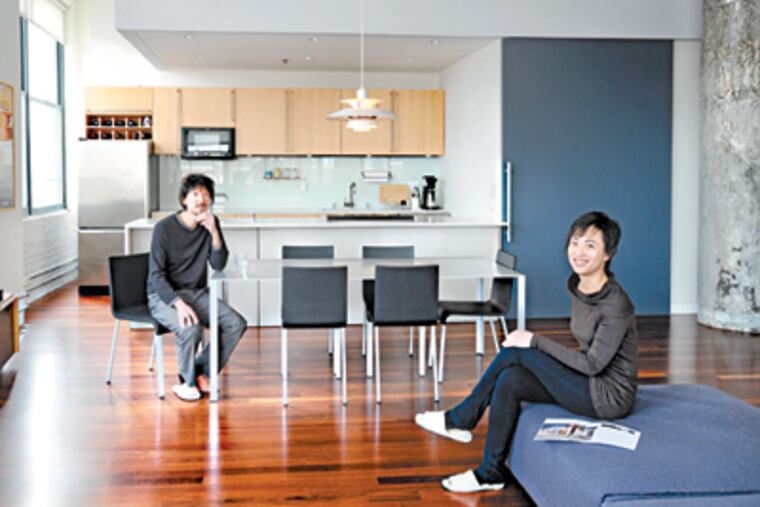
Architects Tse-Chiang Leng and Alice Sun like to think of the factory workers who once toiled nearby and the travelers who once rode the Reading Railroad as their neighbors, just as they do the young professionals now living in Philadelphia's Loft District along Callowhill Street east of Broad.
Of course, the factory workers and the Reading are long gone. But Leng and Sun, who are married, believe the footprint of a city's past is an important part of its texture and of their understanding of it.
They chose their home, in a former shoe factory, partly because it is at the intersection of the Philadelphia of yesterday and the Philadelphia of today.
"We saw this abandoned building and felt it was part of the history of the city," Leng said. "Our building was a shell of its industrial past."
The two, in their early 30s, were born in Taiwan. Sun came to the United States as a child; Leng came for college. They met at the Syracuse University School of Architecture.
In 2009, their firm, Populace, won a merit award from the American Institute of Architects' Philadelphia chapter for the design of their unit in the shoe factory-turned-modern-condo-building.
From 8-foot-high windows overlooking the Vine Street Expressway, Leng and Sun can see the Reading Viaduct and the dilapidated remnants of the city's industrial past on one side.
On the other, they can see the towers of Philadelphia's contemporary resurgence and the glass-curtain walls of high-rise office buildings.
When you walk into the fourth-floor condo Leng and Sun share, what you see is the gleaming present. Shiny cherrywood floors stretch across 1,400 square feet of space splattered with light from the huge windows lining the main room.
The space seems sparse and comfortable at the same time.
"We bought two apartments and joined them, so we have a public and a private area," Leng said.
Their public space includes the kitchen, living room, and library. Their private space contains two bedrooms and two baths.
An undecorated pillar in the hall separates the two sectors. The scratched, grayish post, two feet in diameter, reaches from floor to ceiling and contrasts with the walls' clean, modern lines.
"The pillar was part of the shoe factory, and it held up the wall when people were toiling there," Leng said. He and his wife decided not to paint it or in any other way disguise its more than 100-year-old identity.
The condo's great room is 22 feet long and 30 feet wide, with ceilings 12 feet high. Those dimensions, and the size of the windows, make the couple's large furnishings perfectly scaled.
An enormous light-blue, armless sectional sofa occupies the center of the entertainment area.
"We bought the couch in New York, and because it has no arms, people can sit on it facing any direction," Leng says.
The exposed-beam ceiling is lined with track lighting. Reading light is provided by pendants hanging from the high ceilings.
The furniture placement seems to make sense. The library area, for example, has bookcases and a collapsible desk in one corner under a window. Facing that is an entertainment unit with low shelves holding a television and audio equipment.
Across the room, bookshelves are attached to a wall. All the cabinet wood is unvarnished maple.
But Leng said all the positioning is temporary, that all the furniture is mobile. Everything, including the bookcases and the entertainment unit, is set on platforms with casters underneath for ease of movement.
In the kitchen, the cooktop faces the living room, so the chef can chat with guests seated on the other side of the island.
Other seating in the condo reflects the couple's interest in midcentury modern styling: Barcelona chairs, an Eames chair, and a Norman Cherner chair designed by Herbert Goldman, "who never gets credit for his work." Leng said.
The chairs are arranged in the living area, "not because we like to collect valuable chairs, but because we admire the design," he said.
How do the two work as partners in design?
"I like to see a connection with history and can find a way to use history in my design," Leng said. "We are both professionals and are each other's most severe critic. It is working with someone who understands everything you do."
Said Sun: "He is more of a visionary than I am, and I am the more practical one who often has my eye on the budget. But I am also supportive of my husband's designs."
Is your house a Haven?
Tell us about your haven by e-mail (and send some digital photographs) at properties@phillynews.
com.
EndText