A 'retirement home' built for their needs
The morning after that unusual pre-Halloween snowstorm, Don and Helen Johnson, who are in their mid-70s, traveled down the long wooden ramp leading from their house in Belmont Hills to their car, so they could drive to the Devon church where Don was scheduled to sing with the choir.
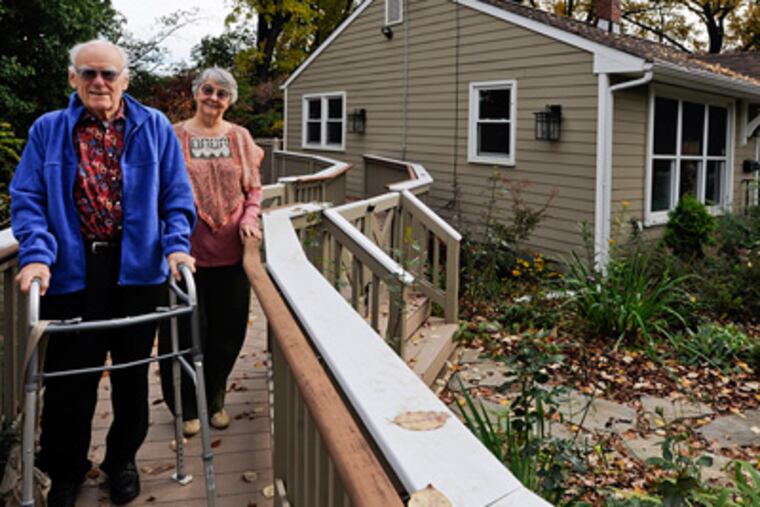
The morning after that unusual pre-Halloween snowstorm, Don and Helen Johnson, who are in their mid-70s, traveled down the long wooden ramp leading from their house in Belmont Hills to their car, so they could drive to the Devon church where Don was scheduled to sing with the choir.
Though Don has lost much of the use of his legs because of neuropathy, he and Helen would never let anything like early snow stand in the way of their obligations or - in the case of music - their passion.
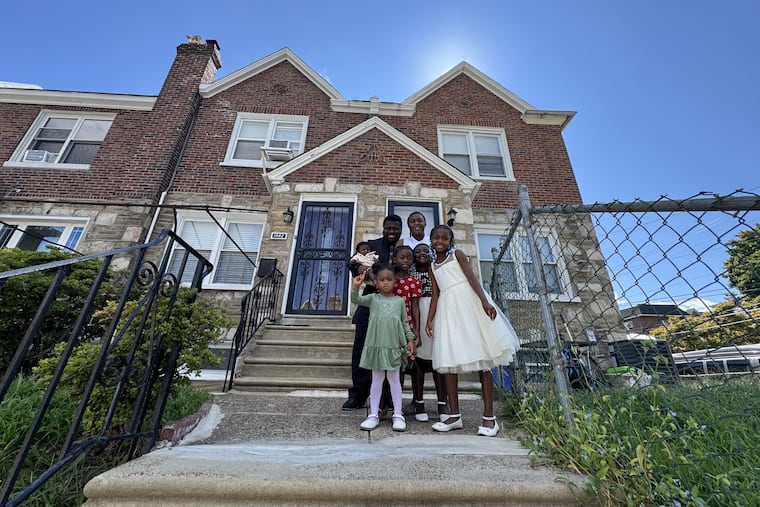
And their house, which the Johnsons bought and modified three years ago, has a lot to do with the couple's independent lifestyle. The circa 1950 property has been transformed from an unassuming 1,000-square-foot ranch house to a 2,000-square-foot two-story dwelling with a garden Don can enjoy and a small elevator he can use to get between floors.
"We wanted to stay in our own house and live as we wish, eating our own food and coming and going as we like," Helen says. "We not only did not want to go to a retirement home, but I don't think we could have afforded one that would give us our independent lifestyle."
So she and Don, a retired patent lawyer, looked for the perfect house to replace the five-bedroom Haverford home where they had raised their children for a number of years.
The Johnsons had lived in Haverford for more than three decades, since meeting at the University of Pennsylvania, where Don was studying law and Helen was taking courses related to her studies at the Pennsylvania Academy of Fine Arts.
But it was time to downsize, and when they found the small rancher in an online search, Helen's trained artist's eye saw the potential for modifying it to accommodate their needs.
"We were looking for the perfect house for about five years and didn't find it until we saw this one and decided to make it work for us," Don says.
Helen contacted architect Shep Houston, a relative of one of her friends, and asked her to redesign the house so Don would have access to every part of the structure and garden, whether he was using a wheelchair or a cane.
"The result is a home that we can both enjoy," says Helen, her Atlanta accent emphasizing the last word.
The 60-foot ramp connects the house to the street, as well as to a rear deck that spans the house's width.
"Don can enjoy our garden, and from the deck we can both have a 360-degree view of the trees and hills behind our house," Helen says.
Houston also modified the kitchen so that a small window in the center of the rear wall facing the garden was moved to one side. Large glass doors now provide light and a route to the outdoors.
It's also possible now to see from the kitchen, through the dining room, and into Don's office at the front of the house.
Doorways between the kitchen, dining room and living room have all been widened to three feet, so Don can pass through easily in a wheelchair.
In the dining area and living room, walls painted in terra, a pinkish-brown, add warmth. Displayed near a grand piano are Helen's realistic paintings, in frames of various sizes.
"Believe it or not, pink is not my favorite color, but I tried several shades before I came across this one," Helen says. "I think every space just asks for its own color, and shades of pink belong here."
Set into a corner of the living room is the elevator, which enables Don to go down 12 feet to the family room created from a onetime basement.
The elevator, which has five windows, offers views of the front lawn to passengers. And, Helen says, it's "very comfortable," too, almost like another small room.
Down in the family room, Don and Helen can watch television, use their computers, and visit informally with friends. There is also a small guest room, with lots of toys, for visits from their grandchild.
In addition, the lower level includes a large closet and storage space for Helen's sewing materials and machines.
She describes herself as someone who learned to sew as a little girl and now likes to produce everything from children's clothing to household articles.
"We wanted to make sure the house provided us with space to do all the things we have always enjoyed," she says. "I have felt sewing was very important to me, particularly when I grew up in the South, where we often had to make dresses from feed bags that were decorated with flowers. We improvised and survived."
If their home had a theme, "improvise and survive" might very well be it.
Is your house a Haven?
Tell us about your haven by e-mail (and send digital photographs) at properties@phillynews.com