Tenants become owners who transform dark to light
Architect Anthony Weber studied in Italy for his master's degree in architecture. In 1988, he rented an apartment at Third and Catharine Streets, where he discovered that many of his neighbors had Italian roots.
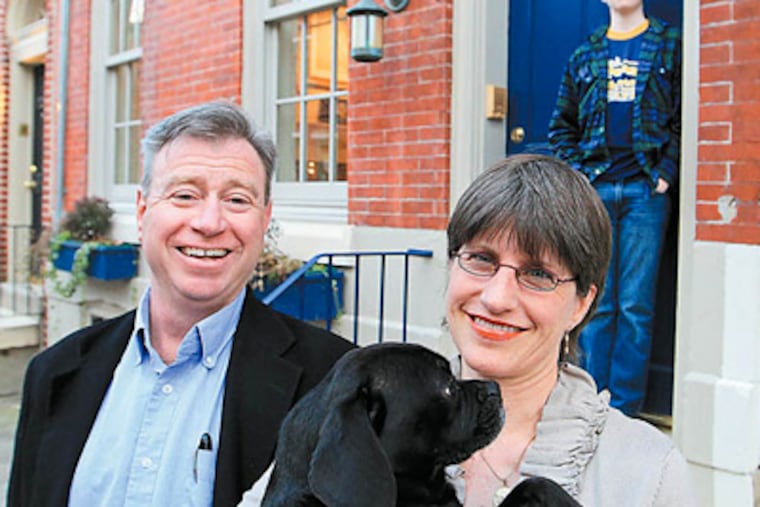
Architect Anthony Weber studied in Italy for his master's degree in architecture.
In 1988, he rented an apartment at Third and Catharine Streets, where he discovered that many of his neighbors had Italian roots.
Weber, who comes from a small town on the Ohio River in Kentucky, fell in love with South Philadelphia.
"At that point, the area wasn't exactly trendy," he said. "I liked the neighborhood and felt comfortable near the Italian Market."
The year and a half he spent studying in Italy might have had something to do with that.
His apartment was in a Federal-style brick-and-stone building constructed early in the 19th century. In the urban design of its day, the house packed 2,000 square feet into three stories, but its footprint (exterior dimensions) was only 18 feet wide and 60 feet deep.
Sometime in the 20th century, the building had been converted into two apartments - one a two-bedroom unit, the other having a single bedroom.
But that would change again a few years before the century ended.
By 1992, Weber had married Lynda Cloud, a graphic artist he met when the two worked at a Baltimore architecture firm. After the wedding, the couple returned to live in the Catharine Street apartment.
Lynda Weber, originally from McLean, Va., joined her husband in appreciation of Philadelphia's urban life.
"I like everything about it," said Lynda Weber, who is a graphic designer at Temple University. "From being able to walk to just about everywhere, to sitting on the stoop, which we do a lot in nice weather."
In 1995, Anthony Weber said, the owner of the apartment house called to ask if the architect would "take care" of the building because he was moving.
"I asked him if we could buy the building, and we settled on a price," Anthony Weber said. "We sealed the deal that night."
Living in the structure long before they bought it meant that the Webers had had lots of time to think about renovations.
Buying the place meant that their "what ifs" would finally become reality.
"We knew we were going to return the apartment building to a one-family house with three bedrooms on the third floor, a family room on the second, and the formal living area on the first," Anthony Weber said.
In the process, they removed the first-floor doors separating the living room, the dining room, and the kitchen.
Rowhouses often lack natural light. Anthony Weber solved this problem in several ways.
He designed a skylight that illuminates the stairs leading to the two upper floors. The 12-pane skylight beams down on the birch stairway, giving the stairs an open feeling.
After demolishing the rear exterior, he designed a wall of windows leading to the kitchen garden and the two stepped gardens behind it.
And in the front of the house, a large 12-pane window allows light and color to filter into the first-floor living area.
Farewell to dark and closed-in spaces.
These days, waxed birch floors form a light and airy path from the living room to the dining room and the kitchen, with its granite counters and stainless-steel appliances enveloped in warm wood.
All the furniture on the first floor is made of cherry wood crafted in a Shaker style by Lynda Weber's father, Harley Cloud, who designed the furniture for his family as gifts.
Sadly, her father died shortly before Christmas, and the furniture has become a reminder of his "talent and generosity," Lynda Weber said.
In the living room, a bench, chairs, and a table, situated in front of a working fireplace, seem to fit the space neatly. Between two 12-pane glass windows, a pair of framed black-and-white drawings of the Pazzi Chapel in Florence hang on the wall, augmenting the straightforward look of the Shaker furniture.
"The drawings were part of my thesis, and they are probably the last thing I hand-drew," Anthony Weber said. "We do everything by computer now."
On the second floor, a family room includes soft traditional furniture and the contrast of a large contemporary flat-screen TV near a Victrola from 1904 that can be wound up to play.
"We play it around Christmas," Anthony Weber said. With a few turns and placement of the phonograph's needle, strains of "O Come All Ye Faithful" ring out.
Today, the almost-two-century-old house reflects the unique interests of Anthony and Lynda Weber; their two children, Max, 16, and Alessandra, 12; and even their terrier, Hope.
And it makes a resounding case in support of their decision to stay in the city and redesign the existing dwelling rather than build a new house in a less-developed area.
The Webers, as Anthony noted, "have an affinity for this urban neighborhood and city living."
Is your house a Haven?
Tell us about your haven by e-mail (and send digital photographs) at properties@ phillynews.comEndText