An architect - and homeowner - shares insights
Local architect John Randolph and wife Missy built and added on to their Center City townhouse on South 25th Street overlooking Schuylkill River Park. It is one of three adjoining homes Randolph designed - and he saved some money by using his own drawings.
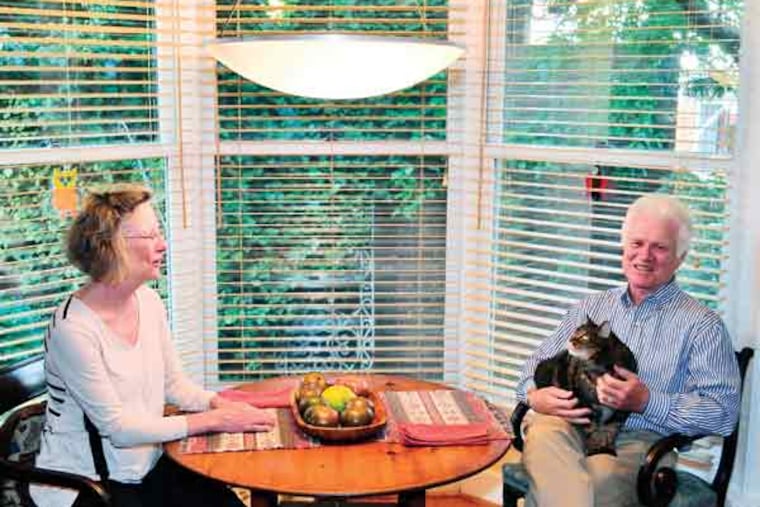
Local architect John Randolph and wife Missy built and added on to their Center City townhouse on South 25th Street overlooking Schuylkill River Park. It is one of three adjoining homes Randolph designed - and he saved some money by using his own drawings.
They bought the site when Randolph was still partners with William Post Thomas. Then they set about designing.
"You do have to have architectural drawings that are stamped by a registered architect. In our case, this was provided by my then-partner, Bill, who is an RA. We designed it together."
Randolph originally worked as a carpenter, and was largely self-taught, then attended Princeton for a graduate degree in architecture.
Randolph designed a house that brought the outside in, especially the gardens and English ivy in the back courtyard. He and Missy lugged beach stones back from Maine one summer to create a quiet water fountain in the brick patio.
And in the process of renovating and adding to the house, "I've distilled all the lessons I've learned over the years as an architect," Randolph said.
For instance, he wanted to separate the living room from the kitchen. So Randolph used the nearly ceiling-high cabinets as a breakfront, rather than a wall. The 3,000-square-foot house he designed also has sunlight and windows on three sides. Each floor has successively higher ceilings, starting at seven feet on the first floor, nine feet on the second, and so on.
Missy had a hankering to grow vegetables, and helped start the community garden in what ultimately became Schuylkill River Park. She was among the first to garden on land that was once just an industrial river's edge. Her husband ultimately helped found the Schuylkill River Development Council in 1992, which he ran for 10 years.
Because Missy was also head gardener at Wyck House and loved her craft, Randolph designed a third-floor deck with an herb garden to grow mint, rosemary, basil, and more. Wyck House, a national historic landmark in Germantown, is where Missy grew vegetables from seed, tracking down old varieties through heirloom-seed catalogs.
John added several stained-glass panels by local artist Ray King, one of which was commissioned for the 50th wedding anniversary of his parents.
"I met Ray King in 1974 when I was designing my first house," John said. King also designed glass-ribbon windows for their upstairs bathroom, which offer privacy but also let in light, and two stained-glass circles for porthole windows.
Randolph has created drawings for other family members, including his sister-in-law's kitchen renovation in the 1990s. But he doesn't recommend do-it-yourself on the architectural drawings.
He would steer clear of advising people to "do design or building on their own unless they have the necessary expertise or license. It is very easy to be penny-wise and pound-foolish," he said.
For those hiring an architect, fees can run the gamut.
For smaller projects, the architect may charge a flat fee, by the hour, or as a percentage of the entire project. That could range from a few to many thousands of dollars.
Others charge, say, 6 percent to 8 percent for new construction (in theory, it's easier than building from scratch), and 10 percent to 15 percent of the project cost for a gut renovation. Still others charge by cost per square foot, or as a percentage of construction costs or a combination.
This is on top of the actual cost of materials and contractors approved by the client. If, for example, the total cost of your renovation is $200,000, your final cost including architects' fees might be $240,000.
Randolph's principal business when he was starting out was development and construction contracting, and in 1989, a recession hit. He wanted to branch out into architectural designs himself and thought it would help smooth out his business. "I shifted from designing houses to larger open spaces in the center of the city," he said.
These days, Randolph is working on creating more access to the water itself on the Schuylkill River - by tour and paddle boat, water taxi, canoe, and kayak. He's the board chair of the Schuylkill River Park Alliance and wants to encourage more Philadelphians to get out on the river.