Builder does his green experiments in-house
If you work as a builder, what better way to experiment with new environmentally friendly techniques and materials than on your own house.
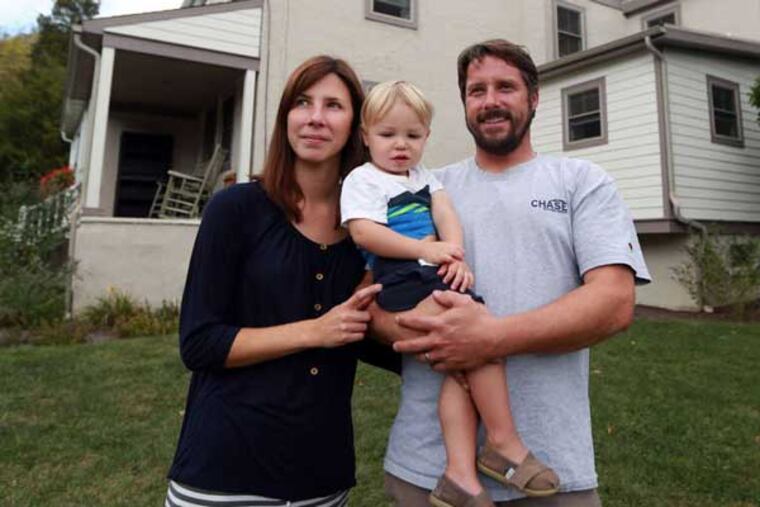
If you work as a builder, what better way to experiment with new environmentally friendly techniques and materials than on your own house.
That's what Matthew Seip and his wife, Sue, did at their Perkiomenville home, nestled on an acre or so of quiet land close to Green Lane Park and the Perkiomen Trail.
For the Seips, buying and rebuilding the three-story, 1,500-square-foot house was an expression of their philosophy that less is more. They have a garden and raise chickens. Through composting, they teach their three children, Emmett, Elisabeth, and Nathan, about recycling.
The family dwelling, built in 1920, has three bedrooms and one bathroom, and the original design incorporated much of the "passive solar" heating Matt Seip said is the mainstay of today's modern green building. Passive solar means using as much heat from the sun as possible, he said.
"The longest exposure of the house faces south," while their neighbor's attached twin shields them on the north side.
"Grab free heat and daylight where you can," he said.
Initially, the Seips thought about knocking the house down, "which may have been better from a resale standpoint. But we are of like mind when it comes to doing something carefully and respecting the environment," he said.
They liked the bones of the house and did not want to expand the footprint more than about 300 square feet. So they built up through the attic rather than outward, which would have created more space to heat and cool. They improved energy efficiency with some simple, old-is-new techniques.
Sue Seip, a professor at Philadelphia University, specializes in interior design, and Matt Seip has an architecture degree, so "we are very green-conscious, so to speak, and are both LEED-certified professionals," she said.
They finished an environmentally friendly renovation on a Warrington house, then moved to Perkiomenville to be closer to extended family.
For about $125,000, they renovated the Perkiomenville house. First, they replaced every window and door with double-pane Andersen products and cut about an inch off the bottom of each room door to improve air circulation. Seip has lobbied Minnesota-based Andersen to start making triple-pane windows, which are even more energy-efficient and not widely available in the U.S.
The couple also installed floors made of eucalyptus, a fast-growth renewable wood; used non-volatile-organic-compound paints and adhesives, and set out a rain barrel to collect water for the lawn.
For interior walls, the Seips installed drywall and used open-cell spray foam insulation, which "is a great air seal and is the highest-yield insulation," Matt said. They installed Kohler low-flow plumbing, a high-efficiency heat pump, Kenmore appliances, and a 40-gallon water heater.
They expanded the attic into a usable third floor, with ceiling fans in all rooms.
On the south-facing outside walls, Matt Seip stripped off and rebuilt the siding using HardiePlank cement fiberboard.
Windows were added: "We wanted as much glass as we could get on the south side of the home, to grab light and heat."
He and his boss, Joe Chase of Chase Building Group in Pipersville, Bucks County, are huge fans of HardiePlank, an alternative to vinyl siding. "Competitors use cheaper, vinyl siding, but we promote HardiePlank because the energy values are so much greater," Chase said.
LED lighting systems are another favorite. Whenever possible, Chase tries to talk his customers into "buying fixtures for a lifetime, then their lifetime utility bill is cut down, and it pays for itself." For instance, an incandescent vanity light might cost $29 as a fixture, while an LED system costs $89, he said. Over time, it costs $2 every six months to run the fixture with LED, he estimated.
The Seips' next dream home? A "net-zero ready" house, one that uses only the energy it produces.
"Green building is the process of creating environmentally responsible structures and homes by efficiently using energy, reducing waste, and promoting human health," Matt Seip said.
215-854-2808