Cherry Hill house designed by Louis Kahn for sale
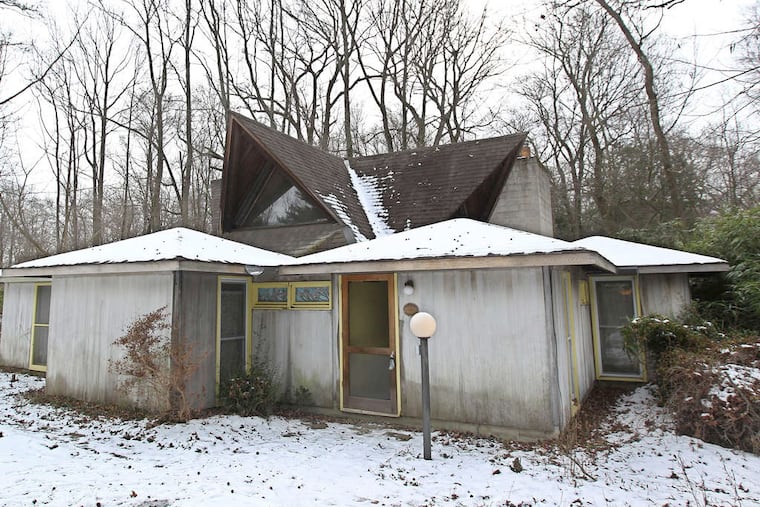
The Cherry Hill home on 417 Sherry Way may look worn on the outside. But its origami-shaped roof and large triangular windows were the work of acclaimed Philadelphia a rchitect Louis I. Kahn. Known as the Clever House, as its original owner was the Clever family, the home was put on the market Jan. 19. The asking price is $289,900.
"My goal is to find a buyer who will restore the property, or maintain its natural integrity," said Rosemary Mercanti of Berkshire Hathaway Fox & Roach in Haddonfield, who is charged with selling it. The design "has not been disturbed at all. It's the original. It's magnificent."
Since listing the Clever House - one of only nine homes designed by Kahn - Mercanti said she had fielded inquiries from all over the country - and all Kahn admirers. She has several tours planned over the weekend - including prospective buyers from New York, Virginia, Pennsylvania, and New Jersey.
The ideal buyer, according to Aubin Clever, 39, the grandson of Fred and Elaine Clever, who commissioned the home in 1957, is "someone who is interested in owning a Louis Kahn house, and who is looking to preserve it as such."
"The house, quite frankly, does need work," said Clever, who lives in South Philly, "though certainly not a teardown. Structurally, it is sound, but does need TLC to get back to its former glory."
The three-bedroom, two-bathroom Clever House sits on .69 acres and is within two miles of the township's other famous historical home - the Sweeton House that architect Frank Lloyd Wright built in 1950 along Route 41.
The central focal point of the Clever House is a large living room with an 18-foot-high pyramid roof composed of four large glass angular gables. Natural light permeates through the gables, as well as two glass walls.
"He was a master of natural light and creating space for natural light in his buildings," said William Whitaker, curator and collections manager at the Architectural Archives of the University of Pennsylvania, and coauthor of The Houses of Louis Kahn.
Elements of geometry
Kahn, who was educated and based in Philadelphia, became one of the most influential architects of the 20th century. His building credits include the Salk Institute in La Jolla, Calif., and the Kimbell Art Museum in Fort Worth, Texas. From 1957 until his death in 1974 at age 71, he taught architecture at the School of Fine Arts, now the School of Design, at the University of Pennsylvania.
Kahn's collaborator, longtime employee, and paramour Anne Tyng is credited with bringing the element of geometry into Kahn's architecture. The duo worked together on the Trenton Bath House prior to the Clever House. The two structures show how geometric shapes can provide order and a sense of hierarchy.
Kahn and Tyng designed the Clever House from 1957 to 1962, which featured "served" and "servant" spaces - which became a common theme in Kahn's homes.
His eight other houses, like the Clever House all single-family homes, are located throughout the Philadelphia region.
The central living area was served space, where family and friends gathered. It was surrounded and supported by five smaller rooms, or servant areas. To Kahn, the servant areas were ancillary to the served space, but just as important. Each of the smaller rooms has its own pyramid roof with wooden siding.
'More connected'
"There is a simplicity to it, and you see it in many of his houses," Whitaker said of Kahn's style. "There's something very unique. There was a time when architecture was just becoming so cold.
"From the 1920s through the 1940s, the steel and glass skyscraper was dominant," he said. "Kahn began moving to aspects of architecture that were more human and more connected to places and people. To him, what people did in that space mattered."
The Clevers, according to Whitaker, were very much into the civil rights and progressive government movement of the '60s, and often held meetings in their living room.
Elaine Clever, a librarian for decades at Temple University, died Sept. 23, 2000, and Fred Clever, an insurance executive and one of the founding members of the ACLU-New Jersey chapter, died a year later on Sept. 11, 2001.
"For all practical purposes, the news of September 11 killed him," Aubin Clever said. "He died of a massive heart attack."
Aubin Clever's father, Eric, 71, inherited and moved into the Clever House in 2003. But financial difficulties and ailing health made it difficult for him to maintain the home.
For the last three years, Aubin Clever said, he's been paying the bills, and his father conceded to giving him power of attorney over his assets.
"In June of 2014, I started cleaning the place out and doing some basic repairs," he said. "We just finally listed the place."
Architect Dan Nichols, a member of the Cherry Hill Historical Commission, said the Clever House was built at a time when Cherry Hill - formerly Delaware Township - was undergoing explosive growth, post World War II, as families moved from the city to the suburbs.
Nichols purchased the Sweeton House in 2008 for $350,000 to live in, and has since invested "a couple hundred thousand dollars" to maintain it.
He's hoping for the same ending for the Clever House. "It's very important to the history and culture of the township," he said. "If I could clone myself to buy it, I would.
"It needs someone who appreciates the house and the work of Louis Kahn," Nichols said, "and is willing to put in the effort to restore and maintain it."
Martha Wright has lived on the Hunt Tract where the Clever House sits since January 2005, though she's lived in Cherry Hill her entire life.
Wright jokes that she owns the "third most notable house in the township" - the one Malcolm Wells designed for his own family. Wells laid out Hunt Tract and designed several homes there. But the Clever House was Kahn's baby.
"I have been passing the Clever House since the 1970s because my best friend grew up a couple of houses from it," Wright said last week. "I always thought the house was interesting, and it has saddened me deeply to see it decline, particularly in the last 15 to 20 years.
"What I hope for the house is an appreciative owner who restores it to its original condition."