Consumer demand is high, but new single-family homes in short supply
There just aren't enough single-family homes under construction in the suburbs to satisfy consumer demand. That's the complaint of buyers who don't want to move to the city but prefer to live in suburbs close to urban areas, or so a recent National Association of Realtors survey says.
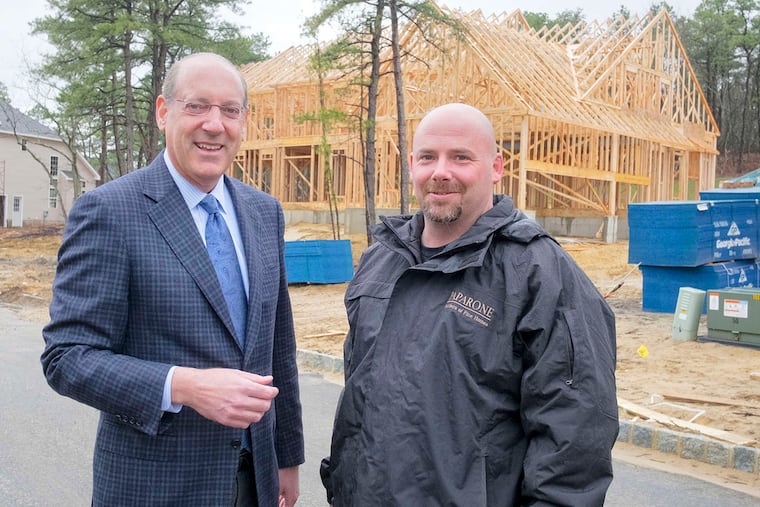
There just aren't enough single-family homes under construction in the suburbs to satisfy consumer demand.
That's the complaint of buyers who don't want to move to the city but prefer to live in suburbs close to urban areas, or so a recent National Association of Realtors survey says.
The Realtors group's survey showed an overwhelming consumer preference for single-family suburban homes, with only 15 percent of homeowners and 21 percent of renters saying they would buy in an urban area.
"The American Dream for most consumers is not a cramped, 500-square-foot condo in the middle of the city, but, instead, a larger home within close proximity to the jobs and entertainment an urban area provides," said Realtors' chief economist Lawrence Yun.
Although few developers in the city of Philadelphia are building homes with so little square footage, the study points to a continuing shortage of new single-family homes in suburban counties.
Keller Williams Real Estate agent Gary Segal in Blue Bell said it may be "the simple fact that there is less land to develop close to the city."
New construction is always the favorite, said Noelle Barbone, of Weichert Realtors in West Chester.
"If the buyer can find a brand-new home within budget, why wouldn't they select something new where they can pick their own amenities?" Barbone asked.
Moody's Analytics chief economist Mark Zandi says the shortage "is a growing problem, particularly for lower-priced homes."
"Builders have been focused on high-end housing since the crash, given the larger margins and constraints on their ability to ramp things up," he said.
Zandi added that the demand for single-family homes also is gaining traction, given high and rising apartment rents and easing credit for low- and middle-income households.
Quita Syhapanya, Northeast director for Hanley Wood's Metrostudy in Philadelphia, said new-home starts are low compared with other markets, "and low when you compare to pre-recession."
Bucks and Montgomery Counties are seeing the most new-home starts in closings in this metro area, followed by Chester County, Syhapanya said.
Three things are holding the new-home market back here, he said.
One is high land costs, with limited amounts of buildable land or finished lots that have suppressed this market. Those costs, as Zandi also noted, are limiting growth in new-home construction, "mainly the move-up or second move-up buyer," Syhapanya said.
First-timers are "the missing domino piece that needs to fall," but they're not in the mix, he said. Communities with entry-level new homes are "outside of the job-growth areas and [in] undesirable locations."
It also takes longer for a builder or developer to take a project through the approval process with municipalities - on average, three to four years and longer, Syhapanya said.
A limited skilled-labor pool also has kept homes from being built in time, and delayed getting infrastructure in place, he said.
South Jersey home builder Bruce Paparone agreed that the absence of "land opportunities" is holding back new construction.
Before 2008, Paparone said, about 15,000 residential building permits were issued in the region, with 90 percent for single-family homes. Since 2008, the number is 13,000-plus, with slightly more than 50 percent being multifamily-housing permits.
"I would have thought that the single-family portion would have rebounded somewhat, but so far that has not been the case," he said.
Open-space preservation "has really created a limited amount of area for developers to effectively build at a reasonable price," and code changes and regulations make it tough to develop new homes profitably, Paparone said.
"While the changes in new homes have resulted in a much better product than the existing resale homes, there is a cost differential to pay for the increased energy efficiencies and construction techniques," he added.
215-854-2472 @alheavens