Three fresh looks at celebrated French style
True French style goes beyond roosters and heavy, kitschy country: It's subtler, with a nonchalant confidence and an embrace of the past.
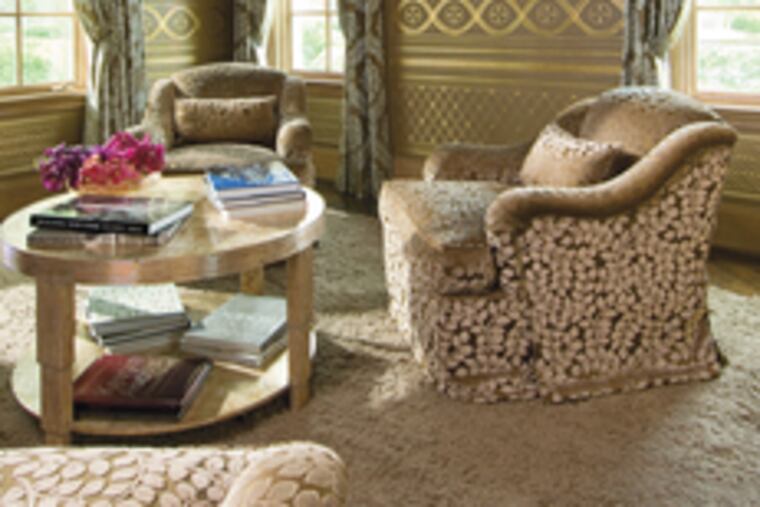
French style is legendary. Yet somehow, in this country, French-inspired interior decor too often means a kitschy version of country French - a busy look heavy on rustic furniture, wrought iron, rooster motifs, and flower-print Provençal fabrics in primary colors.
Aiming to liberate us from all that are three new books on French interiors with a very different take on the Gallic look.
London antiques dealer Josephine Ryan's French Home (Ryland, Peters & Small, $29.95), Dallas interior designer Betty Lou Phillips' Inspirations From France & Italy (Gibbs Smith, $39.95), and French decorator Michele Lalande's The New French Decor: Living With Timeless Objects (Abrams, $40) vary in emphasis. But they agree on a few of the basic elements that characterize sophisticated French interiors.
Among them: rooms that have a certain spareness; simple window treatments; subtle, toned-down color schemes that use lots of warm neutrals or hues with plenty of gray in them; a reverence for antique and vintage furnishings that show the patina of age; and collections of visually interesting objects displayed with flair.
Also key to sophisticated French interiors is the lively mix of periods and styles they typically exhibit, Ryan points out in French Home. For her, true French style is "an 18th-century salon chair covered in shredded silk teamed with a 1930s Lucite table or an oversized contemporary canvas hung above a Rococo console." Its hallmark, she says, is "a certain nonchalance underscored by enormous confidence."
That widespread confidence about the design and decoration of a home is one of the big differences between this country and France, says Phillips, who has written eight previous books on French interior decor (The French Connection, Unmistakably French, and French by Design, to name a few). Americans' dependence on interior designers amuses the French, Phillips said in an interview.
"They would never hand over control of a project to even the most capable hands," she said. "They see decorating their home as an aesthetic undertaking en route to self-fulfillment."
The typically American "get it done now" approach is also anathema, Phillips said. "The French have no problem living with sparseness until they find exactly what they are looking for. And generally it is a piece that is old but speaks to them."
Her latest book pictures French-influenced American interiors with a more sumptuous look than the funky/bohemian homes (photographed in France and England) that illustrate Ryan's volume. Phillips says we have much to learn from the land of champagne and croissants.
"Settings should evolve over time," she writes, and "more than necessity must prompt the desire to buy." Never buy second best, or just to fill in, Phillips writes: "That's money wasted when you find down the line you want to upgrade."
Do as the French do and find a place for furniture and objects that have been passed down, she urges - even if that family heirloom isn't quite to your taste, or seems too imposing for a room. The French hunger for tangible links to their ancestors, Phillips writes, while "Americans may border on being emotionally detached, tossing aside offerings that are not exactly what is fancied."
Ryan says multifunctionality and practicality are key to the French design sensibility, as reflected in her book by unfitted kitchens with simple open shelving, slatted garden seats used as dining chairs, an antique demilune table standing in for a desk, and a bed quilt hung on a rod over a doorway to stop drafts.
This is a look that can be adapted to any budget, says Ryan, who includes an image of the beamed reception room of a 16th-century home with two identical Ikea sofas. In fact, she lists Ikea, Pier One, and Philadelphia-based Anthropologie in the source directory at the back of the book.
"I shop at Ikea, and I was very clear I wanted stores like that included," she said in an interview. "When you mix up what you inherited from your parents, what you had as a student, and what you picked up on holiday, it all comes together to make a home."
No home in the French style is complete, however, without treasured objects on display. "An artfully assembled collection is fundamental," Phillips writes in her book.
And Ryan, who devotes an entire chapter to "Collections and Display," says: "Choosing objects that have meaning, but not necessarily great value, can add significant charm to a room."
For Michele Lalande, whose The New French Decor: Living With Timeless Objects, is devoted to the subject, such items "reflect the personalities and sensibilities of the people who live there. A home without objects would be a place without a soul, devoid of meaning and emotion."
What sort of objects? Almost anything goes here, including collections of shells, rocks, plaster casts, glass bottles, fragments of architectural salvage. Lalande shows a tabletop display of old lanterns and another of crystal glasses filled with ivory manicure instruments and vintage silver compacts. Just as intriguing as actual collections are the arrangements of objects, both elegant and whimsical, related and not, that Lalande depicts colonizing sidetables and mantels: an 18th-century bust, a vintage globe, and a stack of antique books; a plaster dove, a wooden hen, a carved duck and some old tin pots; a Russian samovar, a pair of zinc finials, some wooden architectural models, and a terra-cotta nude.
Look for pieces that are "unusual and unexpected," Ryan advises - mass things together instead of dotting them around a room, and order things as if you were arranging a still life.
But the real essence of French style, according to Ryan, is best summed up by the Japanese concept wabi sabi, or "perfect imperfection." Walls may be rough and floors weathered. And though antiques are a central element of these stylish spaces, they are not precious museum pieces. Decades of love and use show in the worn and chipped finishes on cupboards and chests, the cloudy silvering of an old mirror, and the threadbare spots in vintage textiles.
It's a look that takes getting used to for some, says Ryan, whose own South London home features painted white floorboards and walls stripped down to bare plaster.
"Some people come in and cannot understand how something with peeling paint might be 1,200 pounds," she says. But it is precisely those visible signs of age that add life and warmth to a room, Ryan believes.
Jacqueline Coumans, an interior decorator with a Manhattan home-furnishings shop and online boutique (www.ledecorfrancais.com), agrees. A native of France, she says the French philosophy on home decor boils down to "choosing things of good quality that age well."
"In this country, we like to have things perfect," Coumans says. "But in France, if you have a beautiful old piece you don't need to restore it to its original shine. You don't get upset when things age.
"Just like with people, there is a beauty in aging."