More Rooms Under One Roof
Marriott International Inc.'s acquisition of Starwood Hotels & Resorts Worldwide Inc. will make the Philadelphia area a top market for what is set to become the world's largest hotel company.
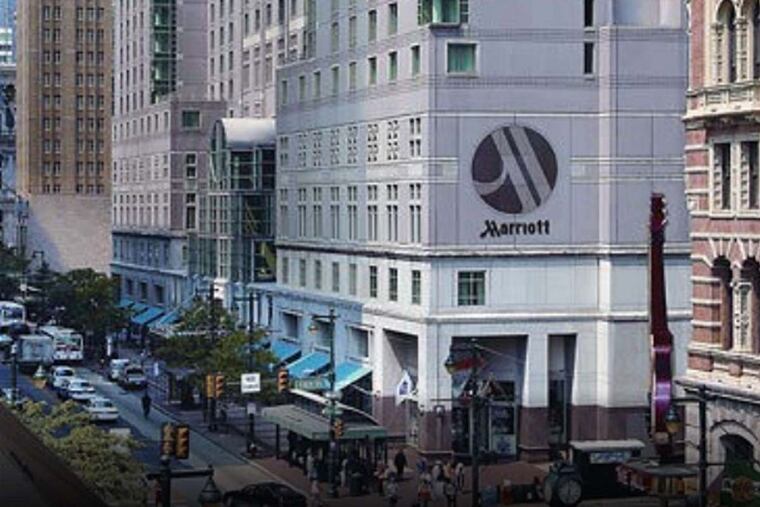
Marriott International Inc.'s acquisition of Starwood Hotels & Resorts Worldwide Inc. will make the Philadelphia area a top market for what is set to become the world's largest hotel company.
Among major U.S. hotel markets, the Philadelphia metropolitan area will have the third-greatest share of hotel rooms affiliated with Marriott brands after the companies merge, according to PKF Hospitality Research.
Marriott's new regional dominance could make it tough for other hotel companies to compete with the hospitality behemoth in and around Philadelphia. But it also may draw greater numbers of visitors to the area by giving the company's massive roll of loyalty-club members more places to spend their points.
"This might work out really well," said Andrew Benioff, a hotel specialist at Philadelphia's Llenrock Group, a real estate finance and advisory firm. "It will be yet to be seen."
Marriott spokeswoman Felicia McLemore said it was too early for the company to discuss how the $12.2 billion acquisition will affect business in specific markets.
The merger - expected to close toward the middle of this year - will affect 63 properties in Philadelphia and its suburbs that are owned, managed, or franchised by the two companies, according to PKF, a subsidiary of real estate services firm CBRE.
They include the 1,408-room Philadelphia Marriott Downtown and the 137-room Residence Inn Philadelphia Conshohocken, as well as the 757-room Starwood-affiliated Sheraton Philadelphia Downtown and the 294-room Westin Philadelphia.
Together, this area's Marriott- or Starwood-affiliated hotels encompass 12,223 guest rooms, about 27 percent of the region's total, according to PKF's analysis, which uses data from industry tracker STR Inc. The data cover the nation's 50 largest metro areas, excluding Las Vegas, by number of hotel rooms.
Only the Washington, D.C., area, where Marriott is based, and the Boston region, near the birthplace of Starwood's Sheraton Hotels and Resorts brand, will have a higher percentage of rooms associated with the expanded company, according to PKF.
In central Philadelphia, the impact will be even more pronounced than in the wider metropolitan area, with 42 percent of Center City and University City hotel rooms due to be in Marriott affiliates post-merger, said Peter Tyson, a senior vice president in Philadelphia at PKF's consulting unit.
The combined company's 4,687 central Philadelphia rooms will vault it past the 2,664 rooms in properties affiliated with McLean, Va.-based Hilton Worldwide, currently the market leader.
The Marriott-Starwood merger could make Philadelphia a more attractive tourism destination for members of the Marriott Rewards loyalty club, perhaps the most popular program of its kind with 54 million participants, said Brian Kelly, founder of ThePointsGuy.com.
Eventually, that program is expected to be merged with the Starwood Preferred Guest club, which reports 21 million members.
The Hilton HHonors program, by contrast, has 44 million members.
Frequent business travelers who earn Marriott Rewards points on the job would have more places in the city to cash in their credits for free stays, possibly encouraging more leisure visits here, Kelly said.
"You can spend more on Philadelphia's thriving culinary scene or museums or all the things you can do when you're saving a huge chunk on hotels," he said.
Michael Bellisario, an analyst at financial-services firm Robert W. Baird, said the post-merger company's pricing power is likely to be lessened by the fact that many of its properties are franchised by independent owners that set their own rates.
Still, Marriott will benefit from its dominant position here, since it gives the company access to more properties' pricing practices, customer-behavior data, and other information that can be used for marketing, Bellisario said.
The bigger company also would have a competitive advantage when it came to booking rooms for visitors to big Philadelphia events such as conferences and trade shows because it could work with organizers to place guests across more properties.
"Bigger is better," Bellisario said. "More dots on the map are important."
215-854-2615@jacobadelman