Haven: Church called home in Brewerytown
Original columns, trusses, and arches were kept.
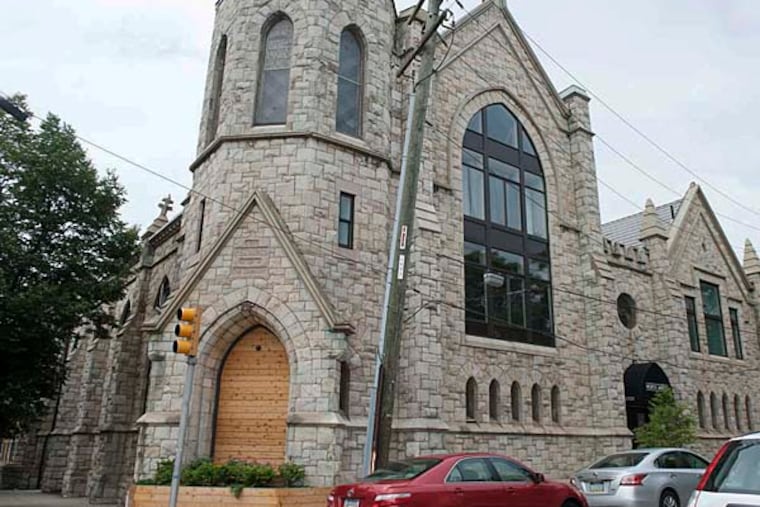
A stately house of worship, designed in the Gothic style by famed architect Frank Rushmore Watson and built in 1888, was saved by real estate developer Jordan Brody in 2012, just as the wrecking ball was heading for the former Episcopal Church of the Covenant on Girard Avenue in Brewerytown.
The stars further aligned for the sandstone neighborhood landmark after Brody bought the building and hired Philadelphia architect Ian Smith.
Smith designed a second life for the edifice that includes 16 apartments for rent, some of which are on two floors, with sleeping quarters in the former church loft.
Brody is passionate about saving historic architecture and says he is troubled "to go to New York and see how they preserve buildings [so] that you can see one every few blocks, while we in Philadelphia just tear them down."
The church was in bad shape, Smith says: "The majestic steeple fell down just before we began work. The stained-glass windows didn't fit residential codes."
But Smith pushed on.
"I thought it was important to keep the ornaments such as the columns, the trusses and arches," he says. Most of the stained-glass windows had to be removed because they were drafty and thus not good for temperature control.
"I did manage to save two windows - a rose window in one of the units and a stained-glass one in the front hall," he adds.
As soon as the retrofit was finished last year, the project, called North Abbey, attracted young professionals mostly in their late 20s and early 30s, such as Claudia Stringham and fiancé Tom Harmon. They relish living in a building with a history.
"I always wanted to live in a renovated church," says Stringham, 29. She and Harmon, 31, met in high school in Delaware and had lived in the Brewerytown area before moving into North Abbey.
Stringham, a human-resources professional, says she has always been interested in history. She began applying to live in North Abbey when construction had barely begun, she says - and thinks she was the first to do so.
"We travel a lot and love to go to Iceland," Stringham says. "We just didn't want to have an ordinary home base."
Harmon, a portrait and wedding photographer, said he really appreciates their home's past.
"After school, I lived in L.A. and never felt there was a history or depth to any of my homes," he says.
On first entering the living room of the couple's 1,300-square-foot second-story unit, a visitor sees light-gray columns set into the far wall, a section of the former pipe organ loft.
At the other side of the living room, next to the door, another cluster of columns designates where clergy once stood far below on the first level.
"We installed new floors for the second and third floors," Smith says. "Originally, there were 50-foot ceilings above the sanctuary."
In front of the columns, a kitchen area is blocked off; a plush rose-colored camelback sofa ties the two spaces together.
Lighting up a wall near the dining area is an abstract orange-and-yellow stretched-cloth art piece.
Baxter, the couple's gray tabby, seems to enjoy climbing on the spiral stairs, perhaps to guide guests up and down. The stairs lead from the dining area to the second level, where, in their bedroom, Stringham and Harmon proudly point out the building's rescued rose window.
There are two bedrooms. The couple's features a window seat covered with cushions.
"I have the best view and love sitting here," Stringham says of the settee that fits just under the stained-glass window.
She is particularly fond of details from the original structure, such as the fact that the two bedrooms look out onto the street through tiny windows that open from the top.
"Lucky," Harmon says, is how he feels. He and Stringham were there at the right time to take advantage of the chance to live in the venerable 127-year-old building.