In digital age, interest in traditional yearbooks wanes
Prom pictures turn up free on Facebook; memories are saved on iPhones. And an increasingly diverse population has never gawked at shelved emblems of their father's shaggy beard or their mother's oversized glasses.
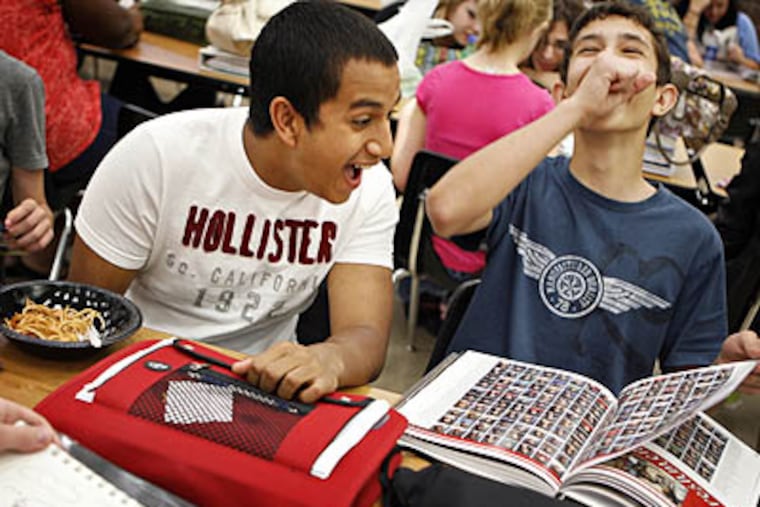
DALLAS - Karl Lorin and Marisa Lander stood at the edge of Liberty High School's cafeteria in Frisco, Texas, oblivious to the lunchtime circus surrounding them. Transfixed, they swept hands across glossy pages and flipped through an index in search of their names.
Yearbooks had arrived.
Then they snapped the book shut and handed it back to the classmates distributing them. Neither had bought one.
The nostalgia of this decades-old relic hasn't faded completely from the Frisco school, but the students' actions represent a growing detachment with the hardbound encapsulation of geeky high school moments.
The traditional yearbook is no more.
Liberty High, which pre-sold yearbooks for $60 each to about half its student body, is at the top of the heap. South Oak Cliff High School sold only a handful to its underclassmen.
The largest yearbook companies, like Dallas' Taylor Publishing Company and Minneapolis' Jostens Yearbooks, won't report exact figures but admit to a slight decline in sales. They battle rising printing costs and a generation raised in a world of immediacy.
Prom pictures turn up free on Facebook; memories are saved on iPhones. And an increasingly diverse population has never gawked at shelved emblems of their father's shaggy beard or their mother's oversized glasses.
"I don't think memories should cost anything," said Liberty senior Paul Tee, pausing his iPod. He planned to save the weekend's prom pictures online from a friend.
The yearbook's transformation and its salvation, say the creation's proponents, depend on re-establishing its resonance through active marketing and technological improvements.
"Newspapers online is one thing, but yearbooks, that just can't happen," said Linda Drake, the Journalism Education Association's yearbook adviser of the year who is also on the National Scholastic Press Association's board of directors.
"We are fighting Facebook and Twitter and we have to be able to keep things interesting for them," she said.
This disconnect is most prevalent at colleges, poor towns and inner cities where school affinity wanes and some families can't afford $60 mementos, said Drake, a teacher in rural Kansas.
"But I have issues with kids saying they can't afford it and then buying a pair of $100 jeans. I don't see the school spirit. I don't see the school camaraderie. "
That loss of attachment is the yearbook's greatest challenge, said James Anderson, a North Texas representative for Taylor Publishing Company. "Yearbooks have to have a certain intrinsic value," he said. "They're tied to all kinds of things when schools are a central part of life."
Successful sales come from combining this philosophy with newer digital capabilities, like DVD enhancements and links that allow students to create their own page, said Anderson, who has been driving from San Marcos to Tulsa selling yearbooks for almost 40 years.
Not everyone is so hopeful.
"I do think the yearbook could die," said Lori Oglesbee, a Journalism Education Association board member and yearbook adviser at McKinney High School, where yearbooks still retain remnants of their past status.
"Collin County's picture looks very different than Dallas County," she said, emphasizing the socioeconomics at play.
To save its historic Grassburr yearbook, Tarleton State College in Stephensville imposed a mandatory $25 fee to all undergraduate students.
Dallas' Justin F. Kimball High School hasn't had a marketable keepsake in years. The senior sponsor tried for a senior version this year. Not even half the class bought one.
"Maybe if I was attached to the school, I would buy one," said Eduardo Sanchez, a junior at Oak Cliff's W.H. Adamson High School, an aged brick building with a "We're Not Done Yet" sign near its entrance. "I don't want to waste money. A yearbook is just a book."
The schools where yearbooks are still thriving have managed to convince students of their long-term worth, said Jeanne Acton, the University Interscholastic League journalism director.
She has a stack of nationally ranked yearbooks higher than a chair in her Austin office.
Yearbook clubs "are trying to make it more connected to students," she said. "It's not just a book about sports and clubs anymore, it's the life outside."
With the additional use of digital cameras and publishing software, the "quality has just skyrocketed," she said.
McKinney High, the only school in the country that won awards for both its yearbook and DVD production this year, has sold at least 1,000 yearbooks to a school of about 1,800 students.
Oglesbee, an adviser for almost 30 years, has shifted the yearbook's role to meet her new clientele's desires.
Instead of viewing social media as competition, Oglesbee said they've "embraced" it. Students can add quotes and pictures to the yearbook via the yearbook's Facebook page, which can be included in print.
She has the class send out individual notes telling students how many times they are in the yearbook. Oglesbee even tracks who buys yearbooks _ normally, freshmen and seniors _ and tries to involve the other classes.
Frisco's Liberty High has added a DVD supplement with scenes from a student-produced broadcast show. The color yearbook's theme is "The end of the beginning," since this is the first class to graduate with all four years under Liberty's namesake.
Even with this vested connection, adviser Carole Babineaux said she had to "tell my kids, 'You have to understand that a yearbook sits on the shelf and people go back and look at it 50 years from now when you want to have memories.' "
Senior Anne Price seemed to understand that as she cradled her book at the mid-May lunchtime distribution. Some students rushed the pick-up table, others the nacho stand.
A couple of Price's friends discussed taking their books to college and dismissed the notion of memories linked online.
"People not selling yearbooks? I would die," she said. "I am, like, really sentimental. I just like having them in one little stack put together nicely."
Then she got back to the universal first task of new yearbook owners _ finding herself in between its covers.
(c) 2009, The Dallas Morning News.
Distributed by McClatchy-Tribune Information Services.