Health-care experts map how to make your medical data digital
Picture a world of medicine where everything is connected by computers and the Internet. Patients go online to figure out which emergency room is least crowded. They don't have to fill out medical-history forms because their information is accessible with a few keystrokes. Specialists could see people or view their tests from hundreds of miles away on a high-definition-video feed.
ORLANDO, Fla. - Picture a world of medicine where everything is connected by computers and the Internet.
Patients go online to figure out which emergency room is least crowded. They don't have to fill out medical-history forms because their information is accessible with a few keystrokes. Specialists could see people or view their tests from hundreds of miles away on a high-definition-video feed.
That futuristic vision was a key point of a discussion recently involving more than 50 health-care-technology experts from hospitals, telecommunications companies and other organizations. The gathering was the first major step toward developing proposals for about $30 billion in health-care and broadband-technology funds contained in the federal stimulus bill.
Organizations represented at the meeting ranged from an on-site medical clinic at Rosen Hotels & Resorts to hospitals; technology companies such as Siemens, IBM and Harris Corp.; and state universities.
"You don't think twice about visiting an ATM that is not your ATM," said Andy Crowder, chief information officer for Florida Hospital. "Imagine if health care got to that point. We've still got a lot of paper, and paper is only as good as the people that get to see it."
Health-care-technology officials said local hospitals were upgrading their technology long before the stimulus funding was announced.
Just a few weeks ago, a pilot program began between the emergency departments at Florida Hospital and Orlando Health hospitals. In the next few months, if a patient visits the ER at Orlando Regional Medical Center and later visits Florida Hospital Orlando's ER, doctors will be able to pull up electronic versions of that person's test results, medical history and other information at both places.
The ultimate goal is that doctors at hospitals across the country will be able to access electronic records instantly, in case you have to go to the emergency room while on vacation or when you move to a new town.
One proposal is a $30 million request for stimulus money being developed by two regional health-care organizations and the new University of Central Florida College of Medicine.
The money would be used to extend medical-record sharing to all seven Central Florida counties, to improve the health of low-income residents in Orange County, and to enable UCF medical students and staff to serve as consultants for doctors setting up electronic-medical-records systems, said Becky Cherney, president of the Florida Health Care Coalition.
But there are hurdles to digitizing hospitals, the group conceded. The federal government is requiring hospitals to use electronic medical records by 2015 or face penalties, but it hasn't provided many details about standards or which vendors to use. And there are concerns about security to protect patients' privacy.
Later this month, the government is expected to release guidelines about electronic records, and many of the officials plan to get together again to refine the stimulus proposals.
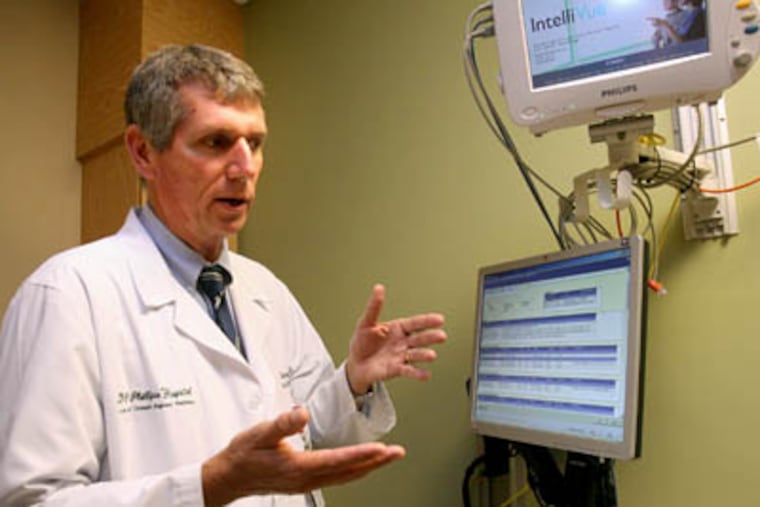
To get an idea of how technology could reshape the medicine, take a walk around Orlando's Dr. P. Phillips Hospital. Instead of thumbing through a paper file, doctors review a patient's medical history on desktops, laptops and computers on wheels, where they take additional notes and order tests, and write prescriptions, which are sent electronically to the pharmacy.
In the ER, a flat-screen TV shows a color-coded list of patients, giving staff a live look at which beds will become available and how each patient is doing.
Converting to digital files will save hospitals money, reduce errors and improve care by allowing doctors to quickly access more detailed information that can allow them to easily spot trends, health officials say.
For Dr. Jeffrey Backer, the chief medical officer at Dr. Phillips, it also has taken the focus off his handwriting, which he said is among the worst at Orlando Health.
"I used to get phone calls probably every hour for prescriptions that I had written," Backer said. "I don't get phone calls anymore."
(c) 2009, The Orlando Sentinel (Fla.).
Distributed by McClatchy-Tribune Information Services.