Media commons at WHYY nears completion
WHYY's headquarters on Independence Mall has grown and is about to become more welcoming as the public broadcaster's $12 million capital improvement project nears completion.
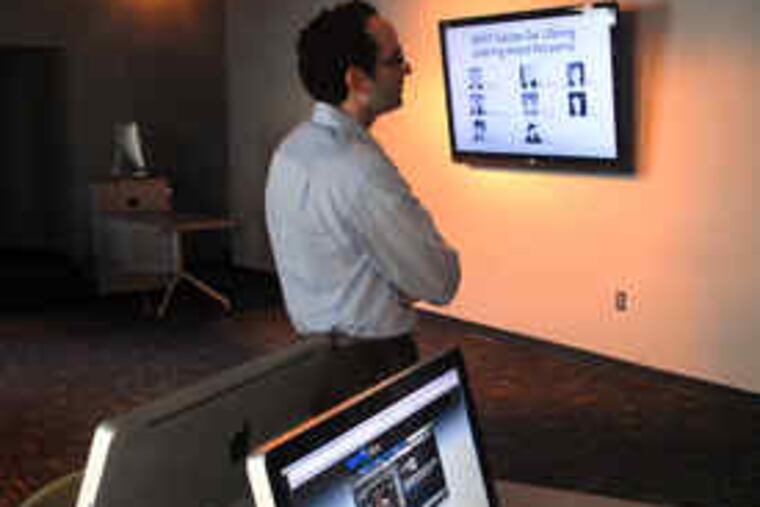
WHYY's headquarters on Independence Mall has grown and is about to become more welcoming as the public broadcaster's $12 million capital improvement project nears completion.
The Dorrance H. Hamilton Public Media Commons has added 8,000 square feet to WHYY's 60,000 square feet of studio and office space on Independence Mall. The building stretches from the station's front door on Sixth Street to Seventh Street. The addition will be a hub for teaching audio and video production - for television, radio, and the Web.
"What we're going to do in this facility is transfer our digital knowledge to our audience so they can use digital technology to tell their own stories," WHYY president and chief executive officer William J. Marrazzo said.
The space will get its first workout Monday night at WHYY's annual President's Dinner, where radio personality Carl Kasell will receive WHYY's Lifelong Learning Award.
The expansion and some renovation created two media training rooms where students can learn to shoot video, record audio, edit material using professional software, and operate studio lighting. The commons also includes editing stations and a digital control room.
The largest chunk of the addition is the Lincoln Financial Digital Education Studio, a 4,100-square-foot room that doubles as a studio and an auditorium.
Marrazzo said homegrown fare, such as Radio Times, hosted by Marty Moss-Coane on WHYY-FM (90.9), periodically will be broadcast with audiences sitting in. WHYY also will screen television programs and independent films and hold large training sessions in the Lincoln studio. Some events will be for students, some for WHYY members only, and some for the public.
The primary goal is to draw more WHYY members and residents into public broadcasting and digital production - from students learning how to produce news pieces (including some that could be used at WHYY) to older members learning to record their own stories and family histories, Marrazzo said. These efforts build on training that WHYY has offered students for about six years.
The educational objective is why philanthropist Dorrance H. Hamilton was the biggest donor - giving $4 million - to the construction project, said Nancy Wingo, executive director of the Hamilton Family Foundation.
Hamilton, a longtime supporter of educational initiatives for children, was interested in having digital communication skills taught to the elderly as well as to younger students.
When Marrazzo told her seven or eight years ago about the idea to establish what then was called the learning laboratory, Hamilton, 81, saw an opportunity to help create "a common ground where everyone could meet and learn about these things," Wingo said.
The public media commons named after her won't formally open until the fall, when a course catalog will become available, though a journalism camp will be held there over the summer, said Kyra G. McGrath, WHYY's executive vice president and chief operating officer.
The technology and surroundings may be new, but the idea of outreach by public radio and television broadcasters is decades old and considered part of the mission, said Arthur Cromwell, an associate professor in Ohio University's School of Media Arts and Studies, who has served in various public-broadcasting capacities.
Cromwell said one of the aims - never fully carried out - of public broadcasting nationwide was to empower citizens to be active in programming "so you're not just sending signals to people, but people have the ability to construct their own media, and to retort and to respond."
Creating space to institutionalize that aim is a useful step, he said, but the challenge becomes how to fund those efforts and integrate what the public produces into programming.
Marrazzo said that $8 million of the WHYY project was for building and technology costs, and that $4 million served as an operational endowment for the public media commons.
Besides formally announcing the name of the expansion, WHYY officials will say Monday that they have raised $45 million of a $50 million fund-raising campaign begun in 2005 to finance local programs and educational services. The $12 million for the public media commons is part of that $45 million.