Jeff Gelles: Middle schoolers learn engineering by building an arm
The challenge was to build a working prosthetic arm for an impossibly low price: less than $40 in materials. It took just one visit to Lowe's last fall for the West Philly middle schoolers to realize that meant cutting some painful corners. Appearances would have to go, for one. Forget about using all five fingers.
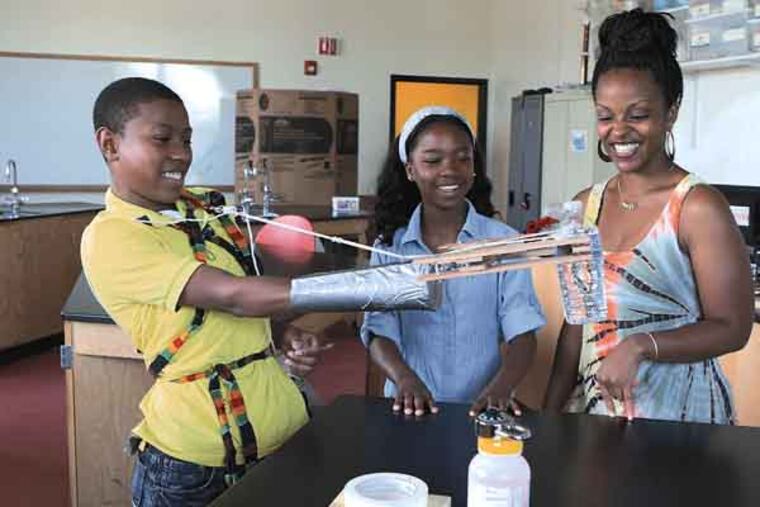
The challenge was to build a working prosthetic arm for an impossibly low price: less than $40 in materials. It took just one visit to Lowe's last fall for the West Philly middle schoolers to realize that meant cutting some painful corners. Appearances would have to go, for one. Forget about using all five fingers.
But last week, four members of the team from Harambee Institute of Science and Technology capped seven months of invention and engineering trial and error with a triumph: Their arm won a second-place trophy at the National Engineering Design Competition of MESA USA in Portland, Ore.
MESA, which stands for Mathematics, Engineering, Science Achievement and is funded largely by the Navy, is a decades-old program that is a newcomer to the region. Based at Temple University, it draws 375 students to programs centered on bioengineering and computing.
This year's national challenge invited MESA students to design and build a trans-radial prosthetic arm, suitable for someone whose arm ends below the elbow. I know that because it was explained to me patiently by Taleah Robinson and Ahmad Curtis, who joined their science teacher, Ayanna Thompas, for a demonstration.
Harambee was not the only Philadelphia school to earn bragging rights at the national competition, which drew 72 finalists from among 49,000 MESA participants. A team from George Washington Carver High School of Engineering and Science, a North Philadelphia magnet school, won top honors for engineering dexterity, design efficiency, and academic-paper display, says Temple's Jamie Bracey, who oversees the MESA program.
"What was really cool is that last year Carver didn't even send a team," Bracey told me.
So what did the Harambee team accomplish? It built a prosthesis for $32.86 in materials - oak for the two-finger hand, string for ligaments, a Pringles can for the forearm - that outperformed much of the competition.
The students' hand wasn't designed to look pretty or natural. Their strategy, like much basic engineering, stressed function over form. And, like inventors everywhere, they began by investigating what had come before - both from similar contests and real prostheses costing thousands of dollars. No reason to reinvent the wheel.
Or, in this case, an arm that had to perform just two key tasks: picking up and relocating objects, such as a liter bottle of water, and accurately tossing different kinds of balls.
"At first, we were worried about the aesthetics - we wanted it to look like a hand," says Robinson, 13. "But then, after a few days of brainstorming, we wanted it to actually work."
They bought some components, such as hinges for knuckles and hair curlers for fingers, that didn't make the final cut. With its oak, two-finger hand, their prosthesis weighed in at 5.7 pounds, just under the 6-pound limit. But it did the trick.
Thompas says the Harambee team excelled at the object-relocation challenge. The students scored especially high - outperforming all but one middle or high school team - by focusing on moving the heaviest objects as quickly as possible. Curtis, 14, who shared the arm during the competition with Stephano Hines, says some teams had more trouble lifting heavy objects.
The MESA team also included Radya Hennie, who helped with the oral presentations at the national competition, and Aaliyah Ellerbee.
The Carver team that won awards in Portland included seniors Cevan Noell and Antonio Williams and freshmen George Baidoo and Jesus Davaloz.
The middle schoolers caught at least one break. The older students' prostheses had to perform an additional, more complex challenge: attaching hex nuts to bolts, a task designed to show fine-motor and rotational control.
To Thompas, the particulars of the competition were less important than MESA's overall goal: instilling the kind of love for science and engineering she gained as a physics major at Lincoln University.
But Thompas also saw broader themes in the challenge, including an opportunity to foster empathy. For that reason, she began by having all the students try to function briefly with their dominant hand disabled with tape.
"I wanted them to realize the problem that was being addressed, because that's what engineers do - we solve problems."