Lighting trade show is illuminating
'What a dim bulb you are!" Not long ago, that statement really hurt, when lightbulbs ran the gamut between off and on, and still used the same glowing filament technology dating to Thomas Edison.
'What a dim bulb you are!"
Not long ago, that statement really hurt, when lightbulbs ran the gamut between off and on, and still used the same glowing filament technology dating to Thomas Edison.
Today, with lots of regulatory goading to cut energy use, lightbulbs are a smarter species. Or twenty. Gizmo Guy was electrified by all the sage bulbs he met at the recent and vast Lightfair International trade show at New York's Javits Center.
The basics: Pressed by the official U.S. phaseout last year of the most common 60- to 100-watt incandescent bulbs and with rivals battling, replacement light emitting diode-based bulbs are now taking over the market.
Not long ago, an early adopter paid $25 to $40 for a "60-watt equivalent" (in light output) LED-based bulb - a curious experiment with its massive metal heat sink, actual 11 to 14 watts power consumption, and odd diffusing cap, which still couldn't mask LED hot spots inside.
At Lightfair, Gizmo Guy was introduced to a "2 bulb Value Pack" of Philips LED 60-watt-equivalents newly selling at Home Depot (with a PECO subsidy lowering the price) for $4.99. The heat sink has been shrunk to practically nothing. With its evenly diffused, "soft white" 800-lumens glow, the Philips could easily pass for a bulb of yore. Except it consumes only 8.5 watts and lasts 10 years rather than two (worked three hours a day).
There's one corner cut: These bargain LED bulbs are not dimmable. But at least you won't experience the "it's flickering and won't shut off" frustration, which comes when trying to mate even a "dimmable" LED bulb with a dimmer switch forged before the great transition.
With even more aggressive bulb pricing sure to follow, there's now no denying Department of Energy Lighting Program manager Jim Brodrick's prediction that "47 percent of all residential lighting will be LED" five years hence, and 99 percent will have switched over in 15 years. Saving us energy resources worth billions.
Willing to splurge $15 to $30 a bulb? That now buys you an LED bulb with super powers, hiding a microprocessor and a radio receiver to make it "wirelessly addressable" from a tablet or smartphone app. Beside hitting on and off, the app will let you custom adjust each bulb's brightness and color, now possibly a way to improve users' "circadian rhythms" affecting mental and physical health.
Philips Hue, Connected Cree, GE's Link Connected LED, and Osram Sylvania's Lightify Connected are all big players in this smart-bulb world, which also demands home installation of a small, companion "hub" with wireless Internet links.
Best of shows: Attended by architects, interior designers, and electrical contractors, Lightfair was equally about decorative and useful light fixtures emancipated by those tiny LED light sources.
Osram Sylvania's OmniPoint, "best of show" at the fair's Innovation Awards, looks like a conventional, ceiling-mounted downlight. But it contains 60 individually addressable LEDs that can be remotely controlled by a tablet to point light at multiple objects or areas in a room. Osram showed one OmniPoint at work in a faux retail shop, another pointing to art hanging in a gallery. Both are scenarios where guys might have to climb ladders to refocus spotlights. Only now they won't have to, though they may cost about $2,000 apiece.
Also super smart: GE streetlights remotely controllable from City Hall (or wherever) to glow extra bright during an emergency. In the "near future," said GE Lighting CEO Maryrose Sylvester, such "industrial Internet"-linked streetlamps also will be fittable with proximity sensors and cameras to brighten automatically (or send an alert) when people are running underneath or parking.
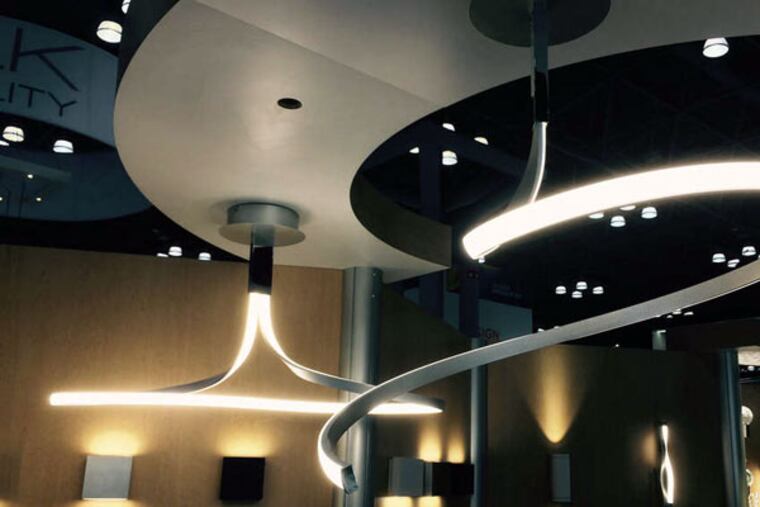
Decorative charms: Gizmo Guy kept snapping images of ultramodern "luminaire" mobiles - sculptural swirls, cylinders, zigzags and stripes of white light, shaped inside brushed aluminum frames and hanging from the ceiling, at $400 and up, from high-end makers such as Reggiani, Lumen Art, and 2nd Avenue Lighting.
All are now possible because LED bulbs come in thin strips, akin to undercounter lighting or (maybe better) those button candies on a paper roll we used to love as kids. They don't put out all that much light, but sure are pretty.
Retro-ready: Working LED bulbs into "nostalgic" fixtures is another big trend. Mod LED lights glowing inside antique jelly jars and nautical-style luminaires ruled at the booths. And we spotted lots of exhibitors (Satco, Bulbrite, Lite-Way, Sunlite, Keyart, Archipelago) showcasing clear or tinted lightbulbs aglow with spidery LED filament tentacles.
These vintage lookers evoke the birth of electrical lights, especially when screwed into a bare, chromed, or brass socket. Should look great in your drawing room or saloon.
215-854-5960
