Why Philly's disabled face a more daunting SEPTA rail commute
It's been a dismal summer for SEPTA's rail commuters. But one group has been faring especially badly: the disabled.
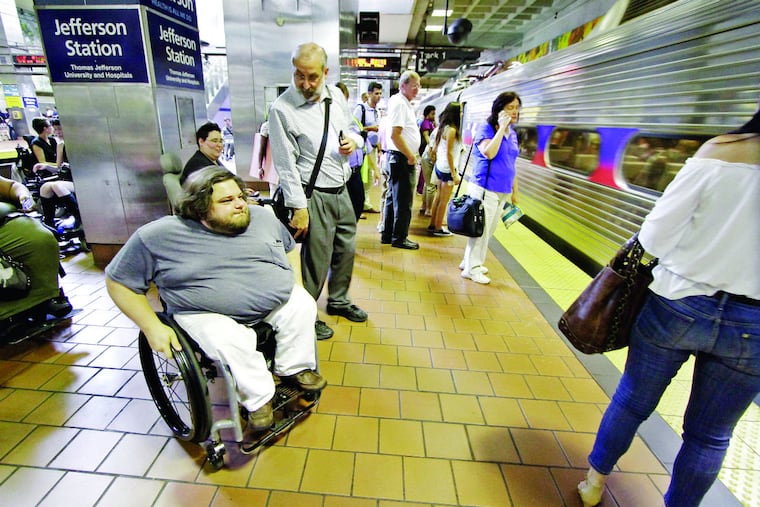
It's been a dismal summer for SEPTA's rail commuters. But one group has been faring especially badly: the disabled.
"There's a harsh irony to the fact that the newest, most accessible [cars] are the trains that had to be taken out of transportation," said Matthew Clark, an advocate for disability rights with the Fair Ride Philly Coalition, who uses a wheelchair.
Disabled riders have also criticized the newer ride service Uber, saying it hasn't done enough on access. Many disabled find trains and cabs too inconvenient to deal with and often avoid them, Clark said.
David Ferleger, a lawyer specializing in disability law, said both Uber and SEPTA had a legal obligation to ensure that the disabled were not waiting unreasonably longer than others. Wheelchair patrons should not have to watch several trains pass just because their chairs can't fit, he said.
Ferleger said SEPTA might consider paying for Ubers or other vehicles to be on site at congested stations. The Americans With Disabilities Act requires "public accommodations" like the agency to make reasonable financial investments in access where it is needed, Ferleger said.
Disabled riders were among the hardest hit when SEPTA removed 120 of its newest Regional Rail cars this month to fix cracks.
Those new cars have two wheelchair berths each, wider aisles, audio and visual notice of stops, and foldout ramps for boarding.
The Silverliner IV cars that now dominate Regional Rail were put into service beginning in 1974. They need a conductor to place a portable bridge plate between the train and platform for wheelchairs.
The doors open onto a vestibule, rather than directly leading to the seating area, and they have one space for wheelchairs per car, SEPTA said.
Clark doesn't commute on Regional Rail but knows from experience that requesting the bridge plate adds time and that it's impossible to squeeze onto congested trains.
Adding to the frustration is the recent deal struck by the Philadelphia Parking Authority and Uber, which Clark said was well-known for access issues. The deal allows for the temporary legalization of Uber vehicles with the promise that PPA will get $350,000 from Uber upon the passage of regulatory legislation.
Uber's wheelchair-accessible service, UberWAV, has an average estimated time of arrival of 13 minutes in Philadelphia County, compared with under four for UberX, spokesman Craig Ewer said.
But wait time for UberWAV has fallen from 35 minutes in the last year, Ewer added, and Uber subsidizes WAV rides by guaranteeing drivers $24 an hour in net fares to keep wait times low.
Still, Uber has declined to release the number of WAVs it uses, saying that information is proprietary.
According to PPA general counsel Dennis Weldon, 30 WAV taxi medallions have been sold since last year and 25 are on the road now. A plan to have 150 WAV taxis by 2022 was put on hold due to competitors such as Uber.
Clark said that he had nothing against ride-sharing but feared that PPA's agreement would prevent any ADA regulation of Uber. "Pandora's box has been opened. They're here; they can run themselves without any oversight," Clark said.
Ewer confirmed that the agreement with PPA did not include access requirements for Uber. But he said the agreement's legal certainty had given Uber the freedom to experiment with market-based solutions to access issues.
Katya Vrtis of Upper Darby, who often uses a wheelchair, said that even if Uber were to make it easier to get around, she still dislikes its business model using part-timers. She said she would rather see WAV taxi medallion owners incentivized to invest in accessible vehicles, which would happen "if the city enforced its own laws and didn't allow Uber to operate illegally."
To imagine a world of accessible taxis, Clark said, "I can't even conceive the convenience that would add to my life."
215-854-5915 @lauren_feiner