Stan Hochman | Someone please put Ruffian biopic out of its misery
RUFFIAN WAS a big filly. She was black, she was beautiful, she was brilliant. Swift as a cheetah. Raced 10 times, won 10 times, the past-performance charts looking like a picket fence, all those 1's, every step of the way.
RUFFIAN WAS a big filly. She was black, she was beautiful, she was brilliant. Swift as a cheetah. Raced 10 times, won 10 times, the past-performance charts looking like a picket fence, all those 1's, every step of the way. Won the filly Triple Crown races from here to Hoboken.
Shattered her right front leg in a match race against a colt, Foolish Pleasure. July 6, 1975. They put her through hopeless, hapless surgery in an operating room that became a sauna because the air conditioning broke down. She came out of the anesthesia haze, thrashing. Still running the race? Or agitated by the thick plaster cast? Broke the cast, rebroke the leg, injured her other front leg before they finally put her to rest with a lethal injection. Buried her in the Belmont infield.
And now, 32 years later, ESPN Original Entertainment has made a pitiful movie about an incredible horse. It will be shown Saturday at 9 p.m., on ABC-TV, the network that carries the Belmont earlier that day.
It might be the worst horse-racing film I have ever seen. If not, it's in the photo. The racing sequences are as primitive as the ancient ones when Mickey Rooney played the jockey, cap on backward, a strand of straw between his teeth. The special effects manage to make Belmont Park look like Louisiana Downs. Facts are twisted, key figures misrepresented, truth trampled in this maudlin mish-mash of a film, 60 minutes too long and 30 years too late.
"The story is timeless," huffled executive producer Orly Adelson.
Timeless. And tragic. Who wants to watch a movie where you know the ending, and the ending is heart-wrenching?
" 'Million Dollar Baby' was a downer," moaned EOE vice president Ron Semiao on a teleconference call, "and it won the Academy Award."
Arrrrgh. "Million Dollar Baby" was fiction, a bleak story about a waitress lusting for fame and the sweet smell of success through boxing. She lets her guard down, she gets nailed, she winds up paralyzed. Her crusty, old trainer sneaks into her hospital room and pulls the plug.
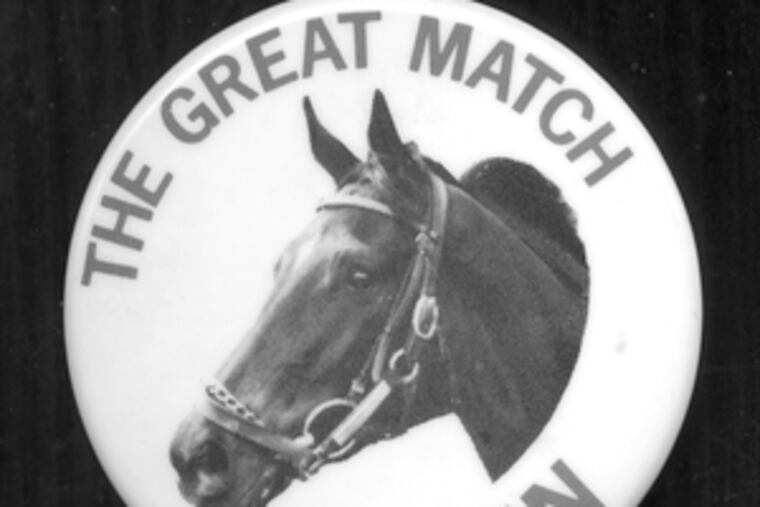
Ruffian was a thoroughbred horse. A real, remarkable, undefeated filly. She didn't get a vote when they were hammering out the conditions for The Great Match Race. Frank Whiteley, her crusty, old trainer, reluctantly agreed to the match, but threatened to walk away if CBS got its wish to start the race on the turn. They started it in the seldom-used chute, an $8 cab ride from the grandstand and most of the 50,764 who came out to watch.
Racing was looking for a shot in the arm and got a left hook to the gut instead. Every so often, you get something memorable from a teleconference call, usually when Bernard Hopkins is involved. This time, someone from Texas asked sports writer Bill Nack whether he felt "guilty" about what happened to Ruffian, since he was enthusiastic about the match race early on.
That's like asking Nack whether he feels guilty about Muhammad Ali's condition because he wrote so many glowing pieces about the fighter. Nack took the verbal punch and shrugged it off.
"I was one of those beating the drums early," Nack said softly. "It was first proposed as the three winners of the Triple Crown races, plus Ruffian. When it became a match race, I was kind of against it. I took a week off before the race and covered the Yankees.
"But I was there that day and I raced across the infield to where she'd broken down. I felt terrible about what happened, but I never felt any personal guilt."
Nack was a terrific writer on racing. Still is. Wrote a breathtaking book on Secretariat. Loved the sport. Walked away after Ruffian was buried in the Belmont infield. Came back to write a book about the filly and act as consultant on the movie.
"The distant memory's a ghostly thing," Nack writes in the book, with type so small it would bring tears to your eyes even if the ending wasn't so heart-wrenching, "a Wisconsin meadow of lost time black as pitch, with only here and there some little necklaced pools of light leading nowhere, scattered about."
The man can write. Frank Whaley plays him in the movie, as a pompadoured dude in a three-piece summery suit when we first see him, bartering a copy of his Secretariat book to settle a $5 bar tab. Nack's idea of a three-piece suit in those days was a tweed sport coat with a leather elbow patch on each sleeve.
"I told them I didn't care what they had me saying for dramatic purposes," Nack said, "but offering the book in the bar was not something I would have done. They tried to make it funny. I said, 'No harm done.' "
There's a tough scene in the movie where Whiteley confronts Brauilio Baeza, the jockey who gets the mount on Foolish Pleasure.
Whiteley hates Baeza, reminds him he hadn't used him in 6 years because the jockey "stiffed" Damascus, so that Dr. Fager could get horse of the year honors.
Just what people need to hear about racing, a dialogue implying corrupt jockeys. Sam Shepard plays Whiteley in the movie, and he's 8 lengths ahead of everyone else in the flick. But Whiteley keeps calling his rider, Jacinto Vasquez, "Porta-Reekin" even though Vasquez is from Panama. Hispanics may still be flinching from the Preakness winner's circle, where the Magna CEO called the winning jock "Robby Alvarez" instead of Albarado. And now this.
In the movie, the Belmont starter, dapper George Cassidy, is transformed into an African-American in short sleeves. Dave Johnson emerges as the only race caller left on planet Earth. The worst transgression involves Moody Jolley, the father of Leroy Jolley, who trained Foolish Pleasure.
Moody gloated after the race, saying, "First time they throw some speed at that bitch, she comes unbuckled." In the movie they have some raucous, anonymous fan shouting that vicious line.
Nowhere, not in the movie, not in Nack's book, does Leroy Jolley say, "It's a tough game, and you don't play it in short pants."
I heard it, I wrote it, that painful day. Or has my memory become a Wisconsin meadow of lost time, black as pitch? Nack defends the movie, despite its clumsy timing. He was there, at Pimlico, talking to Barbaro's owners, the Jacksons, in the winner's circle after a race renamed for last year's Derby winner, the sentimental scene shattered by screams as another gallant horse broke down on the track and eventually had to be destroyed.
"We all know a good story," Nack said, "and Ruffian is a helluva story. What did Hemingway say, 'All great stories end in death.' " Hemingway, isn't he the guy who stuck a shotgun in his mouth and pulled the trigger?
Questions, questions, questions. You will find no answers in the "Ruffian" movie, only a tragic story told clumsily.
*
Send e-mail to stanrhoch@verizon.net.