Ronnie Polaneczky: The fine line that Mia lives on: Should she be denied a vital kidney transplant?
IF YOU DON'T know the name Amelia Rivera, you will soon. Her story is going viral as I type this.
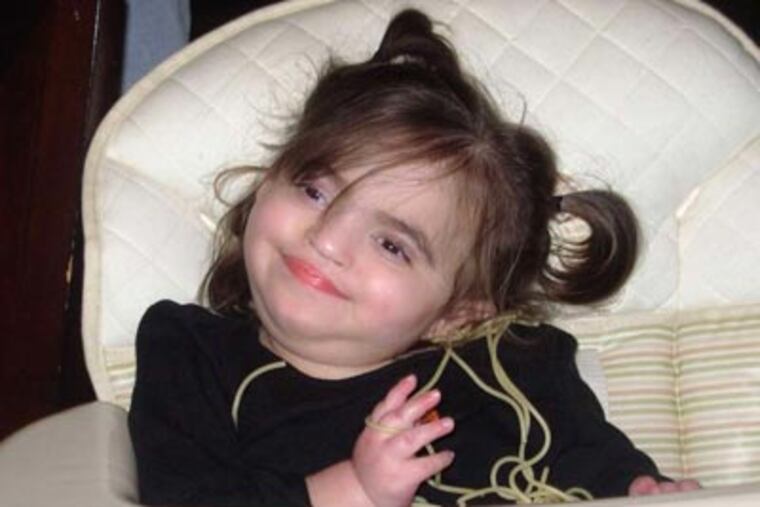
IF YOU DON'T know the name Amelia Rivera, you will soon. Her story is going viral as I type this.
It's no wonder. Amelia is the embodiment of our ongoing moral debate about whom we let live, whom we let go and the line that separates the two.
It's a line that, thanks to medical technology and uneven access to its life-saving powers, continues to blur and shift.
Three-year-old Amelia ("Mia" to her Stratford, N.J., parents, Chrissy and Joe, and her big brothers, Joey and Nathan) was born with Wolf-Hirschhorn syndrome. The rare genetic condition has left her profoundly mentally impaired. She also is disabled. She cannot walk, speak or eat (she receives nutrition through a feeding tube). But she can roll over, hold a toy and interact in ways that her family recognizes as communication.
"She knows who we are, and she is happy," says Chrissy, 36, a high-school English teacher. "She is a snuggler and a cuddler. She loves her brothers and they love her. They want her with them, even at their sports games."
When Mia was diagnosed, her parents were told she would die within two to five years. Chrissy's own research, though, has turned up cases of of patients living well into adulthood.
"We are taking her life a day at a time," she says.
Mia's kidneys are small and will likely fail within the year. So her nephrologist at Children's Hospital of Philadelphia referred Chrissy and Joe to representatives from CHOP's kidney-transplant team for a consultation.
According to an account that Chrissy posted last week on www.wolfhirschhorn.org, a parent website, she and Joe were told that Mia isn't suitable for transplant.
Why? Because Mia is mentally retarded.
Chrissy is emphatic that this was the only reason offered, as Mia's overall health has been stable since August, when she had successful heart surgery
Chrissy says that, even when she told the team that she or Joe would donate a kidney to Mia, the team said that CHOP wouldn't perform the surgery.
"I said, 'If she doesn't get this transplant, she will die. Are you saying that six months from now we should let her die?' " recalls Chrissy. "The doctor said, 'Yes.' "
Obviously, Chrissy's allegation is shocking. So, I wish I could offer CHOP's version of this story. But CHOP did not return calls for comment yesterday. The hospital did, however, issue a general statement on its Facebook page in response to Chrissy's post, which has elicited charged reaction, especially among parents of disabled children.
"Each child is unique, and our goal is always to provide the best possible medical care for each individual patient," CHOP's statement read. "CHOP strives to partner with families and make appropriate decisions based on input from many sources, none more important than the patient's family."
CHOP is also "taking action to review all existing policies to make sure that they reflect the core values we live by, including our deep commitment to not discriminate in any way."
Later, CHOP clarified its position further, stating that the hospital "does not disqualify potential transplant candidates on the basis of intellectual abilities."
If Mia's health is more fragile than Chrissy or Joe realize, then CHOP's transplant refusal is understandable. But if it's not, why was the transplant declined?
Penn bioethicist Art Caplan isn't familiar with the case. But he's written enough about the ethics of organ transplants to know that, medical hindrances aside, some mentally disabled children have been denied organs based solely on their impairment.
Especially if the child faces a shortened life, the way those with Wolf-Hirschhorn do.
Some organ-transplant coordinators, Caplan says, feel they "ought to steward the scarce supply to save the most lives and the most years of life."
About 113,000 Americans are waiting for organs; many die while waiting. Against that desperate backdrop, biases absolutely creep into the decision about organ allocation.
Why else was there an uproar when convicted New York rapist Kenneth Pike was scheduled for a heart transplant (he then turned it down, amid negative publicity)? And when Mickey Mantle received a liver transplant - even though he'd drunk his way to the cirrhosis that plagued him?
When it comes to organ transplantation, we judge candidates' worthiness all the time, though mostly on their moral failings.
In Mia's case, if only the evaluation were that clear-cut.