Mirror, Mirror: Toggery is a thriving Phila.-made fashion line
Toggery is a collection of cotton T's and tanks perfect for layering under this spring's trendy shrunken blazers. The comfy 23-piece line features wraparound cardigans in neutral shades and racerback maxi dresses in punchy pastels, too.
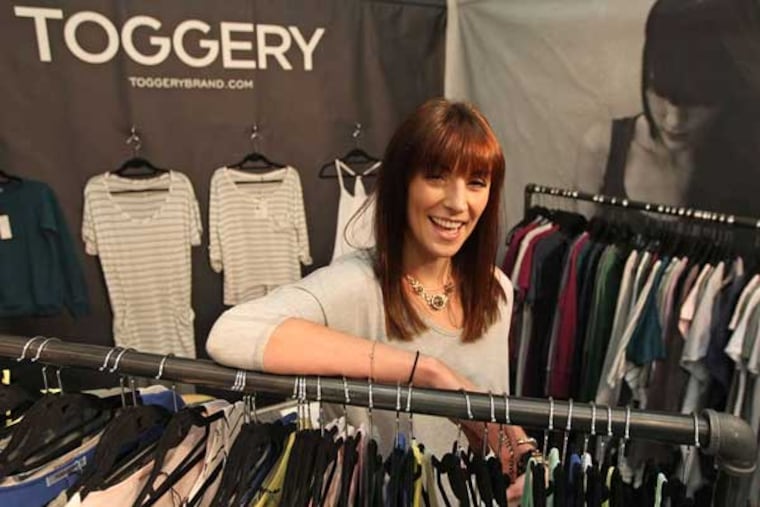
Toggery is a collection of cotton T's and tanks perfect for layering under this spring's trendy shrunken blazers.
The comfy 23-piece line features wraparound cardigans in neutral shades and racerback maxi dresses in punchy pastels, too.
But the locally made label founded by Kate D'Arcy, 32, is more than a grouping of easy-to-wear women's basics. It is proof that designers can have successful fashion careers designing and manufacturing clothing in Philadelphia - after a very long hiatus when a lack of skilled local workers made it nearly impossible.
"We are not just an American-made company; we are a local company," D'Arcy emphasized in a corporate tone uncommon for fashion designers. She sources fabrics from mills on the East Coast, and her clothing is constructed in Chinatown.
On this day, she was sitting in her office away from home, Mugshots Coffeehouse, on Fairmount Avenue. "There are endless business possibilities when you do establish business locally."
Cultivating nearby resources has led other Philadelphia area-based women's wear brands to find the same success - Cabe, by former Anthropologie designer Kathy Rego, and SA VA by Sarah Van Aken. Van Aken, who employs the "vertical" business model, designs, manufactures, and sells her line all herself.
"For the longest time, there were no designers who were making clothing here unless it was some one-off handmade item," said Ali McCloud, owner of eco-friendly boutique Arcadia in Northern Liberties, where Toggery is sold locally.
Within the last 18 months, McCloud said, she has started carrying more locally made apparel, including dress lines Tough Luv, manufactured in Center City, and National Picnic, sewn in Collingswood.
"People who produce in America, by default used to just go to New York and California," McCloud said. "I'm getting the sense that we are in the midst of a shift. It's going beyond the craft and jewelry into real fashion."
Toggery is sold in 220 specialty stores - including Los Angeles' celebrity hot spot Fred Segal - and the company is poised to do more than $1 million in sales this year. D'Arcy's pieces have been featured in InStyle and Us Weekly, and actresses who wear Toggery include Rachel Bilson, Eva Mendes, and Alicia Silverstone.
D'Arcy describes the collection as a grouping of soft closet essentials with a twist: T-shirts feature deep V's with raglan sleeves, and some tanks have cute high-low hemlines. Long cardigan sweater dresses in hot pinks can be dressed up with stilettos or dressed down with ballerina flats. Prices range from $45 for tanks and $55 for T-shirts to $90 for dresses.
It's a very California aesthetic: Think Three Dots or Michael Stars. But Toggery's holiday collections are made from cozier cotton blends and fashioned in Chinatown, where there are still skilled sewers, dyers, and cutters.
There is a movement afoot to replace a fraction of the thousands of manufacturing jobs that were once the fabric of the Philadelphia apparel scene from the mid-1800s through the 1980s.
But instead of hulking buildings with massive assembly lines churning out tons of pieces, the new model could potentially use some of the same spaces but with safe working environments that can tailor production for designers' needs.
And the push to create a local fashion community that has all the resources needed to design, produce, and sell of-the-moment styles is slowly gaining momentum as more shoppers are caring where their clothes are made.
"She's very on-trend," said Rachel Ocner, who sells Toggery in her Maryland-based store, Layla's Boutique. She was perusing this spring and next fall's collection at Coterie, a twice-annual trade show at the Piers in New York that attracts specialty store buyers and designers from across the country. Of the 1,400 vendors showing at Coterie this year, 176 of them manufacture their apparel in the United States, up from 50 designers in 2012.
"We are seeing a lot more small brands with a made-in-the-USA label," Ocner said. "More people are asking for it in my store. It's just really good for business now."
The driving force has as much to do with creating a better quality of life for designers and their local communities as it does with reducing their carbon footprint, they say. In this economy, who has the time and money to maintain quality control on the other side of the world?
"International labor prices are up 30 percent and designers find it more cost-effective to produce locally," said Coterie's executive director, Joanne Mohr. Mohr also said that she's seen a slight uptick in designers manufacturing in their hometowns, too, not just in L.A. and New York.
"It allows for a closer relationship with the manufacturer - giving designers the luxury of producing smaller run sizes and on-demand orders quickly," Mohr said.
Shy Efter, sales director of Arizona-based sportswear company Sportiqe Apparel Co., is an example of that. The label is a favorite of Prince Harry, Busta Rhymes, and Jay-Z and wife Beyoncé.
"We used to do our manufacturing overseas, but we brought it back," said Efter, as he waited for buyers to visit his booth at Coterie. When it comes to shipping work abroad, Efter added, "there is no perceived value in that."
D'Arcy - model-like wearing a casual T, heels, and jeans - grew up in Villanova around U.S.-based businesses. Her father owns a Harley-Davidson store in King of Prussia.
She graduated from Shippensburg University with a degree in communications in 2003, and three years later invested $10,000 in a collection of empire-waist tube dresses she designed called Kathryn Jessica. Back then she worked with FesslerUSA in Orwigsburg to make the pieces.
D'Arcy sold the dresses in local boutiques but stopped after two years. In 2007 she invested $20,000 to start Toggery. Four years later, she partnered with Alison Latta, the financial guru of the pair, and began expanding slowly and steadily. When they started, they were shipping about 8,000 pieces a year; D'Arcy expects to make 15,000 pieces this year.
Does Toggery have plans to move its manufacturing base as it grows? Absolutely not. The goal is to stay independent. That, D'Arcy said, is the new luxury.
"We were tired of looking around and seeing all of these brands that are cookie-cutter," D'Arcy said. "We see value in being local."