Art: KAWS and PAFA's collection face off
Describing an exhibition at the Pennsylvania Academy of the Fine Arts for an artist who calls himself KAWS can be a frustrating exercise. This show is so improbable and bizarre that words can't fully convey the strangeness of the experience.
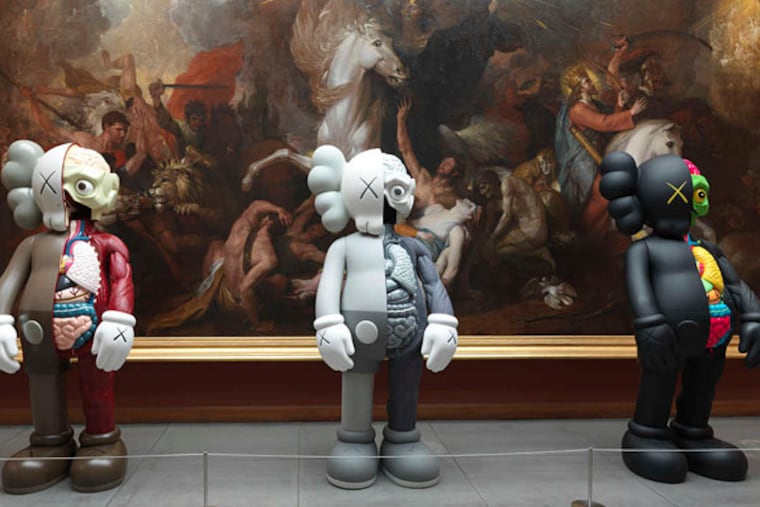
Describing an exhibition at the Pennsylvania Academy of the Fine Arts for an artist who calls himself KAWS can be a frustrating exercise. This show is so improbable and bizarre that words can't fully convey the strangeness of the experience; its unabashed banality must be seen.
"KAWS @ PAFA" is a bold intervention that is supposed to challenge our understanding of what fine art can be now, as opposed to what it was when the academy opened two centuries ago, or even a century ago, when Tom Eakins was in full bloom.
KAWS is the nom de guerre of a Brooklyn artist-designer who was born Brian Donnelly in 1974. His alias is the tag he used when he was a graffiti-writer in Jersey City some years ago. I suspect he kept it because it works commercially; KAWS designs toys and clothing that one can buy on eBay.
The academy introduced him to Philadelphians last spring with a 16-foot-tall sculpture Companion (Passing Through) installed for five weeks at 30th Street Station. The museum and the artist call it a sculpture; I would describe it as a large figurative object or a scaled-up bathtub toy, lawn ornament, or maquette for a parade balloon. (And sure enough, it inspired one in the 2012 Macy's Thanksgiving Day Parade.)
If you saw this example of KAWS' Companion figures, you might anticipate what you're in for at the academy. Yet you can't imagine how his 78 paintings and sculptures are presented there.
They're not installed as a self-contained show in the Hamilton building, where one would expect to find them. They're integrated into several galleries in the historic landmark building, which houses the mainstays of the permanent collection.
Integrated is imprecise; the KAWS works intrude upon, displace, interfere with, and, in a way, mock the paintings and sculptures in the Washington Foyer, Gallery Six, and part of the Rotunda.
One example: Three of the Companion figures stand in front of Benjamin West's monumental 1814 canvas Christ Rejected. Three more, similarly placed, partially obscure an equally monumental biblical narrative by West called Death on the Pale Horse.
At the top of the stairs to the foyer, a seated marble figure of the Assyrian Queen Semiramis by the American sculptor William Wetmore Story is flanked by two long-eared figures that KAWS calls Accomplices, one pink and white, one black. If the Companions nod to Mickey Mouse, these seem to have been inspired by Bugs Bunny.
In the large gallery adjacent, KAWS has taken over the long north wall with a salon-style display of what he calls paintings.
Mostly abstract, they superficially resemble paintings, except that, like just about everything the artist has placed in these spaces, they lack meaningful content. They're as boring as boiled potatoes.
These colorful if bland canvases are hung in front of a 19th-century marble statue called Nydia, the Blind Girl of Pompeii. Could the irony be intentional?
We must acknowledge the magnitude of KAWS' accomplishment - creating a substantial body of work so trite and puerile as to render one speechless. So why is it given such prominence in one of the premier showcases for American art?
Today's media-saturated culture is the key to understanding. Media images are KAWS' source material, especially cartoons and animation. By juxtaposing his work with that of historically traditional artists, the museum hopes that visitors, especially those nourished by a media diet, will more readily connect with and appreciate the older stuff.
At least this is what museum director Harry Philbrick believes, if I understand his rationale. "A painting functions at a different speed of perception for today's viewer," he observes, therefore the artist's job is not to "convey detailed visual data," but to "reference" and "recalibrate" paintings starved for attention in today's perpetual stream of fast-paced imagery.
Perhaps the KAWS intervention will shock some visitors into rethinking, or at least into spending more time contemplating, old-fashioned "slow art."
Still, mixing good art with bad can only devalue the former while falsely valorizing the latter. "Slow art" of the kind that dominates the academy's collection still needs to be considered thoughtfully.
Surprisingly, KAWS' virtuosic superficiality does energize the staid old building. This is especially true for a sculpture installed on a plinth over the Broad Street entrance.
It's essentially a neon-green Gumby figure entwined with what looks like a human sperm cell. If seen from a sufficient distance, its sinuosity and dash of vivid color brighten the dour Victorian façade. Just keep your distance, or the effect dissipates.
Works on paper. The academy still cares about tradition, which is on glorious parade in its new works on paper gallery. The pleasing inaugural show of watercolors features a broad range of styles and periods, from portraits by West and Cecilia Beaux to a Bermuda seascape by Winslow Homer and a set of four gestural abstractions by Robert Motherwell.
This low-ceilinged space on the mezzanine level offers one added pleasure: It's a quiet, secluded refuge from the pop-cult buzz that KAWS generates on the floor above.
KAWS @ PAFA
At the Pennsylvania Academy of the Fine Arts, 118 N. Broad St., through Jan. 5.
Hours: 10 a.m.-5 p.m. Tuesday-Saturday; 11 a.m.-5 p.m. Sunday.
Admission: $15; 60 and older and students with I.D., $12; age 13-18, $8.
Information: 215-972-7600 or www.pafa.org
EndText