Annette John-Hall: Taking his place among nation's 'everyday heroes'
Make no mistake. Ray Gant considers it an honor just to be included among the social entrepreneurs nationally profiled in the recently released (and just in time for the holidays) book, Everyday Heroes: 50 Americans Changing the World One Nonprofit at a Time - especially when you consider how far he has come.
Make no mistake. Ray Gant considers it an honor just to be included among the social entrepreneurs nationally profiled in the recently released (and just in time for the holidays) book, Everyday Heroes: 50 Americans Changing the World One Nonprofit at a Time - especially when you consider how far he has come.
But getting a glossy spread in a coffee-table book isn't why Gant started his nonprofit, the Ray of Hope Project, 10 years ago. All he wanted to do was give back the best way he knew how.
See, it's always been in him to give.
It may be hard to reconcile, but even as Gant corrupted neighborhoods by dealing drugs throughout North Philadelphia, he was into community betterment.
As much as Gant liked making money - the fourth of eight vowed early on that he'd never be broke like his family was - this lumberjack of a man always carried a soft spot in his heart for others. "The money I made, I gave back to the community," he says. "I would help people pay their rent and take care of their kids. I even put a few of my friends through rehab.
"My associates used to say I was hustling backwards."
Yet Gant's do-gooder hustle wasn't enough to keep him out of jail. Years of doing wrong - running with a gang up 25th and Allegheny, dropping out of high school, stealing and robbing - overcame the right that dwelled in his nature. Twelve years of incarceration in state prison, including two spent in solitary confinement, helped nurture and mature the right. By the time Gant was released in 1999, he had a law-abiding plan.
"We spent a lot of time walking the yard, and [Gant] spent a lot of time talking about what he wanted to do," says Gregory Moore, 55, a childhood friend who did time with Gant in Frackville Prison. "We spent time talking about how to help the community get rid of crime, drugs."
Gant hit the streets with a mission of fixing up decaying and damaged homes for low-income families and homeless residents in the city. Once he hooked up with Yardley businessman Willard Bostock, who helped mentor Gant through the paperwork and now volunteers his own sweat equity, the vision became a reality.
So far, Ray of Hope has renovated 80 houses. I'm talking major work, like installing roofs and plumbing, putting down flooring, and doing structural repairs.
Neither material nor manpower goes to waste. Gant enlists unlimited volunteers from schools and churches. But his most meaningful workforce consists of the 35,000 men and women who stream nonstop out of the penal system every year looking for a foothold back into society. Ex-offenders account for 300,000 of Philly's 1,500,000 residents, and some of them are Gant's friends. One of his many goals is to parlay the volunteer work into paying jobs for those who need one.
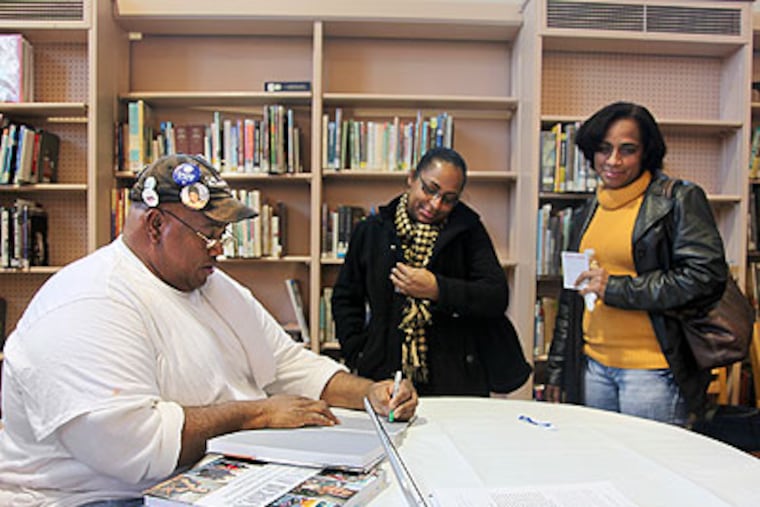
It hasn't happened yet, but that doesn't mean the fruits of his labor aren't visible. Two years ago, Gant wouldn't have been able to have his book signing at the McPherson Square branch of the Free Library in Kensington, because the drug activity was so intense the area was dubbed Needle Park. But on this day, thanks to cleanup efforts of Ray of Hope, the library glistens on the square, clean and inviting. Inside, it teems with children - and Gant, of course.
"I will outlast people who want to do damage to this community," Gant says as he signs another book, "because I ain't going nowhere."