First heyday of gay
TCM marks Gay Pride Month by highlighting the surprisingly frank treatment of homosexual themes in film classics.
Way before
Brokeback Mountain
, nearly a century before, in fact, a gay cowboy rode the Wild West in the movies.
Algie the Miner
(1912), Alice Guy-Blaché's film about an effeminate tenderfoot who proves his manhood, is one of the revelations of "Screened Out," a series airing Monday and Wednesday nights in June on Turner Classic Movies in honor of Gay Pride Month.
TCM is also honoring Ida Lupino as its star of the month - more on her in a moment.
In films like Algie, homosexuality is telegraphed nonjudgmentally through coded gesture and style. In others, it is played for laughs. In yet others, as Vito Russo noted in his seminal study, The Celluloid Closet, the femme man, butch woman or figure who flies beneath the gaydar is a menace to society, an object of ridicule, or invisible.
Richard Barrios, cohost (with TCM's Robert Osborne) of "Screened Out" and author of the book of the same title that inspired the series, had access to pre-'70s films that Russo did not, and begs to differ. Some of the gay figures Russo perceived as objects of ridicule are, to Barrios, subversives flying their freak flags.
For those who think that the soul kiss between Will Ferrell and Sacha Baron Cohen in Talladega Nights broke cinematic ground, "Screened Out" shows that from the dawn of film to the dawn of the gay liberation movement, homosexuality has been out of the closet on screen, though gays and lesbians were not out, as such.
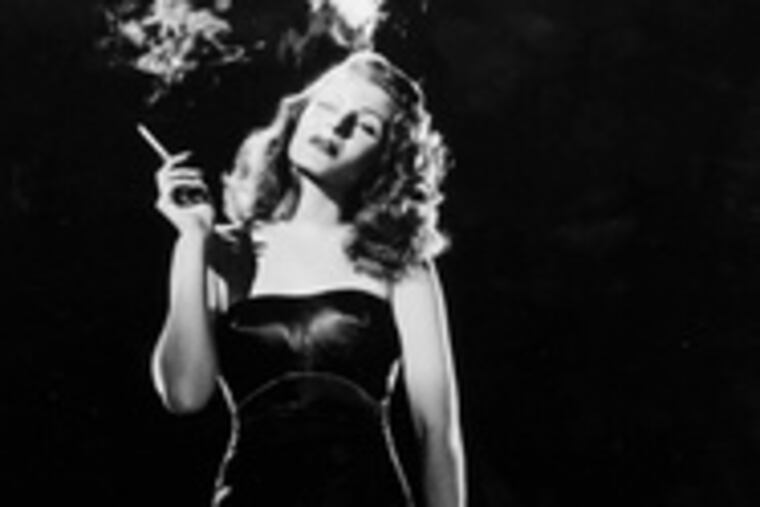
They are there, front and center, in a little-known film like Algie. They are there, more subtextually, in a film classic such as Gilda, in which Rita Hayworth effectively breaks up George Macready and Glenn Ford. And they are there at the heart of movie masterworks such as Queen Christina, where there is as much heat between the cross-dressing monarch (Greta Garbo) and her lady-in-waiting Countess Ebba (Elizabeth Young) as there is between the queen and a Spanish emissary.
"The lesbian theme may have been too subtle for the censors," Barrios says by phone from his home in East Norriton.
Barrios, a film historian who has also written on movie musicals, is a master decoder of "men wearing rouge" and "women wearing neckties," gay guerrillas in '30s films such as the delightful Our Betters, George Cukor's scandalously underknown society comedy.
The film, which screened on TCM last night, has one of the great closing lines in the history of film, one that sets the tone of the series: As two countesses who have feuded for most of the film smooch and make up, Ernest, their rouged male dance instructor, trills, "What exquisite spectacle! Two ladies of title! Kissing!"
Among the highlights of "Screened Out," which spans the early silents through the swinging '60s:
Katharine Hepburn, posing as a youth named Sylvester in Sylvia Scarlett, exciting the romantic interest of a heterosexual male (Brian Aherne).
Gig Young, an employee of Cary Grant in That Touch of Mink, is suspected by his psychiatrist of nursing a crush on his boss.
Jack Cole, the real-life choreographer, as a choreographer in the delightful Designing Woman, debunking gay archetypes by demonstrating that a girly-man is as strong as a he-man.
Lee van Cleef and Earl Holliman as gay hit men in Joseph Lewis' little-known film noir The Big Combo.
Marlon Brando as the married (to Elizabeth Taylor) officer with eyes for enlisted man Robert Forster in Reflections in a Golden Eye.
Organized by film genre rather than chronologically, "Screened Out" examines the evolution of gay representation on screen from subtextual to textual.
It's fascinating to see the spectrum of representation here, and how some classic films regard homosexuality as a given while others regard it as a social problem to be solved.
I look forward to hearing the cohosts' debate on whether Gilda has a homosexual component. (There's something more than an employer/employee relationship between the Macready and Ford characters in this white-hot noir.) I look forward to seeing classic films in a new context. Most of all, I can't wait to see the unfamiliar titles that Barrios and Osborne have unearthed.
For movie geeks (and who is not one?), TCM is the movie palace of the air, our 24/7 continuing education. I plan to be glued to TCM this month for its tribute to Ida Lupino, the fox-faced minx and self-described "Limey broad" who distinguished herself both as actress and director, one of Hollywood's first indie filmmakers.
On-screen, Lupino memorably played dolls, molls, hellcats and the occasional good-time gal. But her most enduring role was as a filmmaker and TV director who made hard-hitting dramas about hard-headed characters. On June 26, TCM will show four films she directed in the '50s, movies about rape, bigamy and mother/daughter relations. On other Tuesdays this month it will air 22 of her films in front of the camera.
The spawn of two acting dynasties, Lupino was born either in 1914 or 1918 in London and drafted by Paramount Pictures in 1933, but she didn't make an impression until she played a Cockney artist's model in The Light That Failed (1939). She shed her ingenue image by gunning for hard-edged roles at Warner Brothers, scoring as the oversexed, overwrought boss' wife with eyes for George Raft in They Drive by Night (1940). The following year she was billed over Humphrey Bogart as the bittersweet moll in High Sierra.
In the Warner pecking order, Bette Davis, Olivia de Havilland and Ann Sheridan were all above Lupino, and she got their leavings. But she made banquets of them. Especially in The Hard Way (1942), as the ambitious big sis who manages Joan Leslie's career (a movie that TCM host Robert Osborne says was inspired by stage mom Leila Rogers and her daughter Ginger). Ditto The Man I Love (1946), as the singer carrying a torch for piano man Bruce Bennett as club owner Robert Alda carries one for her.
In 1948 Lupino married Columbia executive Collier Young and founded an indie company, Filmakers, that made low-budget movies. Lupino wrote five, directed six and starred in three. Most of them were "problem films," movies such as 1949's Not Wanted (about abortion), transgressive in that they're seen from a woman's emotional perspective.
TCM will show The Outrage (starring Mala Powers as a rape victim who struggles with her desire for revenge), The Bigamist (Edmond O'Brien and wife Joan Fontaine are infertile, but he gets a waitress, played by Lupino, pregnant) and my personal favorite, Hard, Fast and Beautiful, with Claire Trevor as an ambitious mom who pushes her tennis prodigy daughter onto the professional circuit. (That's the Philadelphia Cricket Club in one sequence.)
Lupino's personal favorite of the films she directed is The Hitch-Hiker (1953), the chilling tale of a fugitive who commandeers a car belonging to guys on a Baja fishing trip, and is the template of modern action flicks.
Though Lupino continued to act during the '50s and '60s, she was more interested in directing, and made more than 100 TV episodes, leaving her stamp on The Virginian, The Untouchables and Alfred Hitchcock Presents. It was while watching the diminutive Lupino mount her camera atop a horse to shoot a sequence of Have Gun, Will Travel that Clint Eastwood, star of the rival TV western Rawhide, was moved to try his hand behind the camera.