Law Review: At law firms, what hard times?
It is one of life's enduring mysteries: Why are lawyers so well-compensated, especially now, when the legal profession is in its worst downturn since the Great Depression.
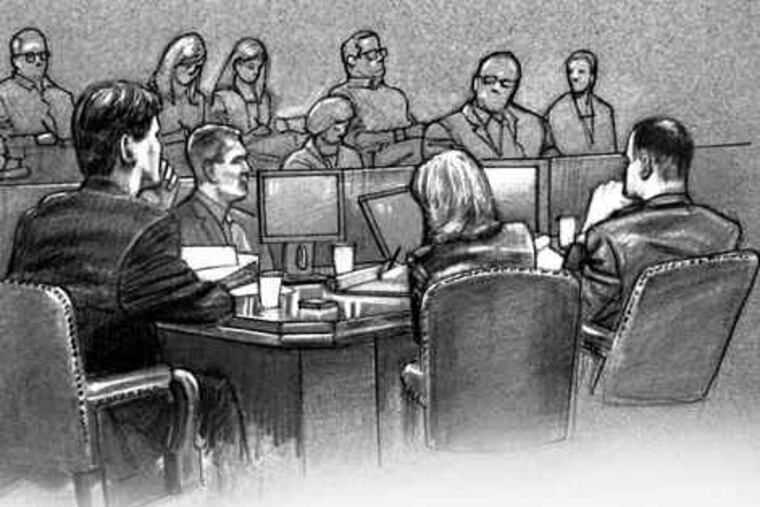
It is one of life's enduring mysteries: Why are lawyers so well-compensated, especially now, when the legal profession is in its worst downturn since the Great Depression.
One persuasive explanation is that law firms, so often behind the curve when it comes to standard business practices, have been very savvy in finding new markets.
Another is that firms were quick to respond to the downturn, which began in the legal marketplace in 2008, by laying off thousands of lawyers and staff to restore their balance sheets.
The cost-cutting had the desired impact, and some firms are reporting surprisingly robust profits for 2009, one year after it seemed the world was falling apart. Look no further than Reed Smith L.L.P., which announced 7 percent growth in profits even though revenues declined almost 4 percent, for signs of how splendidly the upper echelons of the industry are doing despite the economy.
But the legal world's grasp on prosperity is based on more than clever marketing or even the downsizing that has shaken the profession.
Lawyers have a way of making themselves indispensable, even when their clients probably wish they were not.
That is one of the important takeaways from the bitter legal battle between Airgas, the Radnor-based industrial-gas producer, and Air Products & Chemicals, of Allentown, that is now playing out in courts in Delaware and Pennsylvania.
For only well-compensated lawyers, deploying writing and argumentation skills of the highest elegance and sophistication, could turn questions about their own role in litigation . . . into more litigation.
Until Friday, the battle hinged in no small part on Airgas' allegation that Cravath Swaine & Moore L.L.P., the law firm of Air Products, had breached ethics rules by representing both parties as Air Products prepared its takeover bid.
Cravath and Air Products won a major decision Friday, when Delaware Chancery Court Judge William Chandler III ruled that Cravath could remain as Air Products' lawyer. A lawyer for Airgas said yesterday that a decision had not yet been made whether to appeal Chandler's ruling.
A parallel battle is under way in U.S. District Court in Philadelphia, where Airgas is suing for damages it says resulted from the alleged conflict of interest.
This conflict allegation - essentially, that Cravath used information it obtained in its representation of Airgas to buttress Air Products' takeover plan - has generated hundreds of pages of legal briefs, memoranda, and exhibits, and doubtless tens of thousands of dollars in legal fees.
That the dispute involved Cravath, an august, old-line firm based in midtown Manhattan that for generations has been at the pinnacle of the legal profession, has had the legal blogosphere atwitter.
But what is really taking place isn't just a litigation battle over the profession's ethics canon - it's also a series of strategic maneuvers in the context of a bitter and very high-stakes takeover fight.
Lawyers who have been on the inside of corporate-takeover contests say the impulse of targeted companies typically is to use whatever legal weapons are available to get to the result they want: derailing the takeover bid.
Catherine Lanctot, a professor of legal ethics at Villanova University law school, said it had become an increasingly common tactic in takeover battles for one side to seek to disqualify the other side's law firm.
Quite apart from the merits of the conflict allegation, getting a law firm thrown out raises the costs for an opponent and creates just one more obstacle.
"It costs money and resources," she said. "It can slow down the other side."
A little background is in order.
During a dinner meeting in Radnor on Oct. 15, John McGlade, the Air Products CEO, told Airgas CEO Peter McCausland of his interest in acquiring the company in a $5.1 billion transaction.
Several weeks earlier, Cravath had advised Airgas on a financing issue, as it had on other occasions going back to 2001.
During this period, Cravath also had represented Air Products, a client of 40 years, which asked the law firm to explore the possibility of representing the company in its then-nonpublic effort to acquire Airgas.
Cravath lawyers ran the standard conflict checks and, because the prior representation of Airgas was mundane, in their opinion, and had generated no information of strategic value, the representation of Air Products in the takeover bid was a go.
Lawyers for Cozen O'Connor, representing Airgas on the conflict allegation, begged to differ.
In a memorandum filed in U.S. District Court, the company charged that the conflict question implicates "one of the profession's golden rules: that a lawyer may not simultaneously represent two clients who are adverse."
The legal ethics rules, on their face, are clear: a law firm cannot represent opposing clients on the same or substantially related matters.
But what that means is highly case-specific.
Judge Chandler found that, in this instance, Cravath's work for Airgas was limited in scope and that it had established internal barriers preventing Cravath lawyers working on the takeover from obtaining confidential information about Airgas.
In court papers, Cravath perhaps unwittingly suggests an incentive for dropping Airgas. And it may have as much to do with profitability as conflict avoidance.
It argues that its representation of Airgas, though lasting about nine years, involved only minor financial transactions.
Airgas told the firm its representation would be confined to relatively minor debt issues, and the firm had no chance of acquiring more lucrative work because Airgas CEO McCausland had long-established relationships and those would remain in place, according to the sworn affidavit of Ronald Cami, the Cravath relationship partner representing Airgas.
The point that Cravath was making is that the nature of its representation was so minor that it couldn't have gotten inside information.
But there is another way to look at it: Cravath wasn't making all that much money at Airgas, relatively speaking, and it had a much longer relationship with Air Products.
So when the opportunity arose to get a far more lucrative gig from Air Products, its client of 40 years, it ditched Airgas.
The point is that in litigation, as in politics, the underlying purpose can be very different from what the players say it is.
Or there may be multiple purposes, not all of them transparent.
Washington insiders sometimes boast among themselves about how the political process resembles Japanese Kabuki theater, with its exaggerated gestures, costumes, and dance movements, to make a point.
The same is true with some litigation battles, where theatrics and symbolic impact can have as much consequence as the stated purpose of the lawsuit.
In this instance, the message from Airgas to Air Products is this: Expect a very tough fight.