Daniel Rubin: At Philadelphia hospital, musician dispenses tranquilizer
Marcia Kravis is the rare conservatory-trained musician who loves it when her audience falls asleep. Thursday afternoons you can find her sitting in a corner of the emergency room at Thomas Jefferson University Hospital, tapping a hammered dulcimer to set a mood of tranquillity.
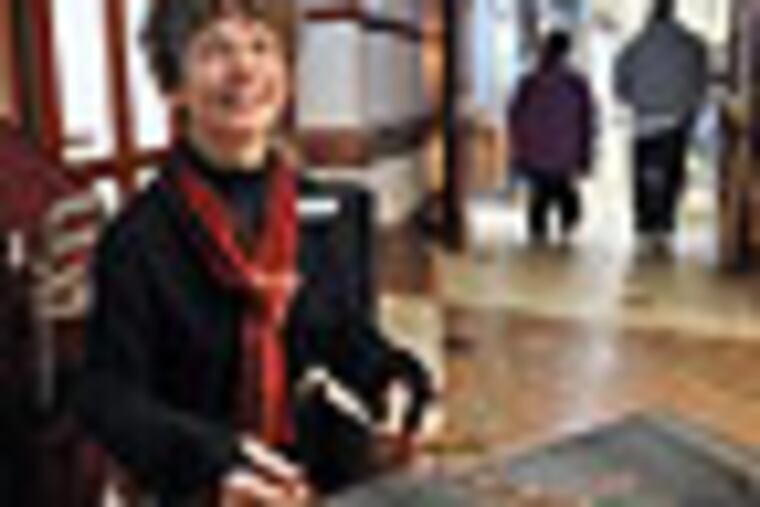
Marcia Kravis is the rare conservatory-trained musician who loves it when her audience falls asleep.
Thursday afternoons you can find her sitting in a corner of the emergency room at Thomas Jefferson University Hospital, tapping a hammered dulcimer to set a mood of tranquillity.
She studied harpsichord at the New England Conservatory of Music and, after years of performing and teaching, trained as a music practitioner. She picked up the dulcimer in part because of something she'd heard in music-therapy class.
"A nurse told of someone who had played the harp for patients who had been comatose for a long time. All of a sudden, one of the patients woke up and went into a panic, saying, 'I'm not ready.' "
She found the hammered dulcimer relaxes people who are stressed without suggesting the heavenly gates.
At 1 p.m. Thursday she wheeled her instrument, its stand, and a folding chair to an empty spot in the emergency medicine department, between a staff consultation area and a bay of rooms for patients in less acute trauma.
Psychologists and nurses were conferring, and few patients filled the beds. She doubted she was doing any good.
So she quickly moved to a corner of the waiting room, where 25 people sat. The petite 62-year-old with brown spiky hair asked if she could turn off the TV. She gave them something more healing, a repertoire that ranged from transcriptions of baroque pieces for keyboard to slowed-down Irish folk songs to "Over the Rainbow."
Against the window, 20-year-old Krystn Adams tried to relax while idly patting her stomach. She's two months pregnant, and has an upper respiratory infection. She said it took her a while to realize that she wasn't listening to the radio.
"It's like when you go to a Chinese restaurant, and you hear this sort of music playing," Adams said. "It's like water trickling. It's real calming, like a massage without the massage."
Four of the people waiting were asleep. A heavily bandaged woman in pink barked loudly on her cell phone to someone named Tony.
"I just want to get this over with," she said. "Can we do this today, Tony? Tony? Tony!"
Sitting nearby, Lucille Ettore, a registered nurse from New Jersey, did her best to put the cell-phone drama behind her. The dulcimer helped.
"I love it," she said. "It's so peaceful, especially if you have to be sitting here a long time."
She'd been waiting an hour and 40 minutes for a sick family member to be seen, she said. "That lady is making it a lot easier."
Every half-hour Kravis switched rooms, returning to the less-acute area, then to a place where the staff tends to the sickest patients behind sliding glass doors.
For the last set of Kravis' two-hour performance, she set up in front of a sonogram machine that hunts veins.
Each time someone walked by, she looked up, making eye contact, exchanging pleasantries, never hurrying the beat. When she plays, Kravis smiles slightly, her head tilted, hitting the 23 double strings of the trapezoidal instrument with two wooden hammers, felt tips up. She likes a bit of volume.
"When I am in the waiting room, I'll try to take the temperature of the room in an emotional sense," she said. "If the room is active, I'll start with some up-tempo music, a little more ornamented, busy-sounding. I gradually slow down the tempo. Sometimes I'll see someone in real pain. I will try to play to that person."
For the music to work, she relies on a principle of physics called entrainment. "Basically, it's a process in which two vibrating bodies that are out of step with each other lock into each other's vibrational rate. They synchronize."
Two weeks before, a mother had brought in her toddler, suffering from an earache. The girl screamed and the mother seemed over-the-top. Kravis kept playing.
As the mother chatted to relatives over the phone, the girl started wandering down the hall. "As the child approached, her crying became more like whimpering. Then she saw me. I started playing 'Hush, Little Baby.' She just stood there and stared at me. We had this wonderful rapport."
Kravis has taught music and drama at the Philadelphia School, worked in a hospice, and performed in early-music groups such as La Bernardinia Baroque Ensemble.
Since 2007 she has played around Jefferson, more recently for pay, and works in the emergency department and in rooms where gravely ill patients receive palliative care. It's there that she finds reward in sending someone off to dreamland. "I feel that is a very positive outcome of a therapeutic music session."
Kravis was just about to pack up Thursday when an emergency medical technician passed by and razzed her.
"Jeez, I haven't seen you in a while," he said. "I thought maybe you hit a bad note and they canned you."
She laughed, playing on.
The curtain to the darkened room across from her opened. The room had been still and dark for a half-hour. A woman who'd been visiting a patient stepped out and approached Kravis.
"So nice and smooth," the woman said. "So nice and smooth."