Daniel Rubin: Graduates in Philadelphia put themselves to good use
You've probably seen the bad news about recent college graduates, or maybe you have someone back home right now stretched out on the couch.
You've probably seen the bad news about recent college graduates, or maybe you have someone back home right now stretched out on the couch.
A Georgetown University study puts the unemployment rate for those with new bachelor's degrees at 9 percent, which is better than the numbers for those who didn't graduate from college, but not so good if they're just starting to pay off all that debt.
Here's something good: Six years ago, a couple of Haverford College alums created a program to reverse the brain drain that was sapping Philadelphia of its finest young thinkers.
Called Philly Fellows, it placed service-minded fresh graduates with local nonprofit organizations, and it has done a fine job of keeping that talent on hand: Half of its 86 alums still work in the city, and one - Justin Ennis - has risen to be executive director of the agency where he began, the After School Activities Partnerships.
At first, it wasn't so easy to persuade 20-somethings who'd come to Philadelphia for college to consider staying in town and working for a salary that puts them just above the poverty level.
Now the Philly Fellows has its pick of candidates.
So many collegians were looking to stay in Philadelphia last year, for pay of just over $12,000, that the organization had to refine the way it was recruiting. "We were getting too many kids who were just looking for something to do," cofounder Tim Ifill said. The latest batch of 16 fellows was culled from 136 applications.
Adrienne Webb is typical of those the program prizes, a Bryn Mawr grad from Pittsburgh who completed three internships in the area before starting in July as a Philly Fellow. Twice, she worked with the Philadelphia Mural Arts Program. And she helped poor people in Norristown fill out their tax forms.
Jobs did not come knocking for her peers this spring. "Quite a few students I know who graduated went straight home and didn't have a job waiting. Some went to grad school. A very small group went into the workforce."
Most of the fellows I spoke with studied liberal arts at places like Penn, Swarthmore, Bryn Mawr, and Haverford. Rob Hanlon studied accounting at Villanova.
Becoming a fellow carried some risk - a lot of his friends had lined up jobs that paid much better.
"I wanted to figure out how to use my business sense to help other people," the San Diego native says. He's assisting small businesses with the Fairmount Community Development Corp.
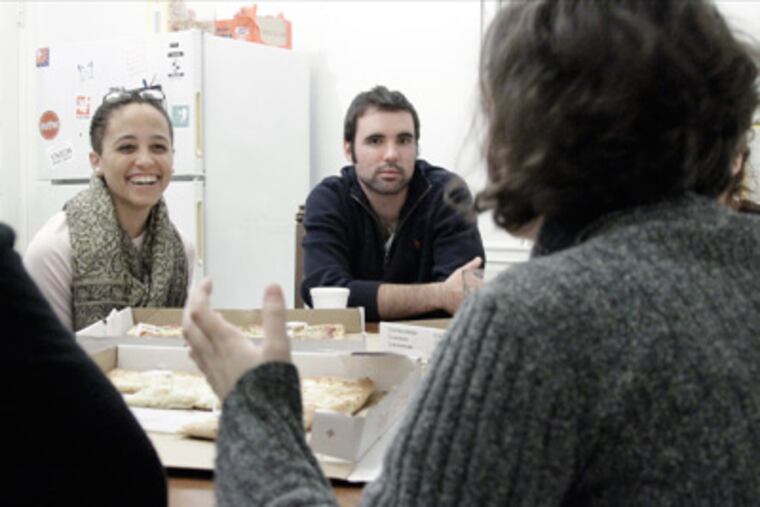
For one year, the fellows live rent-free in one of three rowhouses scattered around the city. In addition to grossing about $1,000 a month (the program is funded mainly by AmeriCorps and the nonprofits themselves), they defer paying off student loans for 12 months, and after their service, they earn a $5,000 stipend.
Brian Mertens, a Penn grad from Berkeley, Calif., said the low pay caused some juggling. Some of the fellows must still rely on parents and "negotiate who's paying for cellphones and trips home over Thanksgiving." The program offers health care to those who are independent of their parents but doesn't cover dental work.
The experience has warmed the fellows to Philadelphia, which four years of living at the city's edge doesn't necessarily do, says Sameer Rao, a Haverford grad from Avon, Conn., now working with the Philadelphia Young Playwrights.
"For a lot of people [in college], Philadelphia is not a very exciting city," he said. "It's much more interesting than people think."
Rebecca Wright, a Swarthmore grad from Newton, Mass., likes living at 46th and Spruce Streets in a flat filled with people her age doing similar work, but knowing different things.
"Adrienne finds out about all these really cool poetry things and film screenings, while others know where the best bands are playing."
The only downside? It's about time for them to start thinking about what they want to do next year.