BET series, though dull, illuminates Vick the man
In this town, Eagles quarterback Donovan McNabb has his detractors and his staunch defenders. McNabb's backup, Michael Vick, is an even more divisive figure - but on a national scale.
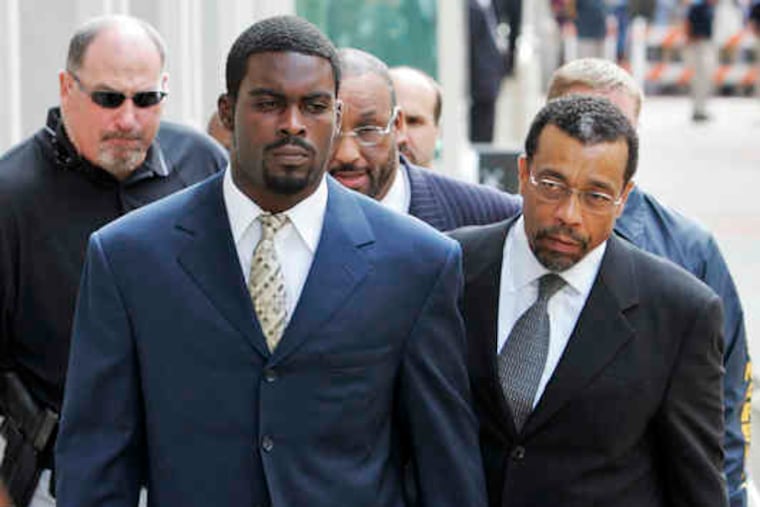
In this town, Eagles quarterback Donovan McNabb has his detractors and his staunch defenders.
McNabb's backup, Michael Vick, is an even more divisive figure - but on a national scale.
Since he pleaded guilty to running an interstate dogfighting ring in 2007, the athlete has been the target of vituperative attacks by people who feel that he organized and bankrolled unforgivably heinous acts of animal cruelty.
Others see him as a guy who has apologized and paid for his mistakes (with bankruptcy and 23 months behind bars), and deserves the opportunity to rehabilitate his reputation and his football career.
The Michael Vick Project (10 p.m., BET), a 10-part documentary series taped over the last six months, is the most far-reaching and arduous effort to date in his ongoing redemption campaign.
It's also the last. Vick has said that after the series is over, he will no longer speak about his dog-fighting involvement (except when he is addressing groups on behalf of the Humane Society).
MVP is a well-crafted apologia pro vita sua. But judging by the first episode, it's also a dry and dull TV experience. Whether you're pro- or anti-Vick, you may not have the patience for this plodding portrait.
If nothing else, it certainly provides a deeper understanding of the man.
Vick grew up in a housing project in Newport News, Va. His scintillating talent as a football player, showcased at Virginia Tech, made him the first African American quarterback to be taken with the first pick in the NFL draft, in 2001. He signed what was at the time the league's most lucrative contract.
"I first seen dogfights when I was 7 years old," he says in the documentary. His adolescent fascination with the animals and their pitched battles only got deeper as he aged.
Big money allowed him to pursue it full tilt. He bought a 15-acre property in Shipp, Va., to house his Bad Newz Kennels. There he and his friends trained 68 dogs.
Vick was rather obsessive about the enterprise, revealing that even during the NFL season, he would fly in at least once a week to check on the kennel.
MVP is composed of a series of talking heads, punctuated with family snapshots and sports and news footage.
The primary interviewee is Vick himself, who allows the cameras extensive access. But Vick is also the reason MVP doesn't generate much sympathy.
America seems to like its contrition served up with a healthy dose of emotion. Vick is simply not going there.
His demeanor has always been impassive. He rarely shows his feelings in public. That's why some people have trouble accepting that he is truly remorseful.
Since he signed with the Eagles last August he has been saying all the right things - over and over. (In the pilot, he describes his behavior as "inhumane and barbaric.")
But his preternaturally unruffled manner makes it easy to believe that these are just words he's been coached to say. In one of the few touching moments in the debut, Vick declares that he shed copious tears for his two young daughters on the day he was bused to prison.
The future is uncertain for Vick. (If the Eagles don't pick up the option year on his contract, he's said he'd love to play for the Redskins.) But this series makes it manifestly clear that he wants to put his past behind him.