Review: Wallacavage meets Jules Verne at the Art Alliance
It’s hard to imagine any exhibition that could rival the over-the-top visual circus assembled by Miss Rockaway Armada at the Philadelphia Art Alliance last spring, but Adam Wallacavage’s enchantingly bizarre "Shiny Monsters: An Installation," though a smaller show limited mainly to the Alliance’s second floor, is just as mesmerizing in its own way. Where the Miss Rockaway Armada succeeds at the DIY, thrown-together effect (not!), Wallacavage is the master of finesse. His baroque octopus and sea serpent-shaped chandeliers and sconces are so seamlessly constructed you wonder if he made them or had them fabricated (they’re all handmade by him). The inspiration behind Wallacavage’s pieces came from the dining room in his own house on Broad Street, which he modeled after Jules Verne’s 20,000 Leagues Under the Sea, and from the interiors of now-closed Gothic and Renaissance Revival Catholic churches in Philadelphia that he visited as a youth. Wallacavage, who is also a photographer, taught himself the traditional techniques of ornamental plastering, began sculpting with epoxy clay (his hand-modeled clay makes up a good part of his works, such as an octopus’ tentacles), and eventually developed his own glistening glazes.
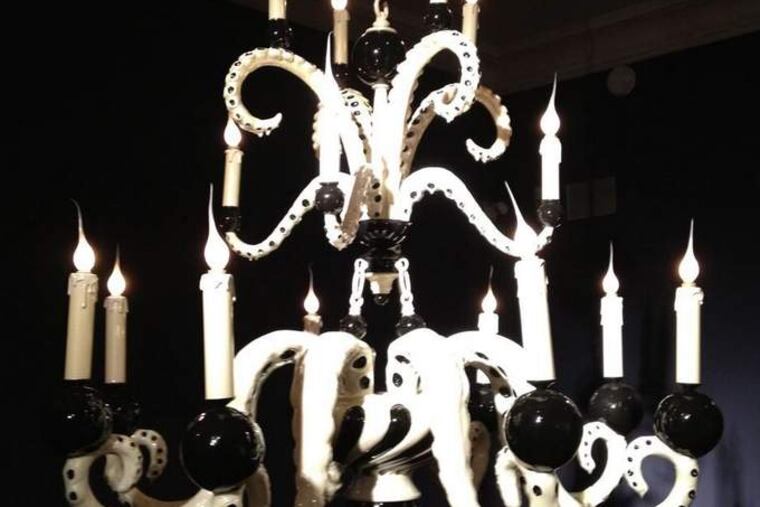
It's hard to imagine any exhibition that could rival the over-the-top visual circus assembled by Miss Rockaway Armada at the Philadelphia Art Alliance last spring, but Adam Wallacavage's enchantingly bizarre "Shiny Monsters: An Installation," though a smaller show limited mainly to the Alliance's second floor, is just as mesmerizing in its own way. Where the Miss Rockaway Armada succeeds at the DIY, thrown-together effect (not!), Wallacavage is the master of finesse. His baroque octopus and sea serpent-shaped chandeliers and sconces are so seamlessly constructed you wonder if he made them or had them fabricated (they're all handmade by him).
The inspiration behind Wallacavage's pieces came from the dining room in his own house on Broad Street, which he modeled after Jules Verne's 20,000 Leagues Under the Sea, and from the interiors of now-closed Gothic and Renaissance Revival Catholic churches in Philadelphia that he visited as a youth. Wallacavage, who is also a photographer, taught himself the traditional techniques of ornamental plastering, began sculpting with epoxy clay (his hand-modeled clay makes up a good part of his works, such as an octopus' tentacles), and eventually developed his own glistening glazes.
Seen against monochromatic backdrops of purple, pink, dark turquoise, and indigo blue — Wallacavage was apparently given carte blanche to paint the second-floor gallery walls as he saw fit — and hung from the ceiling or on walls, his electrically lit chandeliers and sconces seem almost alive, an effect that's exaggerated by their wet-looking surfaces and the lifelike shadows they cast on the walls. You half expect the James Mason version of the control freak Captain Nemo to emerge from a darkened corner in his red smoking jacket.
Downstairs, in his solo exhibition "Periphery," Michael Fujita is showing a group of sculptures composed from humble castoffs that he finds or is given. Broken glass, bits of clay, and wood scraps have all been cleverly recycled into art. There's humor here, but a solemn feeling pervades this work.
In Fujita's Panes, the broken glass he swept up from the street has been perfectly arranged and cast in resin to form elegant panes that are supported in a windowlike wood frame; his towering Tree is made from wood scraps. Kindle, displayed in the former dining room's fireplace, is a pile of thin, glazed ceramic stick-shaped forms.
Eva Wylie, whose solo show "Flat Out: A Screen Print Installation" has the adjacent parlor gallery, also uses the fireplace as a showplace, in her case making a large screen print, Flat Out, directly on the wall above it. Five of her screen prints on paper, which incorporate layers of images from advertising, consumer products, and tourist memorabilia, make up the rest of her show. Made in a manner reminiscent of decoupage, the 18th- and 19th-century ladies' craft of cutting images from prints and gluing them to various surfaces as decoration, they suit their surrounding 19th-century parlor to a T.
Ancient auras
Unlike her first "Roman Paintings" of 1986, whose colors were inspired by her memories of light on Roman architecture as well as by the hues used to represent skin tones in Western painting, Marcia Hafif's "Late Roman Paintings" from 1996 feature paint colors that were likely used in the frescoes of Pompeii.
In their installation at Larry Becker Contemporary Art, where they are being shown publicly for the first time, Hafif's 19 "Late Roman Paintings" are also aligned from their tops (rather than their centers) to reflect the practice of early wall painting rather than the portable tablet of the Renaissance. To the rest of us, these small vertical paintings are hung unusually high and suggest clerestory windows.
Hafif makes her own paint, grinding pigments into oil — and often adding white to create a lighter version of the pure color — and it's easy to differentiate her handmade paint from the contemporary, factory-made stuff. The color rendered from such ancient pigments as Pozzuoli Red and Terra Ercolano has an earthy, tactile quality that is foreign to most contemporary paints.
But the real pleasure of these paintings derives from their duality — as a series of forthright paintings made with a conceptual rigor and as windows to the past.