When TV shows clash with real-life violence, should fiction back away?
USA postpones sniper drama Shooter, while OWNs Greenleaf carries on with storyline about a police-involved shooting.
Thoughts, prayers, TV postponements.
When violence strikes, as it does with almost numbing regularity, calls for the first two often are quickly followed by the third, as network executives scan their lineups for fictional shows that might remind viewers uncomfortably of the all-too-real dramas playing out on the news.
USA's new drama Shooter on Monday had its premiere postponed to the fall in response to the fatal attacks on police in Baton Rouge, La., becoming the latest show considered a little too evocative of current events.
Shooter already had been pushed off a week after five police officers were killed by a gunman in Dallas on July 7.
It stars Ryan Phillippe as Bobby Lee Swagger, an ex-Marine sniper. After a former commanding officer (Omar Epps) lures him out of retirement for a mission involving a threat against the president, Swagger ends up accused of a crime he didn't commit.
Described by USA as a reimagining of the 1993 Stephen Hunter novel Point of Impact and the 2007 film Shooter that starred Mark Wahlberg (and that was partially shot in Philadelphia), this latest incarnation isn't likely to get anywhere near my Top 10 list for 2016, even if I'm as impressed by its treatment of some of the real-world challenges facing military veterans as by Swagger's eagle eye.
Still, there's nothing in the four episodes I've seen reminiscent of the horror in Dallas and Baton Rouge, unless you consider it too much of a coincidence that the shooters in those cases had served in the military, and that guns were involved.
If that's enough to make you flinch, it might be better to stop watching television altogether. Because there is no more guarantee of a safe space there than anywhere else.
And it's not as though USA can be sure, either, that the fall will be a more peaceful setting for the launch of an action-packed conspiracy thriller whose main character is a sniper nicknamed "Bob the Nailer."
TV writers occasionally can be eerily prescient: One of the programs postponed after the Paris attacks last fall was an episode of TNT's Legends that reportedly had someone shooting into a crowd in that city. Sometimes, though, people several pay grades above the writing staff get carried away.
In 1999, immediately after the massacre at Colorado's Columbine High School, the WB postponed an episode of Buffy the Vampire Slayer in which a high school student was seen loading a weapon. The situations weren't really analogous, but it was probably the right call at the time.
But after another school shooting, the network postponed the second half of the show's two-episode season finale, and the level of caution began to seem ridiculous, because the episode, shown several weeks later, had students taking up arms against a high school principal who'd been transformed into a 60-foot-tall, serpentlike demon - a scenario we've yet to encounter on cable news.
The world we live in does include terrorism, fiercely defended Second Amendment rights, and more angry and/or mentally ill people than most of us would like to think about - and, like it or not, all those things are as much fair game for television as vampires or demons.
Producers and networks acknowledging that reality have a choice. They can pretend each new incident is an aberration and hope a particular show or episode won't be the casualty of coincidence, or they can address all acts of violence with enough context to justify their presence - no matter what's happening in the world outside.
This past season of ABC's American Crime took the second path, with a story line that led up to a school shooting. It was an episode we might not have seen coming but when it arrived, it was clearly there for more than shock value, including in its aftermath real people whose lives had been changed by similar events.
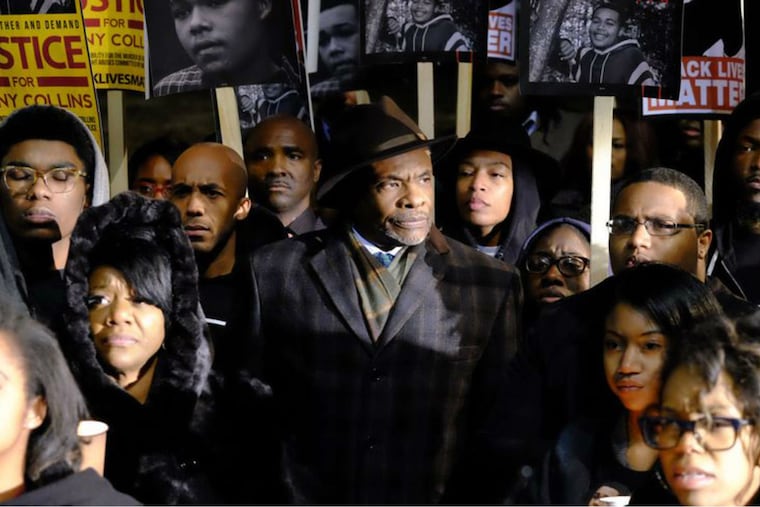
This summer, I've also been impressed by OWN's new Greenleaf. A family drama centered on a Memphis megachurch, it has from the beginning included a story line about the ramifications - legal, political and emotional - of a police-involved shooting.
That both the police officer, who's a member of the church congregation, and the unarmed teenager he shot are black doesn't remove race from the equation.
As a topical drama with an African American family at its center, Greenleaf, which was created by Craig Wright (Six Feet Under) and which features another of its executive producers, Oprah Winfrey, in a recurring role, is able to include a story line like this as a sad fact of life, not breaking news.
(For an example of how TV shouldn't handle the issue of violent police interactions with African Americans, we don't have to look further than the most recent episode of A&E's UnReal, which was, for once, as shoddily manipulative as the fictional "reality" show it depicts.)
I'm liking Greenleaf, too, for the way it has (so far) balanced cynicism about the motives of some church leaders with an acknowledgment of genuine spirituality.
It's too soon to say how successfully Greenleaf will deal with the competing interests of one congregant who's made a terrible mistake and the wider community on an issue that's already threatening to split the church apart.
I'll be watching.
Because this is the kind of story that, if done right, has the power to help illuminate the real ones we don't yet seem to be able to eliminate.
215-854-5950
@elgray