One Last Thing | Why the British outclass us in acting
Helen Mirren's much-deserved Oscar win last week prompted an interesting discussion around the office: Who are the greatest American movie actors?
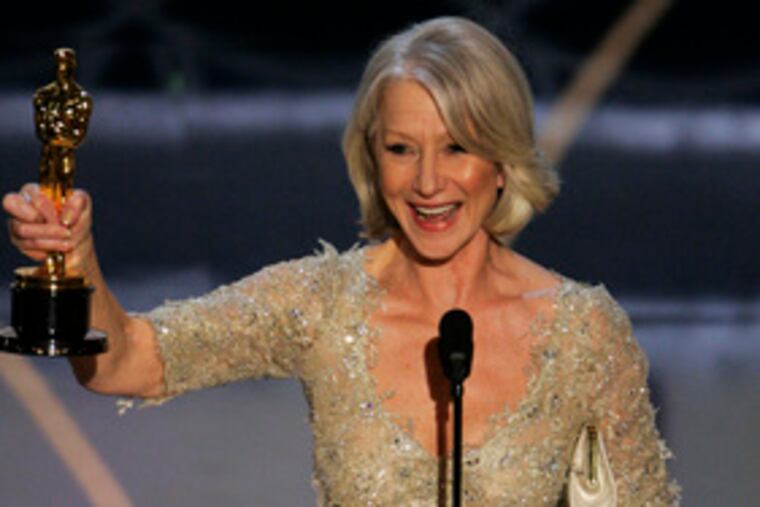
Helen Mirren's much-deserved Oscar win last week prompted an interesting discussion around the office: Who are the greatest American movie actors?
Your list might differ around the margins, but there are a few names that go down in ink. Spencer Tracy. Robert De Niro. Jimmy Stewart. Jack Nicholson. Bogart. Those five are locks. I'd probably include James Cagney and Morgan Freeman, too. We can argue about the rest.
Now make a list of the great British movie actors, and you'll realize something startling - none of our American actors would even crack the British top 10, which could include, just for starters, John Gielgud, Laurence Olivier, Kenneth Branagh, Richard Harris, Michael Gambon, Ian McKellen, Alec Guinness, Jeremy Irons, Richard Burton and David Niven. (We'll leave Cary Grant to the side; born in England, he moved to America at 16 and never left, making him neither fish nor fowl for our purposes.)
It's worse for women. What American actresses belong in the same pantheon as Emma Thompson, Joan Hickson, Judi Dench, Helen Mirren and Maggie Smith? Probably none.
This disparity in elite talent is surprising, but perhaps not wholly unexpected.
There are important differences between the British and American entertainment industries. British actors are reared in the theater; they live and learn on stage. For many of them, television and movies are side gigs. Compared with American actors, whose careers usually are geared toward movies and TV, this gives Brits an enormous advantage, like the Kenyan distance runners who train at 6,000 feet above sea level.
Economics matter, too. The British film industry is not yoked to the special-effects blockbuster. With the exception of the Harry Potter series, there are no British Godzillas or Independence Days. Having limited means can be a blessing. Because British producers aren't given the money to make high-concept, high-popcorn movies, they're free to do small, character-driven pieces. Which is a boon to actors - just ask Natalie Portman how much she enjoyed standing in front of a green screen with George Lucas for three consecutive movies.
Then there's the matter of language. At least half (probably more) of the emotional and artistic effects an actor achieves is through the rendering of language, and English is the province of the English. The race, as Churchill might have put it, understands the language in ways most Americans simply can't. As the old joke goes, the average British writer can make the directions on the back of a box of condoms read like the Magna Carta. And the average British actor can recite them like they're an aside from A Midsummer Night's Dream.
The Brits take some pride in this mastery. As one wag once put it in the New Statesman, "The English language proper belongs to the people who dwell south of Hadrian's Wall, east of the Welsh hills, and north of the English Channel." The late Enoch Powell added, somewhat more sternly, "Others may speak and read English - more or less - but it is our language, not theirs. It was made in England by the English and it remains our distinctive property, however widely it is learnt or used."
Which attitude leads to the final factor: the British embrace of elitism and class. The English have a devastating sense of class, which is both born of, and a cause of, their historical record of greatness. To them, everything - people, ideas, things - has its place (whether they personally like the place it's assigned or not). The American cultural ideal is a noble egalitarianism. For the English, the ideal is nobility itself. They are not afraid of greatness or standards. They yearn for them.
So when British actors take a part in a contemporary movie, they want to create more than the stock silhouette. To take just one for-instance, consider the 1980s, when British actors (beginning with Alan Rickman in Die Hard) became the dastardly villains in many American action movies: They were so interesting that they created a new character archetype, which itself became clichéd.
Of course, one can be overly romantic about these things. The English gave us Shakespeare. They also gave us the Spice Girls. An honest accounting would admit that the Brits have been as susceptible to po-mo cultural relativism as the rest of us.
The difference is that when British elites roll their eyes at the canon, they know it's there. And they accept that they are planted in its shadow. An Anglophile friend who is a professor of English explains it so: "When teaching American students about aspects of culture, you need to teach them that a duke is addressed as 'Your Grace,' etc. English students mock these sorts of class differentiations - but they know them nonetheless." When it comes to culture, you don't have to believe in the system, though that helps. You just have to know it exists.
The British know it. They still read Sheridan and Congreve in school. Their actors still perform Marlowe and Wilde. The great canon is powerful enough to better even those who would reject it.
Meanwhile, American actors raised on the more meager menu of egalitarianism have been taught that "greatness" means playing a drug addict or a drunk. Most years, this means that the Oscar goes to Angelina Jolie or Halle Berry. I'll take Dame Mirren.