Jonathan Takiff: Speakers bureau, iPod-style
SO, HOW MUCH does Apple monopolize the digital entertainment business? There's hardly a home audio/video product made today - from clock radio to a/v receiver to complete "home theater in a box" system - that doesn't have a dock for an Apple iPod or iPhone. You can even find some TV sets (from JVC) with a pop-out connector.
SO, HOW MUCH does Apple monopolize the digital entertainment business?
There's hardly a home audio/video product made today - from clock radio to a/v receiver to complete "home theater in a box" system - that doesn't have a dock for an Apple iPod or iPhone. You can even find some TV sets (from JVC) with a pop-out connector.
Saleswise, the shining star is the least-complicated type of player: iPod speaker systems. The product category registered more than $1 billion in U.S. sales last year.
Lacking a radio tuner or a CD player (both so 20th century), these compact, attractive, amplified speaker boxes put most of their design attention on cranking up and fine-tuning (with "digital signal processing") the output of a docked iPod or iPhone. All so you can listen to your favorite tracks, albums, streaming music services and movie downloads in a more social, sharing way, without having to wear those isolating earphones. And without raising the ire of your "eeww, you're not putting that pile of electronics in my living room" spouse.
Almost all iPod speaker systems come with a wireless remote control to (at the least) skip through tracks, pause play and adjust the volume from across the room.
All systems charge the Apple player while it's docked, an important convenience for iPhone users who want to re-energize the battery every night. And, if a call comes in to a connected phone, these devices smartly damp down the music.
Almost all the amplified speaker docks have an input jack on the back so that you can plug in a non-Apple music/video player (gee, there are some?) or other source like a computer, CD spinner or portable DVD player. Some also have a video output, so you can funnel the visuals of a recorded movie to a bigger display.
All that is well and good, but how musical could these small speaker systems sound? Good enough to toss your big old rack of stereo components?
I've been putting five iPod speaker systems through their paces with an assortment of well-recorded rock, funk, folk, jazz and Broadway tunes that emphasize (for the most part) acoustic instruments and nonprocessed male and female voices - acid tests of "honest" reproduction.
Even the least expensive ($99) has proven at least listenable, and if you're willing to "invest" a bit more - $300-$600 - the performance becomes quite respectable.
Logitech Pure-Fi Express Plus
Bargain of the bunch at $99, this relatively compact (2.8 pound) black box with orange lighting accents features front- and rear-firing speakers that make the sound source seem bigger, especially when positioned close to a wall.
The system's sound is very mid-range, with not much bass definition or high-end tingle evident on singer/songwriter John Wesley Harding's horn- and string-bedecked "A Very Sorry Saint" (from "Who Was Changed and Who Was Dead").
As clock radios go (and it's the only model tested with an alarm clock), the sound's not bad, though. Also unique, it runs on batteries as well as AC (but won't charge an iPod on battery power). A peak volume of 96 decibels (dB) was produced on my sound-pressure meter when playing the taxing "Once Upon Another Time" from the new Andrew Lloyd Webber musical "Love Never Dies."
JVC XS-SR3
This longtime maker of boom boxes is expert at coaxing lots of sound out of crazy-looking enclosures - in this case a small, lightweight (20 ounces) boomerang-shaped plastic tube case designed for youth appeal and priced at $150.
The packaging seems a little chintzy, but jeez, does JVC pack in the features, including a second digital audio input (optical) not found on any other test model, the option to engage Virtual Dolby Surround modes (don't bother), and an unusually full-function remote with most buttons duplicated on the base.
Oh, and its dock rotates 90 degrees to watch movies in the "landscape" mode.
Stereo channel separation was better and the sound brighter than on the Logitech, but there was no sense of concert stage presence in vibraphonist Cal Tjader's Monterey Jazz Festival recording of "Cubano Chant." Sound pressure meter peaked at 90 dB.
iHome Studio Series iP1
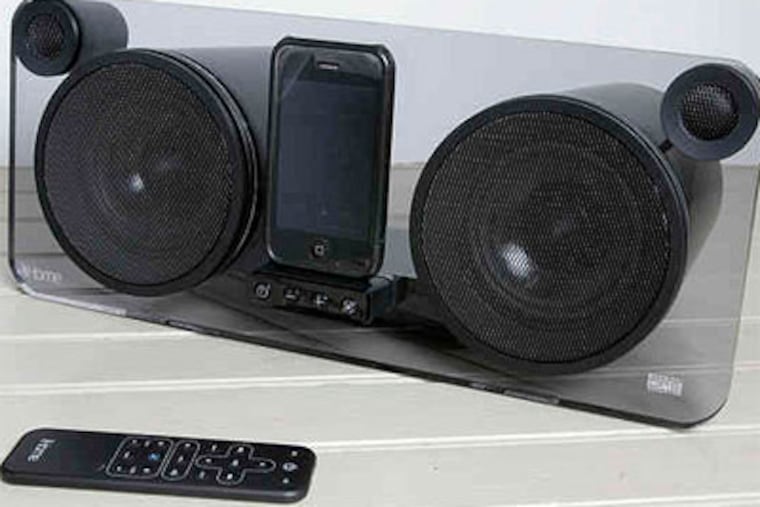
This beefy, 10-pound, $299.99 music maker has really sharp looks, with black, metal-encased speakers seemingly floating behind a clear face plate. And the oversize, dynamic sound says "Yeah, you can live with this as your primary system."
You'll want to engage this device's special Bongiovi Acoustics DPS digital signal processing circuitry, which seemingly enlivens the kick and clarity and definitely ups the sheer volume - to a maximum 104 dB. There are separate bass and treble controls not found on any of the other
iPod speaker systems, plus a best-of-the-bunch remote control and rare component/composite video "outs."
Clearly showing the expertise and taste of DPS developer Tony Bongiovi (Jon Bon Jovi's second cousin and a longtime Manhattan recording studio owner), the digital signal processing maximizes the efficiency of the digital amps and speakers and also emphasizes select frequencies to theoretically correct for digital compression.
But on that "Cubano Chant" cut, the splashy percussion almost drowned out Tjader's lead vibraphone. And there was a raspy touch to the female vocalist's trills on that Webber musical track that was not evident on the two pricier boxes below. But if you don't critically compare, you'll conclude this one is a deal.
Bowers & Wilkins
Zeppelin Mini
The smaller of two iPod systems developed by a renowned British speaker maker, this petite (4.4 pound), $399 black-and-chrome cutie puts out a sweet, natural sound (not a lot of stereo separation, though) that will appeal to purists and blasters alike (peaking at 106 dB).
It accommodated our acoustic jazz, folk and showtune test tracks exceedingly well, as well as a funky, new electronic rock piece ("You and I") from the Disco Biscuits that sounded jumbled on the iHome.
The dock rotates for movie viewing.
A rare second audio input - mini-USB - connects to a computer.
The pebble-shaped, minimalist remote is sure to disappear between the sofa cushions, and there aren't a lot of controls on the box. This is the system that would look best in a professional office - and sounds at its best positioned close to a backing wall.
Bose SoundDock 10
The newest, biggest and, at $599, the most expensive of Bose's iPod speaker systems is also king of this test caravan.
It's weighty in girth (18.5 pounds) and prodigious in output, bellowing at up to 113 dB to fill the biggest room and wake the neighbors. While not as overtly sizzling or booty-kicking as the iHome, the Bose takes a well-tempered, honest and non-fatiguing approach to music reproduction that can't be beat.
There's no confusing a stand-up acoustic bass with an electric bass here, as you'll find with other boxes. And vocalists seem utterly at ease, like they're hanging in the room with you.
The SoundDock 10's remote accesses iPod playlists (but not the complete branching menu, as found on the iHome and JVC). A composite video output works as well as the iHome's component set, and there's a unique USB input for system software updates.
Oh, and if you've got a spare $149, the SoundDock 10 Bluetooth Dock accessory is way cool. It allows you to sit with your iPhone up to 30 feet away and "beam" selected music to the system with excellent sound quality.
E-mail Jonathan Takiff at takiffj@phillynews.com.