Jonathan Takiff: Wi-fi got you mumbling, 'Why me?' Well, wireless just got easier
The Gizmo: Enabling your wi-fi gear Notebook/tablet computers and smart phones no longer hold an exclusive on wireless wi-fi connectivity.
The Gizmo: Enabling your wi-fi gear
Notebook/tablet computers and smart phones no longer hold an exclusive on wireless wi-fi connectivity.
All manner of consumer electronics - from Blu-ray players and TV sets to digital music players and cameras - now also offer the option to hop wirelessly onto the Internet.
What for? To gather extra insights to Blu-ray movies and stream more shows from subscription or pay-per view services. Or to visit TV-optimized websites, download music, or post and print images from a camera.
In fact, the field of "Internet enabled" electronics is growing so fast and furious, major retailers Best Buy and RadioShack (and soon Wal-Mart) have established departments to spotlight the appropriate products and services.
But first thing's first. You gotta establish a wi-fi hot spot at home or for the "road," or you're missing the fun and freedom of these Internet-enhanced gizmos.
Here's how to make it all happen.
A routing good time: About two-thirds of U.S. homes now have a broadband connection to the Internet. But only half of those have set up a wireless network to spread the signals beyond the initial point of contact: that cable or phone-line-linked modem that is usually planted close to your desktop computer.
Establishing a wireless network requires another piece of gear called a router. The setup scares people, and a significant share of buyers (like 20 percent) wind up taking the routers back to the store for a refund, admit the folks at Cisco, a major supplier.
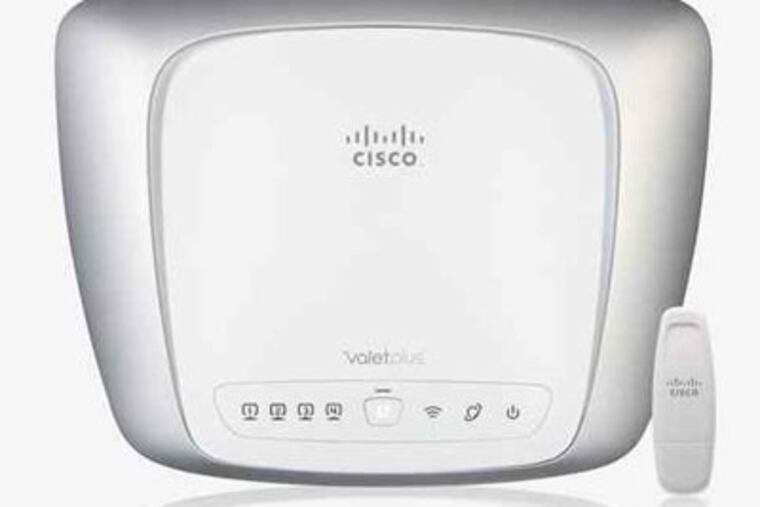
Now to the rescue comes the Cisco Valet - $99 for the basic, M10 model version. Designed with input from the team that also works on the company's easy-as-pie Flip camcorders, the Valet is so user-friendly, so non-techy that you won't even find it identified anywhere on the package as a router, although that's what it is!
Instead, Cisco touts the attractive, slim-line device for all it can do. "The simple way to create your own wireless hot spot."
First connect Valet to a modem and a power line. There are four Ethernet jacks on the back, for hard-wiring gear that's in the vicinity. The wireless wi-fi transmitter/receiver component will now blast signals to (and receive them from) at least a couple of floors away, and it employs the newest, most robust 802.11n (or older "b" and "g") form of wireless technology.
Central to the setup is a programmed thumb drive, the "Easy Setup Key," which you plug into the USB port of a computer to automatically take the temperature of your system and adjust settings, summon up a cute ID name and alpha-numeric password. The toughest part of the 10-minute process is just registering the device online!
Every other wi-fi enabled computer in the house can be added to the network with the same USB key, and the guardian of the key can set restrictions on individual terminals, blocking use by the kids during homework hours, for example.
Up to five visitors bearing laptops can be awarded wi-fi guest privileges that won't let them snoop in your networked system. Other wi-fi Internet-ready gizmos lacking a USB port can be connected with a onetime code entry.
Mobile hubs 'n phones: Don't have any Internet service, or looking for the means to connect wirelessly to your computer/devices when away from home?
If so, look into a pocket-size, battery-operated portable hot spot device like the 3G/4G (WiMax)-ready Sierra Wireless Overdrive from Sprint ($99 with a contract, then $60 a month) or a 3G smart phone like the Palm Pre Plus from Verizon Wireless that's equipped with a built-in wi-fi hot spot.
If you like the Palm ecosystem, the Pre Plus and similar Pixi Plus are quite the deal right now, selling for just $50 and $30 respectively, with a service contract. Better still, Verizon charges nothing extra to access the wi-fi application (it used to be $40 a month with a 5GB data cap.)
Making friends home and away, both varieties of hubs let multiple users hop online simultaneously with their devices. But, of course, the more you subdivide the signal, the slower each stream becomes.
Flying solo with an Apple iPad, I've found surfing the Web quite speedy and stable with both gizmos at my urban Philadelphia home and office. Both devices also streamed music services well, and delivered at least three hours of use on a battery charge.
But only the Overdrive, when updated with the latest software and operating in a 4G service zone, was capable of streaming Netflix movies to the iPad. (The job's done without downgrading the picture resolution, as happens on iPads equipped with built-in, extra cost AT&T 3G service.)
On a train traveling between Philadelphia and New York, the Verizon-serviced Palm Pre Plus generally held a more stable signal than the Sprint-connected Overdrive. The latter kept dropping out, searching for signal then reconnecting as the train moved between 4G, 3G and no-fly zones, tediously requiring me to reenter the access code. It's possible to lock the device in 3G mode, but to do so you must go online - there are no controls on the little box itself.
More smartphones with wi-fi capability are on the way. The HTC-made EVO 4G coming June 4 from Sprint is the first communicator that deserves the description "iPhone killer." It has an amazing set of features, including two cameras for two-way Android video chatting, simultaneous 3G voice and 4G data streaming capability, a beaut of a 4.3-inch screen, 720p HD camcorder recording, high-def HDMI output to connect to your HD TV and Flash support. The opening price is reasonable - $199 - but the cost of full-blown service adds up: $70 for the Everything Data plan plus $10 for premium data features and $30 a month more to activate the mobile wi-fi hot spot. Sprint's 4G service is currently active in just 35 markets, but will expand soon to 50.
For later in the summer, Samsung is cooking up the Galaxy S Android phone which "tethers" wirelessly to a single wi-fi device at a time. Fitted with GSM/Edge technology, it can land here only at AT&T and T-Mobile stores.