PhillyDeals: Moguls love Philadelphia, but invest elsewhere
Today we talk to real estate moguls who love living in Philly but invest their clients' millions far away: Americans aren't buying homes like they used to. They're renting more.
Today we talk to real estate moguls who love living in Philly but invest their clients' millions far away:
Americans aren't buying homes like they used to. They're renting more.
That's good news to landlords such as Philadelphia-based Resource Real Estate, which has been buying troubled apartment complexes in working-class neighborhoods in places such as Memphis and Albuquerque, N.M., fixing vacant units for military and factory workers.
Resource Real Estate is an arm of father-son energy-and-finance moguls Edward and Jonathan Cohen's publicly traded Resource America Inc. The Cohens have a track record of buying mundane assets cheaply, holding them for years, and selling high. Another Cohen company, gas-rich Atlas Pipeline Partners L.P., was bought by Chevron Corp. last month for $4.3 billion in cash and debt.
Resource controls more than 100 properties and 18,000 apartments, many of them bought from "distressed" owners or banks they couldn't repay, says Kevin Finkel, director of acquisitions.
There will be a lot more apartments coming on the market as overpriced loans from the mid-2000s come due in the next few years, said Resource chief executive officer Alan Feldman. "We like bankruptcy," he said. "It adds complexity, and that scares away [publicly traded real estate companies] and folks with a short attention span."
Resource buys in the South and West, but rarely in Philadelphia or New York. Tenants are less demanding here, but prices are higher, profit margins are tighter, vacancies and turnaround potential are less.
You make it sound simple, I said. "It's not rocket science," agreed Feldman. But it was complexity, in the crazy real estate market of the mid-2000s, that "bankrupted other companies," he added.
One more night
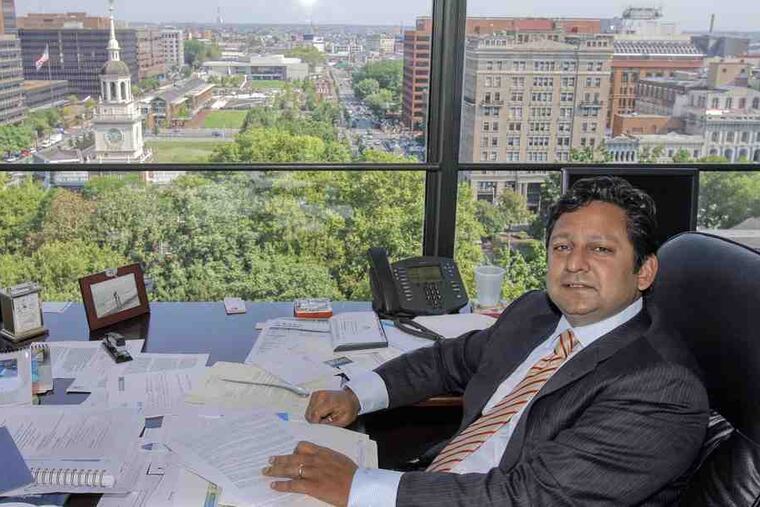
Hersha Hospitality Trust, a billion-dollar company run from offices at the Penn Mutual complex near Independence Hall by brothers Jay and Neil Shah, operates 77 hotels - Marriotts and Hyatts, Hampton Inns and Holiday Inns, Hiltons and Sheratons.
Just two are based in Philadelphia, with its downtown business center and growing tourist trade. Three are in the suburbs. The Independent and the Hampton Philadelphia are the two city properties.
The Shahs like working from Philadelphia because it's close to their main markets, New York and Washington, where they say it's easier to build, and where they're investing $450 million in new hotels.
They grew Hersha with financing from Marlton-based Commerce Bank, and they've expanded with backing from Commerce's successor, Toronto-based TD Bank, whose business-lending boss, Bharat Masrani, keeps an apartment in Philly and has become a friend, the Shah brothers say.
The Shahs welcome the Convention Center expansion. But they hope the city will avoid another round of government-subsidized hotel construction, which Neil Shah says the local market can't yet sustain. "Give it time," he said. "We need overnight visitors to stay a second night."
Get outta town
Why do all these bright people settle in Philly but send their money away?
Wikipedia blames Stephen Girard. It says the richest man in early America "was a key factor in moving the financial center of the United States from Philadelphia to New York, and in moving the number of early government agencies from Philadelphia to Washington, D.C. He saw these undertakings as 'of a lower nature' . . . He sought to keep Philadelphia as 'the village in between' " the greedy politicians and the grubby traders.
So Philadelphia was meant all along to be the Nation's Suburb, a nice place to buy big homes and rent nice offices cheaply, and find elite schools for the kids, while earning and investing abroad? Nice try, but the claim is unsourced, and the scholars I called say it's bunk.
"Girard was certainly critical of Philadelphia. But he would have been critical of anyplace he lived. That is how he rolled," said Robert Eric Wright, who cowrote a chapter on Girard for the book Financial Founding Fathers and wrote The First Wall Street about the rise and fall of Philadelphia as a financial center.
"Even if [Girard] did say something to that effect, he had no power to make it true," Wright said. "Even if he had been politically important, how does that justify Philly's recent stagnation?
"How about this: Horrible schools, a demented political system, outrageous taxes, dangerous levels of crime, and huge areas of urban blight that the city only shifts around, rather than reduces?"
Wright recently relocated to an endowed professorial chair at Augustana College out in South Dakota, but he's still trying to sell his Abington home.
"If you know anyone interested in a real steal," Wright concluded.